Languages
Sunday, September 27, 2026



News and Views from the Global South
Labour

“A Map and Plan”: When Greener Pastures End in a Blazing Desert
“Sometimes when I’m alone, I still get flashes of the grisly images I saw in the desert. I feared I was going to die out there. The people transporting us were ready to get rid of any of us where necessary,” Njoya Danialo recalled as he narrated the ordeal he endured traveling through the Sahara in search of greener pastures.
Valuing the Food System
Many factors contribute to the cost of a tomato. For example, what inputs were used (water, soil, fertilizer, pesticides, as well as machinery and/or labor) to grow it? What kind of energy and materials were used to process and package it? Or how much did transportation cost to get it to the shelf?
Harnessing the Blue Economy Must Consider Social Inclusion and Responsible Stewardship
In April 2018, Commonwealth leaders met in a retreat at a royal residence in the English county of Berkshire and agreed on strategies to deepen trade in their 53-member organisation, improve security, tackle climate change, and work together for the betterment of the lives of the people of the Commonwealth.
Hunger and Food Insecurity Plague the Lives of Millions in Africa
Africa is rising. But at the same time, Africa is the continent with the largest number of people, (390 million) living in extreme poverty.
Food Security and Growth in Asia
A disquieting finding of The State of Food Security and Nutrition in the World 2017, Building resilience for peace and food security, or (SFSN2017), Rome, is that, in 2016, the number of chronically undernourished people in the world increased to 815 million, up from777 million in 2015 although still lower than about 900 million in 2000. Similarly, while the prevalence of undernourishment rose to 11 percent in 2016, this is still well below thelevel attaineda decade ago. Whether this recent rise inhunger and food-insecurity levels signals thebeginning of an upward trend, or whether itreflects an acute transient situation calls for a close scrutiny.
Why Would an Immigrant Support Trump?
Giuseppe DiMarco is 83 years old. He has recognized the U.S. as his home for over 30 years. In the aftermath of World War Two, DiMarco fled an impoverished farming town in Southern Italy in the pursuit of advancement and the promise of wealth he had never known.
Swedish PM ahead of the ILO Conference: It’s not arm wrestling
There’s not one answer, no single solution, Stefan Löfven replies to a question about what the most important focus for the global labour market was.
Agricultural Trade Liberalization Undermined Food Security
Agriculture is critical for achieving the Sustainable Development Goals (SDGs). As the Food and Agriculture Organization (FAO) notes, ‘From ending poverty and hunger to responding to climate change and sustaining our natural resources, food and agriculture lies at the heart of the 2030 Agenda.’
Child Slavery Refuses to Disappear in Latin America
Child labour has been substantially reduced in Latin America, but 5.7 million children below the legal minimum age are still working and a large proportion of them work in precarious, high-risk conditions or are unpaid, which constitute new forms of slave labour.
We Need a Gender Shift to save Our Girls from the Jaws of Extremism
Consider this. Boko Haram, the ISIS-affiliated insurgent group has sent 80 women to their deaths in 2017 alone. The majority of suicide bombers used by terror group Boko Haram to kill innocent victims are women and children, US study reveals.
Sustainable Food Systems; Why We do Not Need New Recipes
Many believe that the food and agricultural sector is different to all other economic sectors, that it is unique, and that it requires special economic models to thrive. After all, we expect the global food and agricultural system to respond to many different goals. It needs to deliver abundant, safe, and nutritious food. It needs to create employment in rural areas while protecting forests and wildlife, improving landscapes, and preventing climate change through lower food production emissions. Well-functioning food systems are also considered essential for social stability and conflict prevention. In fact many politicians today go as far as to argue that food systems need to thrive so as to stem rural-to-urban migration and the cross-border flow of desperate people fleeing food insecure nations.
Ex-President Leaves ILO after Corruption Scandal
There is a compact silence surrounding how the corruption scandal affects ILO’s work on developing a plan to change the UN body.
Economic and Social Survey for Asia and the Pacific 2018 – Mobilizing finance for sustained, inclusive and sustainable economic growth.
Asia and the Pacific remains the engine of the global economy. It continues to power trade, investment and jobs the world over. Two thirds of the region’s economies grew faster in 2017 than the previous year and the trend is expected to continue in 2018. The region’s challenge is now to ensure this growth is robust, sustainable and mobilised to provide more financing for development. It is certainly an opportunity to accelerate progress towards achieving the 2030 Agenda for Sustainable Development.
Protests, Strikes, Solidarity – France Revisits May ‘68
“It’s good to be in Paris on a sunny May day and see many universities occupied … and the strikes against neo-liberalism,” declared British Pakistani writer and activist Tariq Ali at an event in the Paris suburb of Nanterre on May 3. “That’s very pleasing.”
Labour Migration a Key Contributor to GDP
Nepal received remittances of NPR 699 billion (USD 6.56 billion) in FY 2016/17 and ranks fourth in the world in terms of the contribution of remittances to GDP, according to a report launched today by Ministry of Labour, Employment and Social Security, with support from IOM, the UN Migration Agency, the International Labour Organization (ILO) and The Asia Foundation.
Occupational Safety Improves in Latin America, Except Among Young People
Despite progress achieved in occupational safety in Latin America, the rates of work-related accidents and diseases are still worrying, especially among young people, more vulnerable in a context of labour flexibility and unemployment.
Kenya- Overcoming Rivalry & Conflict Through Cultural Diplomacy
Cultural diplomacy is a soft power that promotes the exchange of ideas, information, art, and culture to strengthen friendship and cooperation among nations and communities.
Five Years After the Disaster: Rana Plaza Victims Still Hurting
BANGLADESH. Garment factories lie side by side along the freeway leading into the capital, Dhaka. But between the concrete blocks, a square, uninhabited piece of land is overgrown with greenery. This is where Rana Plaza used to be. Shirin Akhter, 18, turns her eyes away.
We Are Migrants: Teasing Italian Taste Buds
 Atik and Said have many things in common. They are both from Bangladesh, both are about the same age, in their thirties and, they are both migrant workers in an Italian restaurant in the heart of Rome, a stone’s throw from Saint Peter’s Basilica. They are not the only migrants working in the food service industry in Italy, where most of the pizza makers today are Egyptians and most of the Chefs are either Bangladeshis or North Africans. This is an interesting phenomenon in a country known for its cuisine where many of the Chefs today are not locals but foreigners.

Dreaming of A New Sustainable Economy
Officials from around the world came together to create and support a vision for a new, sustainable economy: a bioeconomy. Almost 1000 bioeconomy experts, from former heads of state to civil society leaders, convened in Berlin for the second Global BIoeconomy Summit to discuss best practices and challenges.
FAO and El País Launch Series of Books on “The State of the Planet”
Today the Food and Agriculture Organization (FAO) hosted an event at its headquarters in Rome, to present a set of eleven books jointly realized in collaboration with the Spanish newspaper El País.« Previous Page — Next Page »


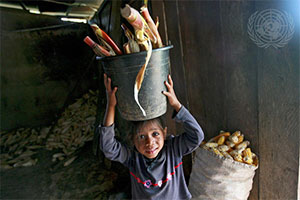 Timorese Girl with Fresh-Picked Corn. Credit: UN Photo/Martine Perret
A global common denominator is the need for a decent job. The economic realities of each country determine just how difficult it is to find one. Despite the labour movement's achievements, serious challenges persist: gender discrimination, child labour, worker migration, the digital divide and AI automation, evaporating pensions, unsafe workplaces, corporate pressure against union organising, negative impacts of trade agreements, and the precariousness of informal employment. The 2025 UN SDG Report identifies jobs and social protections as one of the six priority areas requiring urgent action, with progress either stalled or reversing in many developing nations.
In recent years, the fight to protect labour equality has taken on new dimensions with the rise of Environmental, Social and Governance standards. With the Social aspect aiming to promote equality and human rights, ESG principles have strengthened labour advocacy within corporate and governmental regulatory landscapes. In particular, ESG has become much more institutionalized in emerging economies such as Brazil and China. IPS follows the world’s workers as they confront these challenges - their setbacks and their successes.

The Week with IPS

NEXT STOP - SDGs
Tracking global progress towards a sustainable world
Tracking global progress towards a sustainable world
