Languages
Wednesday, November 18, 2026



News and Views from the Global South
Natural Resources
PERU: Bailout of Mining Co. Eclipses Environmental Disaster
The Peruvian government refused to bail out the U.S. mining and metallurgical company Doe Run, which has caused severe pollution in the highlands city of La Oroya, from its severe financial troubles.POLITICS: Arab-Latam Bid for a Diverse World
The Moors invaded and conquered much of the Iberian Peninsula in 711AD. By the time they were driven out of Granada in 1492, the Arabs had left an indelible racial and cultural imprint. Both the Spanish and Portuguese languages have a marked Arabic influence.MINING-AFRICA: Help Yourself, There's Plenty
The African continent is rich in natural resources; but the terms under which multinational companies exploit these resources mean that governments - and Africa’s people - enjoy only a tiny fraction of the benefits.PERU: Few Benefits from Boom for Poorest Mining Districts
The poorest district in Peru is in an area of intense mining activity, in a country where the mining industry accounts for nearly 60 percent of all export revenues. But the people of Ongón receive no benefits from that activity.RIGHTS-PERU: Spying on Social Movements
Business Track, a private security firm, was engaged in spying on non-governmental organisations, environmental activists, social movements and opposition groups in Peru, sources in the police, prosecutor’s office and courts investigating the case told IPS.AUSTRALIA: African Resources Behind Growing Links
With hundreds of Australian mining companies now involved in the extraction of natural resources in Africa, the Rudd government is also aiming to play a bigger role in the continent’s affairs.
CHILE: Controversial Fuel Taxes and Subsidies
In 2008, Chile’s state coffers took in just over one billion dollars from the specific tax on fuels. But at the same time, the government injected 700 million dollars into a fund that year to shore up fuel prices and made another 500 million available in case the price of oil continued to rise.GHANA: Report Warns of ‘Resource Curse’ Ahead of Oil Boom
The recent discovery of oil in Ghana could undermine its democratic development, warns the international aid agency Oxfam America and the Integrated Social Development Centre (ISODEC) in Ghana.IRAQ: Stumbling From One Conflict to Another?
When U.S. President Barack Obama announced his plan last week to pull out all U.S. combat troops from Iraq by September 2010, the news did not generate much enthusiasm among Iraqi Kurds.
MINING-WEST AFRICA: Ending the Race to the Bottom
Resource extraction in West Africa has often coincided with environmental degradation and brutal conflict. Activists further charge that the agreements between governments and transnational mining companies do little to benefit local communities.UKRAINE: Between the Kremlin and a Hard Place
Ukraine's internal political problems and tensions with Russia threaten its path to stability and its candidacy for NATO and the EU, warns a new Council on Foreign Relations (CFR) report.CORRUPTION-PERU: Parliament Investigates PetroTech Sale
At the government's request, the Peruvian parliament has set up a commission to investigate alleged irregularities in the sale of Petro Tech Peruana (PTP) to Ecopetrol, the Colombian state oil company, and the South Korean National Oil Corporation (KNOC). But opposition politicians are sceptical of the outcome and have refused to participate.
VENEZUELA: Ten More Years, If He Can Woo a Divided Country
Venezuelan President Hugo Chávez won Sunday's referendum with 54 percent of the vote, which will allow him to stand for reelection indefinitely. But he will have to exercise leadership over a country that is stubbornly split in two.CAMBODIA: Chevron Silent on Bribery Allegations
U.S. energy giant Chevron is under fire for failing to disclose the amount of money it allegedly paid to secure rights to drill for offshore oil in corruption-ridden Cambodia.AUSTRALIA: Complicit in East Timor Occupation – Records
Recently declassified government records from 1978 are a further indictment of Australia’s complicity in Indonesia’s 24-year occupation of East Timor.ECUADOR: Indigenous Groups Protest Government Policies
Since the start of his term in January 2007, Ecuadorean President Rafael Correa has had touchy relations with the indigenous peoples' movement, in spite of the fact that it backed his election. But passage of a mining law has deepened the rift between them and triggered protests.ECONOMY-BOLIVIA: Strong 2008 Performance, Uneasy Start to 2009
The Bolivian government of Evo Morales enjoyed a third consecutive year of strong economic growth in 2008, but business leaders warn that the drop in commodity prices will hurt export revenues and lead to a rise in unemployment in the months to come.PERU: Navy Intelligence Agents Arrested for Moonlighting as Private Spies
Peruvian prosecutors and police have busted a ring of active and retired Peruvian navy intelligence agents who moonlighted as telephone tapping experts allegedly engaged in spying.CHILE: End of the Copper Boom
Chile’s anti-crisis plan, announced this week, is based on windfall copper earnings saved up over the last few years. But soaring copper prices are a thing of the past, due to the global economic meltdown that originated in the United States, say analysts.MEXICO: Fishermen on Strike over High Fuel Prices
Thousands of fishermen in Mexico have gone on strike over the last few days to protest the rise in the cost of diesel fuel which, they say, has reduced their profit margin to zero. But the industry's problems, which have been simmering for decades, go beyond the question of fuel prices.
PERU: A Mining Town’s Woes
A four-hour drive from the Peruvian capital, the town of Morococha ("coloured lake" in the Quechua language) is a living example of what the mining industry has brought to many poor rural villages and towns in this country.« Previous Page — Next Page »


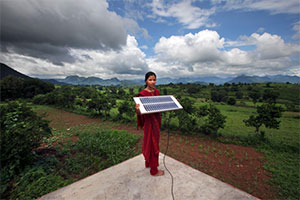 Bringing clean energy to rural India. Credit: Abbie Trayler-Smith / Panos Pictures / Department for International Development
Large reserves of oil, gas and minerals in developing countries generate opulent revenues. They could be used to stimulate economic growth and reduce poverty, but often result in environmental destruction and conflict, benefiting large companies and corrupt governments. Furthermore, competition over natural resources often manifests through geopolitical conflict. For example, before the US-Iraq war, Iraq’s domestic oil industry was nationalized. With US aggression came weakened Iraqi institutions and foreign intervention, thus eventually leading to the privatization of Iraqi oil, leaving the industry now largely dominated by Western companies. As another example, China’s rising investments within the lithium sector in South America are increasing the US-China rivalry across the Western Hemisphere. Notably, Bolivia has the largest reserves of lithium in the world, and the nation’s state-owned lithium extraction firm recently signed a contract with China’s CBC Consortium, while rejecting the entry of Western firms into the nation. In Bolivia’s case, rising Chinese investment in the nation’s lithium sector also raises concerns about environmental sustainability and the sociopolitical rights of Indigenous communities. More broadly, Sub-Saharan Africa holds nearly 30% of global reserves of critical minerals required for low-carbon technologies. Despite this, the region attracts less than 10% of global exploration investment, depicting a critical barrier to both the clean energy transitions and Sub-Saharan Africa’s economic development. Furthermore, resource wealth continues to fuel conflict like Sudan’s civil war, which has led to 9.1 million internally displaced people and is intensely connected to competition over gold, water, and agricultural land. IPS covers news about major oil, gas, and mining projects, their effects on the environment and local communities, and the ideas and actions of the interest groups involved.

The Week with IPS

NEXT STOP - SDGs
Tracking global progress towards a sustainable world
Tracking global progress towards a sustainable world
