Languages
Tuesday, September 15, 2026



News and Views from the Global South
Economy & Trade

Sawantwadi’s Traditional Handmade Toys Struggle for Survival
Sawantwadi in Maharashtra, on the western coast of India, bordering Goa, has always been known for its wooden toys. A picturesque town amid hills and lush greenery, Sawantwadi retains an old-world charm to this day. The regal Sawantwadi Palace holds pride of place, with colleges, schools, and temples cloistered around the periphery of the lake, which was once an extension of the royal grounds. In the centre of the town is the Ubha Bazaar, or Hanging Market, which houses rows of shops selling the iconic wooden toys that are a hallmark of Sawantwadi.
Bangladesh Can Boost Growth & Climate Resilience by Investing in Women
Bangladesh has made major gains for its population, the world’s eighth largest with more than 170 million people. Per capita incomes, one of the best measures of broad economic well-being, have risen seven-fold in the past three decades while poverty has been reduced to a fraction of former levels.
Indignity, Disease, Death—The Life of a Sewer Worker in Pakistan
A dark head emerges, followed by the torso. The balding man heaves himself up, hands on the sides of the manhole, as he is helped by two men. Gasping for breath, the man, who seems to be in his late 40s, sits on the edge, wearing just a pair of dark pants, the same color as the putrid swirling water he comes out from.
Solar Energy, Vetoed as a Source of Income for the Poor in Brazil
“I feel like a mother who lost her son to drugs, to vice, destroying himself,” says Lucineide da Silva, 56, mother of eight children and grandmother of 11.
Climate Change, Pollution Push Karnaphuli Fishers Out of the Profession
Jishuram Das, a sexagenarian who was born in Jelepara, located in Chattogram, has been catching fish from the Karnaphuli River since his childhood. But nowadays, he often sits idle without going to catch fish, as their catches have drastically fallen.
Let’s play!
For the first time ever, we will commemorate the joy of playing with an International Day of Play“ on June 11, 2024. On their website, the UN state that this „marks a significant milestone in efforts to preserve, promote, and prioritize playing so that all people, especially children, can reap the rewards and thrive to their full potential“. But why ist playing so important?
Explainer: What You Need to Know About Climate Change and Blue Carbon
The area where land meets the sea, known as coastal ecosystems, could be the key to reducing the effects of climate change. What is blue carbon? Blue carbon refers to the carbon dioxide (CO2) stored within marine or coastal ecosystems worldwide. These ecosystems include coastal plants such as mangroves, seagrasses, and salt marshes, which trap CO2 in their seabeds.
Blue Economy Must Benefit Fishing Communities in Global South, Says WorldFish Chief
The Global South is crucial for ensuring aquatic food security to feed the growing world population. It is imperative that blue economy initiatives benefit fishing communities in developing and small island nations, which are facing disproportionate impacts of climate change, says Dr Essam Yassin Mohammed, Director General of WorldFish, an international non-profit research organization based in Penang, Malaysia.
Europe Can Reap Sizable Energy Security Rewards by Scaling Up Climate Action
Russia’s invasion of Ukraine triggered Europe’s worst energy crisis since the 1970s and put energy security back at the top of the policy agenda. Policymakers reacted swiftly by securing alternative natural gas supplies, improving energy efficiency, and expanding renewables.
Biodiversity Meetings in Nairobi End, All Eyes Are Now on COP16
Regions struggling to revise and update their National Biodiversity Plans aligning them with the Global Biodiversity Framework adopted at COP15, will now be given the technical and scientific support to develop and submit their plans on time. This was one of the key decisions of the 4th meeting of the Subsidiary Body on Implementation (SBI)—the crucial pre-COP meetings of the United Nations Convention on Biodiversity (UNCBD)—to review the status and challenges of implementing the Global Biodiversity Framework (GBF), which started on May 22 and ended in Nairobi late in the evening of May 29, 2024.
The Dilemma for Small Island Developing States: Recovery or Development?
“We are facing unenviable decisions, between the recovery of today or the development of tomorrow”. These were the words of Fiamē Naomi Mataʻafa, of Samoa at the opening of the 4th International Conference on Small Islands Developing States (SIDS4).
Maggot Farming Creates Entrepreneurs, Saves Farming Costs in Zimbabwe
Three years ago, 43-year-old Benard Munondo was an "ordinary" Zimbabwean teacher at a local primary school, but now he has turned maggots into gold. Thanks to maggot farming, Munondo, who has never owned a home nor driven a car, now has both. In 2020, a week’s training on maggot farming changed his world.
South Suffering Due to Powerful Nations’ Policies
The World Bank expects the international economic slowdown to be at its worst in over four decades in 2024. This is mainly due to powerful Western nations’ contractionary macroeconomic and geopolitical policies.
To Tackle Climate Crisis, the World Bank Must Stop Financing Industrial Livestock
Last week, the World Bank Group released a new report that highlights the urgent need to drastically reduce GHG emissions to address the climate crisis and calls on countries to act. However, while the World Bank’s acknowledgment of the damaging climate impacts of industrial agriculture is a crucial step forward, it’s simply not enough.
Let the Dead Speak: Forgotten Workers
Immigration policies are among the most hotly debated topics in Europe. Xenophobia, combined with curbing immigration, have become the main reason to why ever-increasing large crowds of voters are supporting populist parties.
Small Island Nations Demand Urgent Global Action at SIDS4 Conference
“This year has been the hottest in history in practically every corner of the globe, foretelling severe impacts on our ecosystems and starkly underscoring the urgency of our predicament. We are gathered here not merely to reiterate our challenges, but to demand and enact solutions,” declared Antigua and Barbuda Prime Minister Gaston Brown at the opening of the Fourth International Conference on Small Island Developing States on May 27.
North Macedonia Turns Back the Clock
The old guard is back in North Macedonia, as the former ruling party – the Internal Macedonian Revolutionary Organization – Democratic Party for Macedonian National Unity (VMRO-DPMNE) – returns to parliamentary and presidential power.
Small Island Developing States can be Nature-Positive Leaders for the World
Small island developing states (SIDS) are scattered across the globe, dotting the Pacific Ocean, the Caribbean, the west and east coasts of Africa and the Indian Ocean.
Panama’s Elections: Has Impunity Prevailed?
Regional experts called it Panama’s most important election since the 1989 US invasion that deposed de facto president General Manuel Noriega. Panamanians went to the polls amid high inflation and unemployment, with a stagnating economy. Endemic corruption was also high on their long list of concerns, along with access to water, education and a collapsing social security system.
Rising Temperatures Drive Human-Wildlife Conflict in Zimbabwe
Rising temperatures are being blamed for an increase in human-wildlife conflicts in Zimbabwe as animals such as snakes leave their natural habitat earlier than usual.
More Diversified Trade Can Make Middle East & Central Asia More Resilient
Dislocations from the pandemic, geoeconomic fragmentation, and Russia’s war in Ukraine have shifted world trade dynamics. While this has created challenges, the redirection of trade has also generated new opportunities, particularly for the Caucasus and Central Asia.« Previous Page — Next Page »


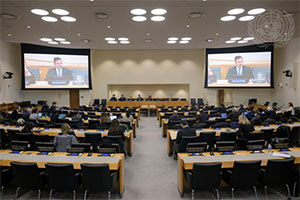 UN Commission on International Trade Law Holds Colloquium on Harmonizing Law in Age of Digital Trade and Finance. Credit: UN Photo/Manuel Elías
Trade has historically been a geopolitical tool that can both be used to propel development as well as entrench inequalities. In various nations in East Asia and Latin America, increased trade, as often seen in export booms, has allowed them to achieve influential standings within the global economy. On the other hand, many low-income countries in Sub-Saharan Africa, Asia, and Latin America struggle to maintain a robust trade performance, and oftentimes are subjugated to exploitative trade dynamics through intense extraction of their natural resources. In recent decades, international trade has reached a new era as emerging economies across the world are rising in economic preeminence. Stable international trade is crucial to world peace as global interconnectedness facilitates reliable diplomacy. Nevertheless, significant challenges are on the rise. Notably, a major wave of United States tariff escalations in January 2025 lifted US import taxes to their highest level since the 1930s, changing market dynamics and forcing renegotiations with global trading partners.These articles are aimed at informing readers about the complexities of trade and its varying effects on development, with a special focus on the consequences of the global economic crisis, the potential of fair trade and the gender implications of trade policies.
Updated by Yilan Batista and Shuli Wong August 2026

The Week with IPS

NEXT STOP - SDGs
Tracking global progress towards a sustainable world
Tracking global progress towards a sustainable world
