Languages
Tuesday, October 6, 2026



News and Views from the Global South
Economy & Trade

Invasive Species, Fast-Riding Horsemen Galloping the Biodiversity Apocalypse
Mango farmer Eufria Nyadome used to earn USD 60 from selling a 20-litre bucket of fresh mangoes and now can barely make USD 20 even though her mango trees are giving a good yield. She is throwing away buckets of rotten mangoes.
Civil Society Organizations Unite to Urge Public Development Banks to Change the Way Development Is Done
In the midst of a complex web of crises, spanning climate change, biodiversity depletion, constraints on civic space and mounting debt burdens, civil society organizations and human rights defenders from over 50 countries have united their voices to call for immediate and impactful action from Public Development Banks (PDBs).
Mushroom Workers Want a Union
The Yakima River runs southeast from the Cascade Mountains through central Washington state to merge with the Columbia a little north of Oregon. From the small city of Yakima on down, its course broadens from a winding canyon into a wide valley bounded by austere low ridges of gray-green sagebrush and tawny grasses. In mid-April, the new leaves of the willows and cottonwoods light up the riverbanks with luminous chartreuse.
From Challenges to Solutions: Unleashing Africa’s Potential for Achieving SDGs
September 2023 marks the halfway point to the deadline for achieving the 2030 Agenda and the Sustainable Development Goals (SDGs). Yet, globally we are still far off-track, and Africa is only halfway towards achieving the SDGs, with nearly 600 million Africans still lacking access to electricity and 431 million people living in extreme poverty.
UN Summits & High-Level Meetings: More Promises, Less Deliveries
The United Nations will host six “high-level” meetings, including two summits of world leaders-- over a short span of five consecutive days, beginning September 18. The back-to-back meetings, described as unprecedented, includes the Sustainable Development Goals (SDG) Summit on September 18-19; a high-level dialogue on Financing for Development (FfD) on September 20; and a ministerial meeting of the Summit of the Future on September 21 (with the summit itself scheduled to take place September 2024).
UN Financing Appeal Last Hope for SDGs and Climate?
The United Nations Secretary-General’s Dialogue on Financing for Development on 20 September may well be the world’s last chance to save the Sustainable Development Goals (SDGs) and curb global warming in time.
Digging Africa Deeper into Hunger
Annual Green Revolution Forum ignores widespread failure of its push for industrialized agriculture
As the adage goes, when you find yourself stuck in a hole, stop digging. As African leaders and their philanthropic and bilateral sponsors prepare for another glitzy African Green Revolution Forum, convening September 5-8 in Dar es Salaam, Tanzania, they are instead handing out new shovels to dig the continent deeper into a hunger crisis caused in part by their failing obsession with corporate-led industrialized agriculture.

Empowering Asia’s Farming Communities through Inclusive Business
When Lisa Huyen first set up her company, Vinasamex, which specializes in certified organic cinnamon and star anise grown in the mountainous and poorer provinces of Viet Nam, she faced daunting challenges including market access and securing financial support from banks.
Biodiversity Credits: Solution or Empty Promise for Latin America?
Located in northwestern Colombia, the Bosque de Niebla is home to 154 species of plants, 120 bird species, 21 species of mammals, 16 water springs and five hectares of wetlands.
Debt & Crisis of Survival in Sri Lanka & the World
Sri Lanka has been faced with an unprecedented political and economic crisis since the beginning of 2022. The dominant narrative attributes the crisis to the confluence of the COVID-19 pandemic, the Ukraine conflict, China’s ‘debt trap diplomacy’ and – most importantly – the corruption and mismanagement of the ruling Rajapaksa family.
Growing Feminization of Migration in Cuba Poses New Challenges
Emigrating from Cuba was an agonizing decision for Ana Iraida. She left behind family and friends; in her backpack she carried many hopes, but also the fear of facing dangers on the journey to the United States.
Flooding, Water Insecurity Looms as Indian Kashmir’s Titanic Water Bodies Shrink
Sadiq Dar, 68, is surprised how the heavy siltation of Wular Lake has turned many of its areas into land masses. “When we were growing up, we would only see water in this lake. Now, we see cattle grazing in it while a large portion is also being used by children for playing cricket,” he tells IPS.
World Bank Freezes Loans to Uganda Because of Anti-Gay Laws, but it Doesn’t Mean it’s Becoming a Human Rights Watchdog
Many people may be tempted to view the World Bank’s recent announcement that it will freeze new loans to Uganda because of the country’s vicious anti-LGBTIQ+ law as a harbinger of the Bank taking a more progressive approach to human rights issues.
UN Must Reclaim Multilateral Governance from Pretenders
International governance arrangements are in trouble. Condemned as ‘dysfunctional’ by some, multilateral agreements have been discarded or ignored by the powerful except when useful to protect their interests or provide legitimacy.
Unlocking Africa’s Potential: Strengthening Partnerships for Sustainable Progress
At this year’s G7 summit in Japan, global leaders emphasized the importance of unity as the world navigates grave threats to multilateralism. The message was clear - trusted global platforms for dialogue and solutions are extremely crucial in current times.
Vaccine Equality Is as Vital for Livestock as for People
El Castellar - For 33-year-old mother-of-seven and poultry farmer Helena Kindole in Chanya village in Tanzania, one of the main barriers to growing her chicken business is a lack of access to health services. But not for herself or her family – for her animals.
Senegal: Democracy in the Balance?
Civic space is deteriorating in Senegal ahead of next February’s presidential election. Recent protests have been met with lethal violence and internet and social media restrictions. Senegal’s democracy will soon face a key test, and whether it passes will depend largely on whether civic space is respected.
Fragility & Poverty in Sub-Saharan Africa: Two Sides of the Same Coin
In 1990, about half of the population in Sub-Saharan Africa and South Asia and two-thirds in East Asia and the Pacific were living in extreme poverty (defined as living on less than what today amounts to around $2.15 per person per day).
World Bank Climate Finance Plan Little Help, Unfair
Rich nations have contributed most to the current climate crisis. They are primarily responsible for the historical emissions and greenhouse gas (GHG) accumulation of the last two centuries.
Mexico’s Interoceanic Corridor Lacks Water
Due to insufficient pressure water does not make it up to Elliot Escobar's house in the Mexican municipality of Matías Romero, where he lives on the second floor, so he pipes it up with a hose from his sister's home, located on the first floor of the house shared by the two families.
Kenya: Cost of Living Protests Met with Police Repression
Protests against the high cost of living in Kenya have been met with police violence. Talks are currently underway between government and opposition – but whatever results will fall short unless it brings accountability for the catalogue of human rights violations committed in response to protests.« Previous Page — Next Page »





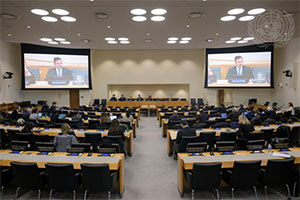 UN Commission on International Trade Law Holds Colloquium on Harmonizing Law in Age of Digital Trade and Finance. Credit: UN Photo/Manuel Elías
Trade has historically been a geopolitical tool that can both be used to propel development as well as entrench inequalities. In various nations in East Asia and Latin America, increased trade, as often seen in export booms, has allowed them to achieve influential standings within the global economy. On the other hand, many low-income countries in Sub-Saharan Africa, Asia, and Latin America struggle to maintain a robust trade performance, and oftentimes are subjugated to exploitative trade dynamics through intense extraction of their natural resources. In recent decades, international trade has reached a new era as emerging economies across the world are rising in economic preeminence. Stable international trade is crucial to world peace as global interconnectedness facilitates reliable diplomacy. Nevertheless, significant challenges are on the rise. Notably, a major wave of United States tariff escalations in January 2025 lifted US import taxes to their highest level since the 1930s, changing market dynamics and forcing renegotiations with global trading partners.These articles are aimed at informing readers about the complexities of trade and its varying effects on development, with a special focus on the consequences of the global economic crisis, the potential of fair trade and the gender implications of trade policies.
Updated by Yilan Batista and Shuli Wong August 2026

The Week with IPS

NEXT STOP - SDGs
Tracking global progress towards a sustainable world
Tracking global progress towards a sustainable world
