Languages
Wednesday, October 7, 2026



News and Views from the Global South
Economy & Trade

Political Will and Investment Will Score the Goal for Zero Hunger
A world free from hunger is possible, but it demands political will, investment, and effective policies to transform agriculture and rural development, says Alvaro Lario, President of the International Fund for Agricultural Development (IFAD).
Nigeria to Expand Education Access Through a Student Loan Scheme
Wisdom Ajah, an 18-year-old senior secondary school graduate living in Karshi, a satellite town in Nigeria’s Federal Capital Territory, dreams of a university education that will secure him a good job after graduation and help support his family. But it is a distant dream considering how many obstacles he has faced trying to acquire a secondary school certificate.
POWER TO THE YOUTH: With Quality Education, Youth are Empowered with the Green Skills to Save Our Planet
To save our people and our planet from the life-threatening risks of the climate crisis, we must invest in the education of today’s youth. They will be the climate activists, climate scientists, climate innovators, game-changers and leaders of the 21st century green economy.
Disappearing Fish Spell Hard Times for Women in Zimbabwe
Zimbabwe's ballooning informal sector has, in recent years, spawned the over-exploitation of the country's natural resources, with the fisheries taking some of the most felt battering.
Mining Revenues Undermined
The primary commodity price boom early this century has often been attributed to a commodity ‘super-cycle’, i.e., a price upsurge greater than what might be expected in ‘normal’ booms. This was largely due to some minerals as most agricultural commodity price increases were more modest.
A Flawed GDP Bypasses Women’s Unpaid Care Work
Last week the IMF offered a cautious estimate of positive global economic growth for this year, warning ‘we are on track, but not out of the woods’. But with the IMF and governments continuing to use gross domestic product (GDP) as the dominant measure of economic progress, a more appropriate warning might be that ‘we’ are failing to see the wood for the trees.
G20: Cutting Food Loss and Waste is an Opportunity to Improve Food Security
With the ongoing global food crisis—triggered by the COVID pandemic, disasters, supply chain disruptions, and conflict in Ukraine—food security should be at the top of the G20 agenda when countries gather in India in September 2023.
Cambodia’s Election a Blatant Farce
The title shouldn’t fool you: Cambodian Prime Minister Hun Sen is one of the world’s longest-ruling autocrats. A political survivor, this former military commander had been bolted to his chair since 1985, presiding over what he turned into a de facto one-party system – and now apparently a dynastic regime.
Sri Lanka: Right Turn, Wrong Move
When this Indian Ocean- island gained independence from Britain in 1948 after some 450 years of colonial rule under three western powers, it was simply named the “Dominion of Ceylon”.
Exchange Rate Movements Due to Interest Rates, Speculation, Not Fundamentals
Currency values and foreign exchange rates change for many reasons, largely following market perceptions, regardless of fundamentals. Market speculation has worsened volatility, instability and fragility in most economies, especially of small, open, developing countries.
Brazil Back on the Green Track
At a meeting with European and Latin American leaders in Brussels this July, Brazil’s President Lula da Silva reiterated the bold commitment he had made in his first international speech as president-elect, when he attended the COP27 climate summit in November 2022: bringing Amazon deforestation down to zero by 2030.
Blue Tourism Spurs Development Goals in Bangladesh
Blue tourism, widely referred to as Coastal or Maritime tourism, is a distinct idea from traditional tourism, which capitalizes on a country's ocean, sea, or coastal region.
Biomethane Tested in Brazil as a Sanitation Input
The city of Franca is an example of basic sanitation in Brazil. In addition to providing universal treated water and sewage to its 352,500 inhabitants, it extracts biogas from wastewater and refines it to fuel its own vehicles.
Improving Healthcare for All
In 2015, almost all heads of government in the world committed to the United Nations’ Sustainable Development Goals (SDGs), including universal health coverage (UHC). This was consistent with the World Health Organization’s commitment to Health for All.
‘Passion Seeds’ Fertilize Brazil’s Semiarid Northeast
Zé Pequeno cried when he learned that the heirloom seeds he had inherited from his father were contaminated by the transgenic corn his neighbor had brought from the south. Fortunately, he was able to salvage the native seeds because he had shared them with other neighbors.
Women Recyclers in Bolivia Build Hope, Demand Recognition
They haul many kilos of recyclable materials on their backs but receive little in return. These Bolivian women who help clean up the environment from dawn to dusk are fighting for recognition of their work and social and labor rights.
Private and Public Spheres: Sweden and Mugabe
The war in Ukraine continues unabated; young men are sacrificed on battlefields, towns laid waste by aerial attacks, the threat of nuclear disasters is looming. People within an often formerly friendly inclined Europe are now wondering if Vladimir Putin has gone insane. The war in Ukraine is generally called “Putin’s war” and in April 2021 Putin signed a legislation providing him the right to run for two more consecutive terms, thus he could stay in power till 2036.
Can Carbon Trading Stop Global Heating?
As our planet continues to heat up at an alarming rate, carbon credits, markets and trading have been promoted as effective measures to combat global warming. While there is an urgent need to curb planetary heating, growing reliance on this innovation is problematic, to say the least.
Grey Market Charcoal East Africa — Why Prohibitionist Interventions Are Failing
At Kampala’s Nakawa market, Lovisa Nabisubi scoops charcoal from a bag and packs it into tins ready for customers. Her bare hands, feet, and clothes are stained black from hours of dealing in this popular household fuel which some equate to “black gold” not just in Uganda but in most of East Africa.
The Dark Side of Wind and Solar Farms as Sustainable Energy in Brazil
"Anxiety, insomnia and depression have become widespread. We don't sleep well, I wake up three, four times a night," complained Brazilian farmer Roselma de Melo Oliveira, 35, who has lived 160 meters from a wind turbine for eight years.
Cloud Lingers over Sierra Leone’s Election
People went to the polls in Sierra Leone on 24 June to pick a president, parliament and municipal representatives. Results were quickly announced and the president sworn in for a second term. But a cloud of doubt lingers.« Previous Page — Next Page »





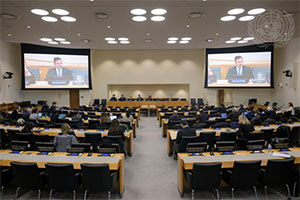 UN Commission on International Trade Law Holds Colloquium on Harmonizing Law in Age of Digital Trade and Finance. Credit: UN Photo/Manuel Elías
Trade has historically been a geopolitical tool that can both be used to propel development as well as entrench inequalities. In various nations in East Asia and Latin America, increased trade, as often seen in export booms, has allowed them to achieve influential standings within the global economy. On the other hand, many low-income countries in Sub-Saharan Africa, Asia, and Latin America struggle to maintain a robust trade performance, and oftentimes are subjugated to exploitative trade dynamics through intense extraction of their natural resources. In recent decades, international trade has reached a new era as emerging economies across the world are rising in economic preeminence. Stable international trade is crucial to world peace as global interconnectedness facilitates reliable diplomacy. Nevertheless, significant challenges are on the rise. Notably, a major wave of United States tariff escalations in January 2025 lifted US import taxes to their highest level since the 1930s, changing market dynamics and forcing renegotiations with global trading partners.These articles are aimed at informing readers about the complexities of trade and its varying effects on development, with a special focus on the consequences of the global economic crisis, the potential of fair trade and the gender implications of trade policies.
Updated by Yilan Batista and Shuli Wong August 2026

The Week with IPS

NEXT STOP - SDGs
Tracking global progress towards a sustainable world
Tracking global progress towards a sustainable world
