Languages
Thursday, October 8, 2026



News and Views from the Global South
Trade & Investment

1997 Asian Crisis Lessons Lost
After months of withstanding speculative attacks on its national currency, the Thai central bank let it ‘float’ on 2 July 1997, allowing its exchange rate to drop suddenly. Soon, currencies and stock markets throughout the region came under pressure as easily reversible short-term capital inflows took flight in herd-like fashion. By mid-July 1997, the currencies of Indonesia, Malaysia and the Philippines had also fallen precipitously after being floated, with stock market price indices following suit.
Ending Child Marriage Could Add Trillions to World Economy
The benefits of ending child marriage are many—boosting a young girl’s morale and increasing her chances of education and work, and by that virtue, curbing high population rates in developing economies and boosting growth.
Southeast Asia: From Miracle To Debacle
The World Bank and other influential international financial institutions and development agencies have been touting Southeast Asian (SEA) newly industrializing countries as models for emulation, especially by African developing countries seeking to accelerate their development transformations. But these recommendations are usually based on misleading analysis of their rapid growth and structural transformation.
China Drives Nuclear Expansion in Argentina, but with Strings Attached
Two new nuclear power plants, to cost 14 billion dollars, will give a new impetus to Argentina’s relation with atomic energy, which began over 60 years ago. President Mauricio Macri made the announcement from China, the country that is to finance 85 per cent of the works.
East Asia’s Real Lessons
International recognition of East Asia’s rapid economic growth, structural change and industrialization grew from the 1980s. In Western media and academia, this was seen as a regional phenomenon, associated with some commonality, real or imagined, such as a supposed ‘yen bloc’.
IFAD’s President Houngbo Calls for Investment in Climate-Smart Agriculture for Poverty-Free Future
Implementing climate-smart agriculture is critical to reduce hunger and poverty, according to International Fund for Agricultural Development’s (IFAD) new president Gilbert Houngbo.
East Asian Miracle Myth Making
Even before the term ‘Washington Consensus’ (WC) was popularized, it was already coming under great criticism despite the ‘counter-revolutions’ against ‘development economics’ and Keynesian economics associated with Thatcherism and Reaganomics. At the World Bank, the Japanese Executive Director argued that the WC menu of policy advice and conditionalities had resulted in the 1980s’ ‘lost decade’ in Latin America and Africa. In contrast, the East Asian region had seen rapid growth and industrialization.
Renewing Commitment to SDGs: Private Sector Gets Active
Just last month business representatives from around the world joined the United Nations Sustainable Development Goals Fund commemorate their work as part of the Private Sector Advisory Group (PSAG).
Global South Calls for International Body to Fight Tax Havens
Tax havens are “one of the worst enemies of our democracies,” said state representatives during a meeting at the United Nations.
Why Do International Financial Crises Happen?
International currency and financial crises have become more frequent since the 1990s, and with good reason. But the contributory factors are neither simple nor straightforward. Such financial crises have, in turn, contributed to more frequent economic difficulties for the economies affected, as evident following the 2008-2009 financial crisis and the ensuing Great Recession still evident almost a decade later.
Time To Focus On ‘Hidden Hunger’
As World Hunger Day May 28 approaches, it is time for us all to redouble our efforts to reach the goal of Zero Hunger by prioritizing the battle against micronutrient deficiency. If the international community pulls together this year to incorporate proven solutions such as biofortifying crops into the UN framework for sustainable development, we could reduce malnutrition on a truly global scale.
Why the G7 Must Fund Health & Nutrition
The G7 Summit, held annually among the leaders of the world’s most powerful economies (Canada, France, Germany, Italy, Japan, the United Kingdom, the United States, and the EU), plays an important role in shaping responses to global challenges—theoretically at least.
Slow Growth Stalls SDGs’ Progress
The world will not be on track to eradicate poverty by 2030 if current growth trends continue, a UN task force found.
Gateway Portals and the Quest for Sustainable Urbanization
On a busy Friday afternoon, the number 1 subway train heading north through Manhattan’s Westside comes out of a dark tunnel --and if one takes a minute to release oneself from communication devices—one can catch sight of the approaching 125th street in the distance, the crosswalk buzzing with yellow cabs.
Community Seed Banks: Securing Diversity for Climate Change Adaptation
For thousands of years, farmers have used genetic diversity to cope with weather variability and changing climate conditions. They have stored, planted, selected and improved seeds to continue producing food in a dynamic environment.
Ecuador Focuses on New UN Tax Body to Fight Illicit Financial Flows
The time is now to work together to fight illicit financial flows, according to Ecuador’s Foreign Minister Guillaume Long.
Norwegian Trade Union Boycott Israel
The Norwegian Confederation of Trade Unions (LO) has voted in favour of a boycott against Israel, which is expected to affect cultural, economical and academic ties. Condemnation has come from Isreali politicians, diplomats and unions.
Africa and India – Sharing the Development Journey
Africa, like India, is a continent of rich and compelling diversity. Both continents share a similar landscape, a shared colonial history, and similar economic and demographic challenges. This helps both India and Africa work especially well with each other.
Unlocking the Diaspora Development Potential
 ‘Diaspora is the biggest development community that exists in the world’, according to Pedro De Vasconcelos, manager of IFAD‘s Financial Facility for Remittances. However, its potential is still largely untapped.

Using Agriculture and Agribusiness to Bring About Industrialisation in Africa
No region of the world has ever moved to industrialised economy status without a transformation of the agricultural sector. Agriculture, which contributes 16.2% of the GDP of Africa, and gives some form of employment to over 60% of the population, holds the key to accelerated growth, diversification and job creation for African economies.
World Bank Must Stop Encouraging Harmful Tax Competition
One of the 11 areas that the World Bank’s Doing Business (DB) report includes in ranking a country’s business environment is paying taxes. The background study for DB 2017, Paying Taxes 2016 claims that its emphasis is “on efficient tax compliance and straightforward tax regimes”.« Previous Page — Next Page »





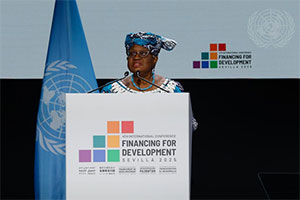 Opening of 4th International Conference on Financing for Development. Credit: UN Photo/Mariscal
International trade and investment are crucial elements of the world economy. While they can be powerful stimulators of development, they can also lead to global imbalances and dynamics of exploitation. In 2025, international trade entered a period of immense disruption, driven in part by a new wave of United States tariffs that reshaped global supply chains and investment flows. The increase in the US tariff rate, the highest since the 1930s, has forced bilateral renegotiations with global trading partners. Furthermore, the debt crisis in developing nations has accelerated while Official Development Assistance (ODA) has substantially dropped 7.3% in 2024.
In the 21st century, advancements in economic diversification in formerly colonized nations have propelled them into more central roles in the global economy. For example, both China and Mexico were able to develop their manufacturing sector and channel this development into booming export flows, thus advancing into the position of emerging economies. Foreign investment also plays an essential role in providing capital for developing countries, although they are oftentimes accompanied by social and environmental exploitation. For example, rising Chinese investments in natural resources in Latin America have often been met with tension as these investment projects fail to properly mitigate environmental risks and protect workers’ rights. In a more multifaceted vein, Sino-African relations have led to infrastructure development in Sub-Saharan Africa while also heightening the region’s economic dependency on China. IPS reports on global news in trade and investment, while shining a light on the nuanced nature of these endeavors.

The Week with IPS

NEXT STOP - SDGs
Tracking global progress towards a sustainable world
Tracking global progress towards a sustainable world
