Languages
Wednesday, October 7, 2026



News and Views from the Global South
Trade & Investment

South-South trade cooperation key to sustainable and inclusive model of globalization
Thanks to globalization and trade liberalization of commodities, services and goods, global trade has reached an unprecedented level. According to the United Nations Conference on Trade and Development, world trade in goods was valued at approximately USD 16 trillion. North-North trade generates the highest trade volume at approximately 6 trillion; trade flows within and between countries of the Global South amounts to 4.6 trillion. Trade between the Global South and the Global North -approximately between 2.5 and 3 trillion - add up to less than the trade flows within the Earth’s two main poles.
Latin America Discusses How to Finance the Sustainable Development Agenda
Is it possible for the financial sector of Latin America and the Caribbean not only to think about earning money but also to contribute to the 2030 Agenda for Sustainable Development? The answer was sought in Buenos Aires, Argentina, at a regional roundtable on sustainable finance, the United Nations Environment Finance Initiative.
Scaling up Development Finance
The Business and Sustainable Development Commission has estimated that achievement of Agenda 2030 for the Sustainable Development Goals will require US$2-3 trillion of additional investments annually compared to current world income of around US$115 trillion. This is a conservative estimate; annual investments of up to US$2 trillion yearly will be needed to have a chance of keeping temperature rise below 1.5°C.
Small Entrepreneurs Emerge as Backbone of Bangladesh’s Rural Economy
She was born in the early 1950’s to an ultra-poor family in Kundihar, a remote village of Banaripara of Barisal division in Bangladesh. She was a beautiful baby and her father named her ‘Shahndah Rani’ which means ‘Queen of Evenings’. But in reality her life was far from that of a queen.
Towards a Resource Efficient and Pollution Free Asia-Pacific
Senior government officials from across Asia and the Pacific will meet in Bangkok this week for the first-ever Asia-Pacific Ministerial Summit on the Environment. The high-level meeting is co-convened by the United Nations Economic and Social Commission for Asia and the Pacific (UN ESCAP) and UN Environment and is a unique opportunity for the region’s environment leaders to discuss how they can work together towards a resource efficient and pollution-free Asia-Pacific.
Quantitative Easing for Wealth Redistribution
Following the 2007-2008 global financial crisis and the Great Recession in its wake, the ‘new normal’ in monetary policy has been abnormal. At the heart of the unconventional monetary policies adopted have been ‘asset purchase’ or ‘quantitative easing’ (QE) programmes. Ostensibly needed for economic revival, QE has redistributed wealth – regressively, in favour of the rich.
When Policies Speak the Same Language, Africa’s Trade and Investment Will Listen
The rising Maputo-Catembe Bridge is a hard-to-miss addition to Mozambique’s shoreline.
Leadership Failure Perpetuates Stagnation
What kind of leadership does the world need now? US President Franklin Delano Roosevelt’s leadership was undoubtedly extraordinary. His New Deal flew in the face of the contemporary economic orthodoxy, begun even before Keynes’ General Theory was published in 1936.
UN Analytical Leadership in Addressing Global Economic Challenges
The United Nations recently released the 70th anniversary issue of its flagship publication, the World Economic and Social Survey (WESS). First published in January 1948 as the World Economic Report, it is the oldest continuous publication analyzing international economic and social challenges. The 2017 issue reviews 70 years of WESS policy recommendations, many of which remain relevant today to address global challenges and to achieve the 2030 Agenda or Sustainable Development Goals.
“The Time is Now” to Invest in Youth, Girls
The demographic dividend: though not a new concept, it is one of the major buzzwords at the UN this year. But what does it really mean? There are 1.8 billion young people between the ages of 10 and 24 around the world, the most in the history of humankind.
Migrant Contributions to Development: Creating a “New Positive Narrative”
Despite the “undeniable” benefits of migration, barriers including public misconceptions continue to hinder positive development outcomes, participants said during a series of thematic consultations here on safe, orderly, and regular migration.
Alcoholism Cannot Explain Russian Mortality Spike
The steep upsurge in mortality and sudden fall in life expectancy in Russia in the early 1990s were the highest ever registered anywhere in recorded human history in the absence of catastrophes, such as wars, plague or famine. The shock economic reforms in the former Soviet economies after 1991 precipitated this unprecedented increase in mortality, shortening life expectancy, especially among middle-aged males.
Kenya and Ethiopia Join Forces to Advance Peace, Security, Development and Hope
The Horn of Africa is often synonymous with extreme poverty, conflict, demographic pressure, environmental stress, and under-investment in basic social services such as health, education, access to clean water and infrastructure.
Early Death in Russia
The transition to market economy and democracy in the Russian Federation in the early 1990s dramatically increased mortality and shortened life expectancy. The steep upsurge in mortality and the decline in life expectancy in Russia are the largest ever recorded anywhere in peacetime in the absence of catastrophes such as war, plague or famine.
Brazil’s Shipyards – Victims of a Failed Reindustrialisation Process
“I have lived through three good periods and two bad ones,” prior to the present crisis in the Brazilian shipping industry, said Edson Rocha, a direct witness since the 1970s of the ups and downs of a sector where nationalist feelings run high.
How to Achieve Universal Goals, Strategically
Discussion around the 2030 Agenda for Sustainable Development, a list of 17 goals listed by the UN, was all the buzz in the conference rooms of UN headquarters this week.
Civil Society on SDG Engagement: “We Are Not Guests”
Showing up in record numbers, civil society groups are urging greater inclusion and accountability in sustainable development processes at a UN high level meeting.
Reforming the International Financial System
When we fail to act on lessons from a crisis, we risk exposing ourselves to another one. The 1997-1998 East Asian crises provided major lessons for international financial reform. Two decades later, we appear not to have done much about them. The way the West first responded to the 2008 global financial crisis should have reminded us to do more. But besides accumulating more reserves, Southeast Asia has not done much else.
We Have to Reclaim the Public Policy Space for SDGs
At the High-Level Political Forum which currently takes place at the United Nations in New York several events, for instance a SDG Business Forum, are devoted to the critical role of business and public-private partnerships (PPPs) in implementing the 2030 Agenda for Sustainable Development.
Argentina Plans Billions of Dollars in Railway Projects
Development in Argentina in the second half of the 19th century and the first half of the 20th century was closely tied to that of the railway. The eighth largest country in the world, Argentina’s economy grew through exporting agricultural and livestock products, and the railways were key to founding centres of population and transporting goods to the ports.
Mexico’s Methane Emissions Threaten the Environment
Mexico is in transition towards commercial exploitation of its shale gas, which is being included in two auctions of 24 hydrocarbon blocks, at a time when the country is having difficulty preventing and reducing industrial methane emissions.« Previous Page — Next Page »





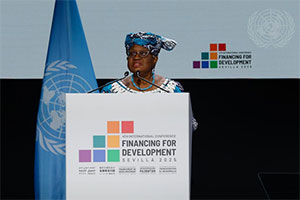 Opening of 4th International Conference on Financing for Development. Credit: UN Photo/Mariscal
International trade and investment are crucial elements of the world economy. While they can be powerful stimulators of development, they can also lead to global imbalances and dynamics of exploitation. In 2025, international trade entered a period of immense disruption, driven in part by a new wave of United States tariffs that reshaped global supply chains and investment flows. The increase in the US tariff rate, the highest since the 1930s, has forced bilateral renegotiations with global trading partners. Furthermore, the debt crisis in developing nations has accelerated while Official Development Assistance (ODA) has substantially dropped 7.3% in 2024.
In the 21st century, advancements in economic diversification in formerly colonized nations have propelled them into more central roles in the global economy. For example, both China and Mexico were able to develop their manufacturing sector and channel this development into booming export flows, thus advancing into the position of emerging economies. Foreign investment also plays an essential role in providing capital for developing countries, although they are oftentimes accompanied by social and environmental exploitation. For example, rising Chinese investments in natural resources in Latin America have often been met with tension as these investment projects fail to properly mitigate environmental risks and protect workers’ rights. In a more multifaceted vein, Sino-African relations have led to infrastructure development in Sub-Saharan Africa while also heightening the region’s economic dependency on China. IPS reports on global news in trade and investment, while shining a light on the nuanced nature of these endeavors.

The Week with IPS

NEXT STOP - SDGs
Tracking global progress towards a sustainable world
Tracking global progress towards a sustainable world
