Languages
Thursday, September 10, 2026



News and Views from the Global South
Trade & Investment

Opinion: Developing Nations Set to Challenge Rich Ahead of SDG Summit
The final round of negotiations on the Sustainable Development Goals – the successor to the Millennium Development Goals, due to be inaugurated in September at the U.N. General Assembly – is now underway in New York.
Opinion: European Federalism and Missed Opportunities
"A serious political and social crisis will sweep through the euro countries if they do not decide to strengthen the integration of their economies. The euro zone crisis did not begin with the Greek crisis, but was manifested much earlier, when a monetary union was created without economic and fiscal union in the context of a financial sector drugged on debt and speculation.”
Mideast Arms Build-up Negative Fallout from Iran Nuclear Deal
The nuclear agreement concluded last week between Iran and six big powers, the United States, Britain, France, Russia, China and Germany, is threatening to trigger a new Middle East military build-up – not with nuclear weapons but with conventional arms, including fighter planes, combat helicopters, warships, missiles, battle tanks and heavy artillery.
Opinion: Addis Outcome Will Impact Heavily on Post-2015 Agenda – Part 2
The United Nations is the only universal forum that connects systemic issues to the global partnership for development. The latter recognises North-South cooperation based on historical responsibility and varying levels of development and capacity among member states of the U.N.
Opinion: A BRICS Bank to Challenge the Bretton Woods System?
The formal opening of the BRICS Bank in Shanghai on Jul. 21 following the seventh summit of the world’s five leading emerging economies held recently in the Russian city of Ufa, demonstrates the speed with which an alternative global financial architecture is emerging.
Caribbean Seeks Funding for Renewable Energy Mix
A leading geothermal expert warns that the small island states in the Caribbean face “a ticking time bomb” due to the effects of global warming and suggests a shift away from fossil fuels to renewable energy is the only way to defuse it.
Security Council Defies U.S. Lawmakers by Voting on Iran Nuke Deal
When all 15 members of the Security Council raised their collective hands to unanimously vote in favour of the recently-concluded nuclear agreement with Iran, they were also defying a cabal of right-wing conservative U.S. politicians who wanted the United Nations to defer its vote until the U.S. Congress makes its own decision on the pact.
Opinion: Strengthen Tax Cooperation to End Hunger and Poverty Quickly
By the end of this year, the 15-year time frame for the Millennium Development Goals will end, with good progress on several indicators, but limited achievements on others.
Opinion: Unrestrained ‘Privatisation of Poverty-Reduction’ Puts Human Rights at Risk
Corporate lobbyists are unusual guests at development meetings, but when the United Nations held its Financing for Development conference in Addis Ababa this week to decide who pays for its new “Sustainable Development Goals”, some governments laid out the red carpet for the private sector.
Civil Society Sceptical Over “Action Agenda” to Finance Development
Despite high expectations, the third International Conference on Financing for Development (FfD) ended on a predictable note: the United Nations proclaimed it a roaring success while most civil society organisations (CSOs) expressed scepticism over the final outcome.
Opinion: What Will It Take to Bring a Second Green Revolution to India?
Long-term agricultural growth in India is slowing down. The lands that saw remarkable increases in productivity in the 1970s and 80s, thanks to the technology rolled out as part of the first “Green Revolution”, are not yielding the same results today.
Nuclear Deal Takes U.S.-Iran Ties Out of Deep Freeze – Partly, at Least
A historic deal on Iran’s controversial nuclear programme was announced today during the early morning hours in Vienna over a decade after talks between Tehran and world powers began.
Opinion: U.N. Can Help Reform the International Financial System
The growth in global interdependence poses greater challenges to policy makers on a wide range of issues and for countries at all levels of development.
Will the New BRICS Bank Break with Traditional Development Models, or Replicate Them?
Just days ahead of a summit of the BRICS group of emerging economies (Brazil, Russia, India, China and South Africa) in which the five countries are expected to formally launch their New Development Bank (NDB), 40 NGOs and civil society groups have penned an open letter to their respective governments urging transparency and accountability in the proposed banking process.
Opinion: SDGs, FfD and Every Single Dollar in the World
Ethiopia will host an important meeting on Financing for Development (FfD) Conference next week. One of the most-asked questions is: How much will it cost us to achieve the Sustainable Development Goals (SDGs)?
Putting the “Integrity of the Earth’s Ecosystems” at the Centre of the Sustainable Development Agenda
By 2050, we will be a world of nine billion people. Not only does this mean there’ll be two million more mouths to feed than there are at present, it also means these mouths will be consuming more – in the next 20 years, for instance, an estimated three billion people will enter the middle class, in addition to the 1.8 billion estimated to be within that income bracket today.
Sustainable Use of Biodiversity Could Fill Gap When Belo Monte Dam Is Finished
Some argue that the sustainable use of biodiversity is the best alternative for local development in the area surrounding the enormous Belo Monte hydroelectric dam, now that the construction project is entering its final phase on the Xingú River in Brazil’s Amazon jungle.
Financial Transaction Tax Could Boost New Development Goals
Ever since the Monterrey Consensus on Financing for Development in March 2002 called for new and innovative strategies to complement traditional Official Development Assistance (ODA), various financial instruments have been discussed.
Panama and Nicaragua – Two Canals, One Shared Dream
Nicholas Suchecki Guillén is blind. His dream was to visit the Panama Canal expansion works, touch the cement structures, and feel part of this new period of history in his country.
Opinion: BRICS for Building a New World Order?
As the leaders of the BRICS five meet in the Russian city of Ufa for their annual summit Jul. 8–10, their agenda is likely to be dominated by economic and security concerns, triggered by the continuing economic crisis in the European Union and the security situation in the Middle East.Foreign Investment Fell Worldwide in 2014, U.N. Says
Global Foreign Direct Investment (FDI) inflows in 2014 declined 16 per cent to 1.2 trillion dollars, according to this year’s newly released World Investment Report from the United Nations Conference on Trade and Development (UNCTAD).« Previous Page — Next Page »


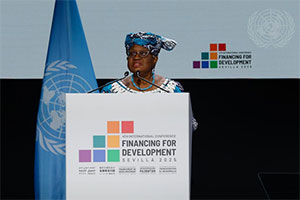 Opening of 4th International Conference on Financing for Development. Credit: UN Photo/Mariscal
International trade and investment are crucial elements of the world economy. While they can be powerful stimulators of development, they can also lead to global imbalances and dynamics of exploitation. In 2025, international trade entered a period of immense disruption, driven in part by a new wave of United States tariffs that reshaped global supply chains and investment flows. The increase in the US tariff rate, the highest since the 1930s, has forced bilateral renegotiations with global trading partners. Furthermore, the debt crisis in developing nations has accelerated while Official Development Assistance (ODA) has substantially dropped 7.3% in 2024.
In the 21st century, advancements in economic diversification in formerly colonized nations have propelled them into more central roles in the global economy. For example, both China and Mexico were able to develop their manufacturing sector and channel this development into booming export flows, thus advancing into the position of emerging economies. Foreign investment also plays an essential role in providing capital for developing countries, although they are oftentimes accompanied by social and environmental exploitation. For example, rising Chinese investments in natural resources in Latin America have often been met with tension as these investment projects fail to properly mitigate environmental risks and protect workers’ rights. In a more multifaceted vein, Sino-African relations have led to infrastructure development in Sub-Saharan Africa while also heightening the region’s economic dependency on China. IPS reports on global news in trade and investment, while shining a light on the nuanced nature of these endeavors.

The Week with IPS

NEXT STOP - SDGs
Tracking global progress towards a sustainable world
Tracking global progress towards a sustainable world
