Languages
Tuesday, August 25, 2026



News and Views from the Global South
Trade & Investment

Fracking Expands Under the Radar on Mexican Lands
“People don’t know what ‘fracking’ is and there is little concern about the issue because it’s not visible yet,” said Gabino Vicente, a delegate of one of the municipalities in southern Mexico where exploration for unconventional gas is forging ahead.
Ghosts Of War Give Way to Development in Sri Lanka
 It is an oasis from the scorching heat outside. The three-storey, centrally air-conditioned Cargills Square, a major mall in Sri Lanka’s northern Jaffna town, is the latest hangout spot in the former warzone, where everyone from teenagers to families to off-duty military officers converge.

Corporate Interests Dominate Lobbying With EU Policy-Makers
The overwhelming majority of lobby meetings held by European Commissioners and their closest advisors are with representatives of corporate interests, according to an analysis published Jun. 24 by Transparency International (TI).
Bougainville Election Intensifies Hopes for Independence
A referendum on independence within the next five years dominated campaigning in the recent general election held in Bougainville, an autonomous region of 300,000 people in the east of Papua New Guinea (PNG), which emerged from a decade-long civil war 15 years ago.
On Kenya’s Coast, a Struggle for the Sacred
Travel into the heart of Kenya’s southern Coast Province, nearly 500 km from the capital city of Nairobi, and you will come across one of the planet’s most curious World Heritage Sites: the remains of several fortified villages, revered by the indigenous Mijikenda people as the sacred abodes of their ancestors.
Opinion: Sub-Saharan Africa, Addis and Paris
After the turn of the century, growth in sub-Saharan Africa (SSA) picked up again after a quarter century of near stagnation for most, mainly due to increased world demand for minerals and other natural resources.
Critics of World Bank-Funded Projects in the Line of Fire
For an entire month beginning in February 2015, a group of between 40 and 50 residents of the Durgapur Village in the northern Indian state of Uttarakhand would gather at the site of a hydroelectric power project being carried out by the state-owned Tehri Hydro Development Corporation (THDC).
Opinion: The Oceans Need the Spotlight Now
The international community must focus its energies immediately on addressing the grave challenges confronting the oceans. With implications for global order and peace, the oceans are also becoming another arena for national rivalry.
Amazon Dam also Brings Health Infrastructure for Local Population
Extensive public health infrastructure and the eradication of malaria will be the most important legacy of the construction of the Belo Monte hydropower dam in Brazil’s Amazon jungle for the population affected by the megaproject.
Farmers Find their Voice Through Radio in the Badlands of India
Eighty-year-old Chenabai Kushwaha sits on a charpoy under a neem tree in the village of Chitawar, located in the Tikamgarh district in the central Indian state of Madhya Pradesh, staring intently at a dictaphone.
Opinion: No Place to Hide in Addis
My colleagues just got back from Munich, where we held a summit bringing together over 250 young volunteers from across Europe. These youngsters campaigned in the run-up to and at the doorstep of the G7 Summit in Schloss Elmau, as one of the key moments in a year brimming with opportunities to tackle extreme poverty.
From Residents to Rangers: Local Communities Take Lead on Mangrove Conservation in Sri Lanka
Weekends and public holidays are deadly for one of Sri Lanka’s most delicate ecosystems – that is when the island’s 8,815 hectares of mangroves come under threat.
Opinion: Journey Towards an African Taxation Renaissance
Africa is known as the ‘paradox of plenty’. How can a continent so rich in natural resources be so poor?
Organic Cacao Farmers Help Reforest Brazil’s Amazon Jungle
“Now we realise what a paradise we live in,” said Darcirio Wronski, a leader of the organic cacao producers in the region where the Trans-Amazonian highway cuts across the Xingú river basin in northern Brazil.
Infrastructure Investments in Emerging Economies Hit Record Levels – but at What Cost?
According to new data released by the World Bank Tuesday, investments in infrastructure in 139 emerging economies shot up to 107.5 billion dollars in 2014, with just five countries – Brazil, Colombia, India, Peru and Turkey – accounting for 73 percent of the total.Africa on Threshold of Triple Energy Win for People, Power and Planet
Renewable energy is at the forefront of the changes sweeping Africa, and a “triple win” is within the region’s grasp to increase agricultural productivity, improve resilience to climate change, and contribute to long-term reductions in dangerous carbon emissions.
Opinion: G7 Makes Commitment on Climate … to Climate Chaos
One of the promises made by the leaders of the world's seven richest nations when they met at Schloss Elmau in Germany earlier this week was an energy transition over the next decades, aiming to gradually phase out fossil fuel emissions this century to avoid the worst of climate change.
India Confronts Water Woes as it Transitions from MDGs to SDGs
 As the United Nations closes its chapter on the Millennium Development Goals (MDGs) and charts a new plan of action under the framework of 17 Sustainable Development Goals (SDGs), India – a country of 1.2 billion people – is confronting its resource challenges.

Rights Abuses Still Rampant in Bangladesh’s Garment Sector
Some say they were beaten with iron bars. Others confess their families have been threatened with death. One pregnant woman was assaulted with metal curtain rods.

Compensation Fund for Victims of Bangladesh Factory Collapse Reaches 30-Million-Dollar Target
Two years after a massive garments factory collapsed in a suburb of Bangladesh’s capital, Dhaka, killing over 1,100 people and leaving more than 2,500 injured, a major international fund has met its target of raising 30 million dollars to be paid out in compensation to the victims and their families.
Why ACP Countries Matter for the EU Post-2015 Development Agenda
We are witnessing a shift in the original rationale behind the unique relationship between the European Union and the African, Caribbean and Pacific countries of the ACP group, which goes beyond the logic of “unilateral aid transfer”, “donor-recipient approach” and “North-South dialogue”.« Previous Page — Next Page »


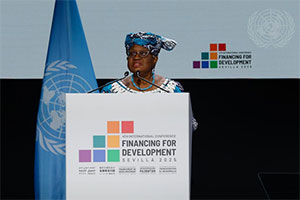 Opening of 4th International Conference on Financing for Development. Credit: UN Photo/Mariscal
International trade and investment are crucial elements of the world economy. While they can be powerful stimulators of development, they can also lead to global imbalances and dynamics of exploitation. In 2025, international trade entered a period of immense disruption, driven in part by a new wave of United States tariffs that reshaped global supply chains and investment flows. The increase in the US tariff rate, the highest since the 1930s, has forced bilateral renegotiations with global trading partners. Furthermore, the debt crisis in developing nations has accelerated while Official Development Assistance (ODA) has substantially dropped 7.3% in 2024.
In the 21st century, advancements in economic diversification in formerly colonized nations have propelled them into more central roles in the global economy. For example, both China and Mexico were able to develop their manufacturing sector and channel this development into booming export flows, thus advancing into the position of emerging economies. Foreign investment also plays an essential role in providing capital for developing countries, although they are oftentimes accompanied by social and environmental exploitation. For example, rising Chinese investments in natural resources in Latin America have often been met with tension as these investment projects fail to properly mitigate environmental risks and protect workers’ rights. In a more multifaceted vein, Sino-African relations have led to infrastructure development in Sub-Saharan Africa while also heightening the region’s economic dependency on China. IPS reports on global news in trade and investment, while shining a light on the nuanced nature of these endeavors.

The Week with IPS

NEXT STOP - SDGs
Tracking global progress towards a sustainable world
Tracking global progress towards a sustainable world
