
Tuesday, November 17, 2026



News and Views from the Global South
Environment
SUDAN: Feeling the Economic Impact Before Secession
Amira Amer* becomes very picky the minute she reaches the bus station. One by one she lets the new air-conditioned busses pass her by. She is waiting for a cheaper bus. They are limited in the expensive city of Khartoum and are constantly packed to the point of overflowing.Poor Countries Host Vastly More Displaced People Than Wealthier Nations
The hardest part of Jan Egeland’s job is coming home at the end of the day. He is the Director of the Norwegian Institute for International Affairs and the former U.N. Emergency Relief Coordinator, and has travelled to the farthest reaches of the world to help protect refugees and displaced people.Amidst ‘Dire’ Humanitarian Crisis, U.S. Urges Ceasefire in South Kordofan
As the date for South Sudan’s long anticipated Jul. 9 secession inches closer, on-going violence in the Northern state of South Kordofan threatens to destroy the country’s hopes for peace.
Carbon Markets Are Not Cooling the Planet
Carbon markets have been widely promoted as the only way to generate enough money to enable industries and countries to reduce their carbon dioxide emissions, which are largely responsible for global warming. The only problem is that nearly 20 years after their conception, they have failed to work, and have also been subject to fraud and other financial crimes.HUMAN RIGHTS-MEXICO: Overdue Homework
Although four of the five sentences in which the Inter-American Court of Human Rights has found the Mexican state guilty involved cases from the southwestern state of Guerrero, the effects of the rulings have not yet had an impact on that area, one of the poorest parts of the country.SOUTH SUDAN: Fuel Shortages Grip Country
South Sudan is facing severe fuel shortages less than three weeks before it gains independence from the rest of the country. Many gas stations have shut down and those that remain open have people lining up overnight for fuel.
EGYPT: Solar Energy Projects Picking up Again After Uprising
On a blazingly hot summer’s day in Cairo, it’s 36 degrees Celsius in the shade. Air-conditioners and fans whirr across the city, burdening the national electricity grid. Last summer, the populous city experienced frequent water and power cuts, causing a furore. Consumption had grown by 2,600 megawatts, an increase of 13,5 percent from 2009.DR CONGO: Publish All Mining, Oil and Forest Contracts
Civil society and the government are agreed: the Democratic Republic of Congo must make public the details of all mining, forestry and oil contracts.OP-ED: Growing Goat Herds Signal Global Grassland Decline
After the earth was created, soil formed slowly over geological time from the weathering of rocks. It began to support early plant life, which protected and enriched it until it became the topsoil that sustains the diversity of plants and animals we know today. Now the world's ever-growing herds of cattle, sheep, and goats are converting vast stretches of grassland to desert.JAPAN: Anti-Nuke Policy to Bring Severe Economic Fallout
Three months after the devastating Mar. 11 earthquake that caused an accident at the Fukushima power plant, energy experts warn of economic fallout if nuclear energy is snuffed out too quickly, much to the dismay of an increasingly angry and frustrated public.PERU: Dam Project Temporarily Suspended to Calm Protests
The outgoing government of Peruvian President Alan García has suspended construction of the Inambari hydroelectric complex, part of an energy deal with Brazil. But activists say the move is merely aimed at calming tempers among local people opposed to the dam, while handing the problem on to García's successor, president-elect Ollanta Humala.North and South Sudan Sign Pact over Abyei
North and south Sudan have signed an agreement to demilitarise the disputed Abyei region and allow in Ethiopian peacekeeping forces, former South African president Thabo Mbeki said on Monday.
Hydropower Dams Hurt Amerindians in Brazil and Canada
Michael Lawrenchuk, a Cree political activist from Canada, was given a standing ovation at the International Hydropower Association congress held in this Brazilian border town, after depicting the suffering of his people since dams began to be built on rivers across their land.
AFRICA: Poor Excluded From Benefits of High Economic Growth
The high economic growth enjoyed by many African states during the 2000s have not led to poverty elimination. This is because the growth did not happen in the sectors where poor people work, as in agriculture, or in the rural areas where poor people live, or simply did not involve labour provided by poor people.Pollution Rising Fast in China’s Seas
Rapid economic growth in China’s coastal regions has resulted in serious levels of ocean pollution, damaging marine life and posing a threat to humans. As much as half of China’s offshore areas are considered polluted.Postponing Emissions Cuts Carries Steep Price-tag
If we're lucky, by the time a tough but fair international treaty to meet the climate change challenge is finalised, it will be largely unnecessary. The snail's pace of negotiations certainly gives countries plenty of time to understand the financial, social and environmental advantages of kicking their dangerous addiction to fossil fuels.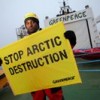
OP-ED: Drilling Deep Mistakes in the Arctic
Nuuk is a long way from my hometown of Durban, and the Arctic is a long way for an African to come to campaign about climate change. Yet, here I sit, in a jail cell, with my colleague Ulvar Arnkvaern, in the ‘Institution’, a prison in Greenland’s capital. I sit here for breaching an exclusion zone and climbing aboard a dangerous deep water drilling rig some 120 km off Greenland’s coast.Ecobreves – HONDURAS: Office Created to Administer Climate Funds
The government of Honduras has established a specialized unit to ensure transparency in the use of loans and donations earmarked for climate change initiatives, at the request of international financial institutions.Ecobreves – VENEZUELA: The Páramos Are Shrinking
The Andean páramo grasslands, located between 3,000 and 4,500 meters above sea level, are shrinking as the result of the expansion of agriculture and cattle farming and the demand for freshwater, leading to the loss of endemic flora and fauna.Ecobreves – BRAZIL: Consumers Less Concerned About the Environment
Despite the growing amount of information available on environmental issues, the Brazilian public’s willingness to adopt eco-friendly consumer behavior has declined in recent years, according to a survey by the Trade Federation of the State of Rio de Janeiro.
ICELAND: New Energy Stinks, And Worse
Public health authorities in Reykjavik have criticised plans for the expansion of the Hellisheidi geothermal power plant. They say that levels of the gas hydrogen sulphide could increase by 40 percent if a new geothermal field, Grauhnukur, is developed and nothing is done to ensure that the levels of the gas remain below maximum permitted levels.« Previous Page — Next Page »


Through our global network of local writers, we are continuing our award-winning coverage of global and local environmental challenges, with a focus on the people for whom the ecosphere matters in a direct way: rural dwellers who have little means to protect themselves against adverse conditions; communities that need to switch to sustainable development in order to survive; poor women and children, who are the most vulnerable in natural disasters. Sponsored by the United Nations Environment Program (UNEP), the United Nations Development Program (UNDP) and The World Bank (WB), IPS also maintains the award-winning Tierramérica, a specialised information service on environment and development.

The Week with IPS

Tracking global progress towards a sustainable world


