
Tuesday, November 17, 2026



News and Views from the Global South
Environment
COLOMBIA: Kidnapped in No Man’s Land
"Today we are launching the new campaign for demobilisation in Caguán. Planting seeds of hope against the terror of the FARC," Colombian Defence Minister Rodrigo Rivera recently wrote in his Twitter account.Tourism, Climate Change – Threats to Antarctic Wilderness
Too many tourists and too much climate change are the main concerns of environmental organisations and the governments of signatory countries of the Antarctic Treaty, which came into effect 50 years ago.
ZIMBABWE: Harvesting Water for Food Security
Earth mounds running across her field hold back the water that Caroline Ndlovu uses to grow maize, pumpkins, beans and watermelons long after the short rainy season in this arid part of Zimbabwe.
Mauritania Could Lose Its Capital City to the Sea
For the past five years, water has been seeping out of the ground beneath parts of Nouakchott, undermining foundations and transforming some areas of the Mauritanian capital into uninhabitable marshes.
DR CONGO: Water Shortages Grip the Capital
In recent months, no one in the Congolese capital has been spared the effects of water shortages. Where spending entire days criss-crossing Kinshasa in search of water with battered containers in hand was previously the unhappy task of women and children, now men in suits have joined the fray.Nuclear for the Poor, Renewables for the Rich?
In a debate about the future of energy, the global south wants to spend tens of billions of dollars on nuclear plants while the global north looks to spend hundreds of millions on decentralised, renewable energy.On the Road to Green Energy for All
Like our cave-dwelling ancestors of 200,000 years ago, nearly three billion people still use fire for cooking and heating. Of those, some 1.5 billion people have no access to electricity. For a billion more, their only access is to sporadic and unreliable electricity networks.
“Microfinance Can Help Rural Communities Adapt to Climate Change”
Projects to fight climate change are being designed all around the world. But only five percent of them can be financed with the current international funds available, which means resources have to be used more wisely. Microfinance could be one solution.MALAWI: Power Interconnection Project Costly but Needed
In Malawi’s administrative and commercial capitals, Lilongwe and Blantyre, two things are clear, especially at night: blackouts and the sound of generators in various workplaces.
Gender Indicators for Global Climate Funds Still an Afterthought
Of the millions of dollars spent on climate change projects in developing countries, little has been allocated in a way that will benefit women. Yet, in Africa, it is women who will be most affected by climate change.
Politicians Out of Sync With Public Sentiment on the Environment
While the vast majority of Brazilians place priority on environmental conservation, their elected leaders continue to focus on economic interests and short-term gains.
Whales: U.S. Replaces Japan in Role of Villain
In addition to the scientific whaling quotas defended by Japan, there are now demands for increased quotas for aboriginal subsistence whaling.Ecobreves – BRAZIL: Wind Power Potential Ignored by Government
Wind power is an abundant source of energy in Brazil, but it is not given priority in government plans, according to a study by the Institute of Electrotechnics and Energy at São Paulo University.Ecobreves – MEXICO: Mesoamerican Drylands Project Launched
Marginalized communities in four states in southern Mexico and the central Guatemalan department of Baja Verapaz will be involved in a project to improve natural resource management in areas with scant rainfall.Ecobreves – ARGENTINA: Schools in Mendoza to Teach Safe Handling of Pesticides
An Argentine government agency is carrying out a program to teach students in rural primary schools in the western province of Mendoza about the safe handling of pesticides.Ecobreves – HONDURAS: Climate Change Adaptation Projects in Indigenous Areas
Work will begin in July on four climate change adaptation projects in four primarily indigenous departments in Honduras.JAPAN: Workers Bear Brunt of Nuke Clean-up
Twenty-eight-year-old Yushi Sato washes cars for a living, but they are no ordinary cars. Every day, Sato hoses down vehicles contaminated with radiation from the Fukushima Nuclear Power plant that was damaged by the earthquake and tsunami that hit north-east Japan Mar 11.
INDIA: Human Barricade Stops India’s Big Ticket Steel Project
Fourteen-year-old Satikanta Sahu loves going to school, but these days, he would rather spend his time manning the barricade and facing down policemen in the sandy coastal village of Govindpur in India’s eastern state of Orissa.VENEZUELA: Ambitious Promises of Affordable Housing
"I want my own roof over my head, my own home. I don't want to live in a curtained-off cubicle surrounded by masses of people," says Elena Díaz, who does ironing for a living and lives in a temporary shelter in the centre of the Venezuelan capital.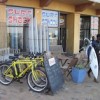
AFRICA: Bike-Share Systems Already Thrive
One winter morning in central Cape Town, despite the gale force wind and the threat of rain, Jacques Sibomana, who was going to be ‘up and down the city all day’, decided he’d rather cycle than brace against the wind on foot.BOLIVIA: Women Fight Superstition, Machismo in Mining Cooperatives
Hundreds of women belonging to mining cooperatives in Bolivia are striving for the right to mine seams of tin and silver in the country's western highlands, where an age old superstition maintains that the presence of women "scares away" the minerals.« Previous Page — Next Page »


Through our global network of local writers, we are continuing our award-winning coverage of global and local environmental challenges, with a focus on the people for whom the ecosphere matters in a direct way: rural dwellers who have little means to protect themselves against adverse conditions; communities that need to switch to sustainable development in order to survive; poor women and children, who are the most vulnerable in natural disasters. Sponsored by the United Nations Environment Program (UNEP), the United Nations Development Program (UNDP) and The World Bank (WB), IPS also maintains the award-winning Tierramérica, a specialised information service on environment and development.

The Week with IPS

Tracking global progress towards a sustainable world


