
Friday, November 20, 2026



News and Views from the Global South
Environment
ARGENTINA: Adding More Coal to the Fire
Bucking recommendations to build up renewable energy sources, Argentina is forging ahead with a plan that will increase its dependence on coal, regarded as the most polluting fossil fuel.
BIODIVERSITY: We Can Live Without Oil, But Not Without Flora and Fauna
The policies and deals that contributed to the massive oil spill under way in the Gulf of Mexico are also jeopardising the Earth's vital biological infrastructure, according to the Global Biodiversity Outlook 3, published Monday.Ecobreves – HONDURAS: Food Aid Arrives
The drought that affects some 150,000 people in six of the 18 departments in Honduras has led to stepping up aid with the support of the World Food Program, Lisandro Rosales, coordinator of the government's Permanent Contingency Committee, told Tierramérica.Ecobreves – VENEZUELA: Seeds to Restore Burned Forests
A government program for tree seedbeds, with community participation, began last week in Mochima National Park and the coast and islets of northern Venezuela.Ecobreves – CUBA: Simple Device to Economize Electricity
Cuba has begun producing devices made from clay to be placed in household electric ovens to help save energy, company officials from the factory in the coastal municipality of Gibara told Tierramérica.
We Can Live Without Oil, But Not Without Flora and Fauna
The latest global study on biodiversity outlines what could be "the sixth great extinction event of life on Earth" and predicts the tipping point of the Amazon rainforest's transformation into savanna.
Forced Eviction from Rio's Slums Echoes Dark Past
The tragic landslides this year in the steep hills of Rio de Janeiro brought to light an official plan to relocated impoverished neighborhoods - a move that experts criticize for failing to consult the residents affected, and for being authoritarian and ineffective.Ecobreves – BRAZIL: When the Internet Saves Energy
A new Internet-based control system developed in Brazil allows greater energy efficiency in public buildings, homes and machinery.ENVIRONMENT: Australia Backflips on Climate Action
Australian Prime Minister Kevin Rudd’s Labor Party has made much of its plans to tackle climate change even before it came to power with victory in the country’s 2007 election.
ASTRONOMY: Big Southern Eye in Search of Extraterrestrial Life
The construction of the world's largest telescope in the northern region of Antofagasta could make Chile an international leader in astronomy research and provide a launch pad for developing other scientific disciplines.
BIODIVERSITY: Odds Stacked Against San Harvesters of Devil’s Claw
Nguni Diyasen gently loosens the earth with a hoe and then widens the hole with her bare hands. Fifty centimetres down she uncovers the light brown root of a devil's claw. Used to treat arthritis and rheumatism, the plant also constitutes her only income.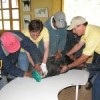
ECUADOR: Saving the Condor – A Mission Possible
Indiscriminate hunting and ecological changes in the Andean highlands have dramatically reduced the condor population in Ecuador. Experts say there are likely no more than 50 of these large birds of prey in this country. A century ago their numbers were in the thousands.MEXICO: Oil Spill Fuels Debate on Environmental Safety
The spreading oil spill in the Gulf of Mexico has highlighted the urgent need for stricter environmental rules and standards for deep sea oil rigs.MALI: Farmers Restore Forests
Villagers in the interior delta of the Niger River, already experiencing the harsh impacts of climate change, have a good understanding of the need to restore forests decimated by drought. Where forest cover has been rehabilitated, it is already reshaping the surrounding environment - and economy.Nuclear Power Nearly as Dangerous as Weapons, Critics Say
The quest for nuclear disarmament is likely to fail if governments and corporations continue to promote nuclear technologies as a solution to the world's energy needs, say independent experts.ENVIRONMENT: Small Islands Urge Action at UN Oceans Meet
Faced with rising sea levels, dying coral reefs and decreasing fish stocks, small island developing states (SIDS) are feeling the effects of ocean decline, and they want wealthier countries to do more to ensure the survival of the world’s seas and other waterways.ECUADOR: Native Groups Poised for Nationwide Protests Over Water Bill
Indigenous organisations in Ecuador opposed to a water reform bill that they say would give mining companies and agribusiness privileged access to water have threatened to extend their protests around the country in order to keep the legislature from passing the bill without certain modifications.
Q&A: World’s Fastest Cat on Its Ninth Life
Over the last century, 90 percent of the cheetah population in the world has been killed, and it is now the most endangered animal in Africa.
CLIMATE CHANGE: Colombian Forest Project Reaps Credits… and Criticism
The "Procuenca Initiative" in the Andes region of western Colombia may be the first in the world to sell certified forest carbon credits with a biodiversity protection component. But alarms are sounding about the potential negative social and environmental consequences.
Residents Hope 2010 Flooding Prompts Govt Action in Luanda
The water seeped into Feliciana Teresa Matia’s home from beneath its mud floor and when her 20-year-old son Francisco got up to go to work, grabbing a metal pole for guidance in the dark, he was electrocuted.POLITICS: East Timor-Australia Urged to Dialogue Over Gas Fields
The prickly issue of where to pipe and process gas from the Timor Sea between Australia and East Timor must be resolved through open dialogue, say members of civil society in East Timor.« Previous Page — Next Page »


Through our global network of local writers, we are continuing our award-winning coverage of global and local environmental challenges, with a focus on the people for whom the ecosphere matters in a direct way: rural dwellers who have little means to protect themselves against adverse conditions; communities that need to switch to sustainable development in order to survive; poor women and children, who are the most vulnerable in natural disasters. Sponsored by the United Nations Environment Program (UNEP), the United Nations Development Program (UNDP) and The World Bank (WB), IPS also maintains the award-winning Tierramérica, a specialised information service on environment and development.

The Week with IPS

Tracking global progress towards a sustainable world


