Languages
Saturday, November 21, 2026



News and Views from the Global South
Global Geopolitics
POLITICS: U.N. Session Marked by Highs and Lows
The two-week long high-level segment of the U.N. General Assembly, which concluded last week, was characterised by historic moments, political controversies, and at times, routine boredom.BRAZIL: Olympics in Rio – ‘Happiness’ Trumps Wealth and Technology
Brazil has "the happiest and most creative" people in the world, and deserved this opportunity, Brazilian President Luiz Inacio Lula da Silva said in Copenhagen, celebrating Friday's election of Rio de Janeiro as the host of the 2016 Olympic Games.IRAN: Non-Western Big Powers Enjoy Growing Influence
Thursday's seven-party talks in Geneva on Iran's nuclear programme resulted in a breakthrough agreement on Russian enrichment of materials Tehran needs for nuclear-medical work.POLITICS: New Doubt Cast on U.S. Claim Qom Plant is Illicit
An Iranian assertion that construction on its second enrichment facility began only last year and further analysis of satellite photos of the site have cast fresh doubts on the Barack Obama administration's charge that the construction of the plant near Qom involved a covert decision to violate Iran's obligations to report immediately to the International Atomic Energy Agency (IAEA) on any decision to build a new facility.ECONOMY: ‘Too Early To Declare Success’
The official opening of the annual meetings of the World Bank and the International Monetary Fund (IMF) is scheduled for Oct. 6, but political activities and tension have already taken control of the daily life of Istanbul.CLIMATE CHANGE: Food Supply Hangs in the Balance
Rocketing food prices and hundreds of millions more starving people will be part of humanity's grim future without concerted action on climate change and new investments in agriculture, experts reported this week.RIGHTS: Security Council Backs Advocate for Women in War Zones
The U.N. Security Council Wednesday called on Secretary-General Ban Ki-moon to appoint a special representative to intensify efforts to end sexual violence against women and children in conflict situations.HEALTH: “Patent Pool” Could Ease HIV Drug Prices
Pharmaceutical giants like Pfizer and GlaxoSmithKline hold the future welfare of poor people living with HIV/AIDS in their hands, argues the humanitarian group Doctors Without Borders, which is urging the companies to release their patents on specific HIV drugs into a collective pool that will increase access and affordability to treatment in developing countries.RIGHTS: Women’s Groups Take on Laws Based on Sex
When a landmark U.N. conference on women adopted a "platform for action" in Beijing in 1995, member states were urged to commit themselves to revoke all existing laws in their statute books that discriminate on the basis of sex.ENVIRONMENT: Synergies in Fight Against Desertification , Climate Change
Climate change aggravates soil degradation, but sustainable use of land resources can, in turn, mitigate global warming, according to participants at the United Nations conference on desertification in the Argentine capital.
Q&A: “Latin America Faces a Tough Balancing Act”
Chile is leading the way towards the Millennium Development Goals (MDGs), while Honduras is seriously lagging behind, says Alicia Bárcena, executive secretary of the Economic Commission for Latin America and the Caribbean (ECLAC).ENVIRONMENT: Could Food Shortages Bring Down Civilisation?
In early 2008, Saudi Arabia announced that, after being self-sufficient in wheat for over 20 years, the non-replenishable aquifer it had been pumping for irrigation was largely depleted.POLITICS: U.S. Story on Iran Nuke Facility Doesn’t Add Up
The story line that dominated media coverage of the second Iranian uranium enrichment facility last week was the official assertion that U.S. intelligence had caught Iran trying to conceal a "secret" nuclear facility.POLITICS: U.N. Chief Weighs in on Iran, Libya and Afghanistan
Addressing his monthly press conference Tuesday, Secretary-General Ban Ki-moon refused to back a Western endorsement of a premature election victory for Afghan President Hamid Karzai, implicitly criticised Libyan Leader Muammar el-Qaddafi for denigrating the U.N. charter, and faulted Iran for lack of transparency in its nuclear programme.EASTERN EUROPE: Fair Trade Takes Off
Fair trade is becoming popular in Central and Eastern Europe, as activist groups raise awareness of the region's responsibility towards the rest of the world, and open an increasing number of fair trade shops and cafes.
Q&A: 'Closer Now to a Nuke-Free World'
A world free of nuclear weapons is no longer utopia - it is a concrete possibility, says Daisaku Ikeda, president of the Buddhist association Soka Gokkai International (SGI).FINANCE: World Bank Head Acknowledges Shifting Global Order
The world economic crisis has called attention to shifting international power structures as emerging economies gain more influence and the failure of globalisation to assist the poorest countries becomes clear, said World Bank President Robert B. Zoellick in anticipation of the bank's annual meeting in Istanbul, Turkey next week.POLITICS-CHINA: Coming Soon: A Stage-Managed 60th Anniversary Bash
When it comes to pageantry, China’s communist leaders leave little to chance. This October, which marks six decades of their rule over the Middle Kingdom, mass events and grand spectacles would have needed little choreography to elicit a joyous mood.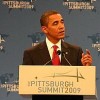
G20: Leaders Agree on Reforms, Poor Still "Out in the Cold"
World leaders at the two-day G20 Summit in the U.S. city of Pittsburgh agreed to work cooperatively to recover from the global economic crisis and create structural reforms with long-term growth as the goal.IRAN: New Nuke Charges Raise Stakes in Upcoming Talks
Charges by U.S. President Barack Obama and the leaders of France and Britain Friday that Iran is building a secret underground plant to enrich uranium appear certain to heighten tensions just days before critical talks between Tehran and its three accusers, as well as Germany, China and Russia.
G20: Rising Above the G8
Something that was perhaps only half-expected has happened in Pittsburgh: the G20 has moved on from being an event to becoming an institution.« Previous Page — Next Page »


Is the world dominated by three great empires -- the U.S.A, China and the European Union? How much power do the great behemoths of the south -- India, Brazil, and South Africa -- wield? And where does Russia fit in that equation? Are we in the middle of a new Cold War? What are the implications of the armed conflict with Georgia? What about the new axis: Venezuela-Russia? And what role does Turkey play? What about issues like Climate Change and other global forces like the food crisis and the high energy prices? How is all this reshaping the world's forces? IPS looks for some answers.

The Week with IPS

NEXT STOP - SDGs
Tracking global progress towards a sustainable world
Tracking global progress towards a sustainable world
