Languages
Friday, October 9, 2026



News and Views from the Global South
Global Geopolitics

African Brain Drain: Is There an Alternative?
“Brain drain is particularly acute in sub-Saharan Africa,” says the World Economic Outlook (October 2016), a report published by the International Monetary Fund (IMF). “The migration of young and educated workers takes a large toll on a region whose human capital is already scarce. The concentration of migrants among those who are educated is higher than in other developing economies.
Vision 2030 & the Political Costs of Saudi Reforms – Part 2
A pillar of the Saudi social contract has been the allocation of oil rents to the population in exchange for loyalty and fidelity to the Saud clan. A key weakness of Vision 2030 is its lack of focus on the potential political consequences of economic reforms. The plan seems to assume that its ramifications will be easily borne by the Saudi population.
The United States: Innovation and Immobility
It is the country of paradox, based on the double column of creativity and tradition. Americans are unable to escape the twin submission to the adamnism of being the first and the last to accept that the rest of the planet can be more original and may outrank them in any field.
Geopolitical Tug of War Between India and China for the Indian Ocean, in Case of China’s One Belt, One Road Initiative Is Implemented”
Nevertheless, with globalization the economic and political concentration is shift from Western to Eastern countries and as a result, Indian Ocean & its significance has rapidly increased by becoming world’s busiest waterways. Moreover, India has been the ‘heart’ of trade in Indian Ocean famous for its aromatic species but China has been considered as the ‘brain’ of trade in Indian Ocean as a leader of initiating famous ‘Silk route’ to export its rich silk to Mediterranean and establishing trade.
Will Vision 2030 Usher the New Kingdom of Saud? – Part 1
The Kingdom of Saudi Arabia is undergoing a process of change in its social, economic, and political structures unseen since its founding in 1932. Crown Prince Mohammed Bin Salman and a group of close advisors, aided by an army of multinational consultants and investment bankers, have been driving this transformation.
Boycott, Divest & Sanctions Campaign Not Anti-Israel but Pro-Palestinian, Says Norwegian MP
When Norwegian parliamentarian Bjørnar Moxnes recently nominated the BDS movement for the 2018 Nobel Peace Prize, the leader of Norway’s Red Party faced the inevitable: a furious backlash from pro-Israeli and anti-Palestinian groups.
Pyeongchang Olympics: A New Cornerstone for Peace and Prosperity
All eyes are on the 23rd Olympic Winter Games and 12th Paralympic Winter Games in PyeongChang this February. Top athletes will carry their national flags in an opening ceremony which has come to epitomize the international community. Sports fans worldwide eagerly await the Olympics, and this time there is cause for cautious optimism that sport diplomacy may lower tensions on the Korean Peninsula itself. Leaders, diplomats and citizens from the world over will witness North and South Korean athletes walking side by side. For this, there could be few better places than PyeongChang, which means peace (Pyeong) and prosperity (Chang): goals integral to the mission of the United Nations and the 2030 Sustainable Development Agenda.
BDS Movement for Palestinian Rights Nominated for Nobel Peace Prize
As a member of the Norwegian parliament, I proudly use my authority as an elected official to nominate the Boycott, Divestment and Sanctions (BDS) movement for Palestinian rights for the Nobel Peace Prize.
US, Led by an Erratic Trump, Seeks to Undermine UN
The continued erratic and outrageous comments by President Donald Trump – and his attempts to undermine the United Nations – are threatening to cause irreparable damage to the world body.
Pakistan, Facing Military Aid Cuts, One Step Ahead of US
When the United States abruptly cuts off military supplies to its allies for political or other reasons, the reaction has been predictable: it drive these countries into the arms of the Chinese, the Russians and Western European weapons suppliers.
The Reality of North Korea as a Nuclear Power
With a track record of six underground nuclear tests between 2006 and 2017, North Korea is desperately yearning to be recognized as the world’s ninth nuclear power – trailing behind the US, UK, France, China, Russia, India, Pakistan and Israel.
US Faces Collective Defiance at UN Over Jerusalem
When the UN General Assembly condemned the United States for its decision to recognize Jerusalem as the capital of Israel, the vote was described as a “collective defiance” of the international community against public threats against the United Nations and its member states by a politically unpredictable and predictably wavering US President.
Goodbye to 2017, a Trump-dominated Year
In 2017, Donald Trump dominated the year by using US clout to change many aspects of global relations, and not for the better.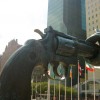
Arming Poor Countries Enriches Rich Countries
Although the Cold War came to an end over a quarter century ago, international arms sales only declined temporarily at the end of the last century. Instead, the United States under President Trump is extending its arms superiority over the rest of the world.
Should Foxes Rule the Chicken Coop? Reflections on Security Council Reform
Since the end of the Cold War, the UN Security Council has dramatically increased its activity and authority. Though the Council has exercised unprecedented global power, it has remained a very insular, secretive and undemocratic body, dominated by its five Permanent Members, armed with their notorious vetoes and benefiting from perpetuity in office.
Trump-Mideast: Much More than a ‘Kiss of Death’ to Palestinians
US President Donald Trump’s decision to recognise Jerusalem as Israel’s capital does not represent only a ‘kiss of death’ to the two-State solution, but also a strong blow in the face of 57 Muslim countries, let alone igniting fire in this easily inflammable region, providing more false arguments to criminal terrorist groups to escalate their brutal attacks, in addition to taking a step further in Washington’s new conflict with Iran and the ‘restructuring’ of the Middle East.
Post-Nuclear Nightmares Still Linger Over Pacific Islands
The Pacific islands have long remained victims of nuclear crimes – but the perpetrators, three of the world’s major powers with permanent seats in the UN Security Council, never paid for their deadly sins.
First Use of Nuclear Weapons Would be Counterproductive
Over the past year, cavalier and reckless statements from President Donald Trump about nuclear weapons and his threat to unleash “fire and fury” against North Korea have heightened fears about Cold War-era policies and procedures that put the authority to launch nuclear weapons in his hands alone.
Cuban Immigration in the Eye of the Storm
Cuban migration to the United States is the great loser under Donald Trump's hostile policy toward Cuba, and creates additional difficulties for citizens of this Caribbean island nation who were accustomed to benefits that their neighbors in the rest of Latin America never enjoyed.
Russian & US Vetoes Protect Client States
The vote on the latest American-sponsored resolution in the UN Security Council (UNSC) on Syria was predictable: of the five big powers, China abstained and Russia vetoed, while the US, UK and France voted for it.
Austrian Elections: The Crisis of Europe Continues
The Austrian elections show clearly that media have given up on contextualising events. To do that, calls for a warning about Europe’s future, as a vehicle of European values is required. Europe has been weakened by all the recent elections, with the notable exception of France. Common to all, France included, were some clear trends, that we will hastily, and therefore maybe imperfectly, examine.« Previous Page — Next Page »





Is the world dominated by three great empires -- the U.S.A, China and the European Union? How much power do the great behemoths of the south -- India, Brazil, and South Africa -- wield? And where does Russia fit in that equation? Are we in the middle of a new Cold War? What are the implications of the armed conflict with Georgia? What about the new axis: Venezuela-Russia? And what role does Turkey play? What about issues like Climate Change and other global forces like the food crisis and the high energy prices? How is all this reshaping the world's forces? IPS looks for some answers.

The Week with IPS

NEXT STOP - SDGs
Tracking global progress towards a sustainable world
Tracking global progress towards a sustainable world
