Languages
Thursday, October 15, 2026



News and Views from the Global South
Aid

Grenada to Launch USD42m Water Resiliency Project
Water-scarce Grenadians will soon get some relief through a Green Climate Fund-approved project to be launched next year that will make Grenada’s water sector more resilient to the impacts of climate change.
‘A Turtle is Worth More Alive Than Dead’
On the north-eastern shores of Trinidad and Tobago, on the shoreline of Matura, more than 10,000 leatherback turtles climb the beaches to nest each year. But there the local community is keenly area of one thing: ‘a turtle alive is worth more than a turtle dead.”
Earth’s Biodiversity: A Pivotal Meeting at a Pivotal Time
The quality of the air we breathe, the food we eat and the water we drink depend directly on the state of our biodiversity, which is now in severe jeopardy. We need a transformational change in our relationship with nature to ensure the sustainable future we want for ourselves and our children.
Q&A: All Sustainable Development Goals Relate in Some Way to the Oceans
When Peter Thomson, the United Nation’s Secretary General’s Special Envoy for the Ocean, heard in 2010 there was going to be a 2030 Sustainable Development Agenda, he knew he had to include the ocean question.
Creating Beauty and Worth from Bamboo Enhances the Livelihoods of Ghana’s Artisans
Yaw Owiredu Mintah from Ghana has been working as an all-round processor of bamboo and rattan since the 1980s. And while he says that he can do most things with bamboo like weaving, framing and finishing, he admits, “I need to improve my skills and designs because all of us are, most of the time, doing the same things.”
North African Countries Need to Protect Their Economies From Illicit Trade
Since the 2011 revolution, Tunisia has been heralded as a model of democratic transition. However, nine governments in the past seven years have been struggling to revive the economy and the North African state faces the difficult task of maintaining faith in democracy amid a lagging economy, rising security challenges, and widespread corruption.
Why It is Vital for Everyone to Eat Organic
 "Organic is the only living solution to climate change," says Vandana Shiva, food and agriculture expert and member of the World Future Council (WFC). Nowadays, favouring the scale up of agroecology – which includes producing organic products – is unfortunately not that simple.
Q&A: Creating a Safe Space for Survivors of Sexual Exploitation in the Aid Sector
How to prevent and respond to sexual exploitation, abuse and harassment in the aid sector is a question that has come to the forefront in the past year as allegations have been made against various global organisations, including the United Nations.
Africa’s Bumpy Road to Sustainable Energy
For years, Kenyans freely used and disposed of plastic bags. The bags were ubiquitous—in the markets, in the gutters and in the guts out of 3 out of every 10 animals taken to slaughter.
With Poor Human Rights Record, Repatriation Not Possible
Policies that allow for impunity, genocide, and apartheid are “intolerable” and make repatriation of Rohingya refugees impossible, say United Nations investigators.
The value of a health scheme
The challenges for the success of Ayushman Bharat are more than just at the financial and infrastructural level On September 24, the government launched the grand government-funded healthcare scheme, the Ayushman Bharat-Pradhan Mantri Jan Arogya Yojana (PMJAY). While some see its ambitious goals as its main strength, others are sceptical given the inadequate funding for the scheme, the weak infrastructure of primary health care centres, and the time required for the goals to be accomplished. However, nobody disputes the imperative of an insurance scheme as vast as the PMJAY, since every year about 36 million families, or 14% of households, face a medical bill that is equal to the entire annual living expenses of one member of the family. This frequently pushes many families into penury.

Rich in Agriculture, Madagascar Suffers from Extreme Malnutrition
As much as 80 percent of Madagascar’s population of 24 million people is involved in agriculture and the country’s economy largely depends on the sector, yet 48 percent of households are faced with food insecurity according to the National Nutrition Office (NNO). Over 70 percent of households live below the national poverty line of 535,603 Malagasy ariary per year (1 U.S. dollar equals 3,447.50 ariary).
Solar Power Lights up the World’s Fastest-Growing Refugee Camp
Solar energy has long powered homes, businesses and portable electronics. Now, it’s powering a field hospital in the middle of the world’s fastest-growing refugee camp.
Africa Remains Resolute Heading to COP 24
In December 2015, nations of the world took a giant step to combat climate change through the landmark Paris Agreement. But African experts who met in Nairobi, Kenya at last week’s Seventh Conference on Climate Change and Development in Africa (CCDA VII) say the rise of far-right wing and nationalist movements in the West are threatening the collapse of the agreement.
For the Survival of the Nile and its People
Running through eleven countries for 6,853 kilometres, the Nile is a lifeline for nearly half a billion people. But the river itself has been a source of tension and even conflict for countries and territories that lie along it and there have been rumours of “possible war for the Nile” for years now. While to date there has been no outbreak of irreversible tension, experts say that because of increasing changes in the climate a shared agreement needs to be reached on the redistribution of water soon.
Q&A: Using Data to Predict Internal Displacement Trends
This year the Internal Displacement Monitoring Centre (IDMC) noted that 2017 saw the highest number of displacements associated with conflict in a decade-11.8 million people. But this is not a situation that is going to be resolved any time soon, says the organisation which has been reporting on displacements since 1998.
A New IFC Vision for Greening Banks in Emerging Markets
The International Finance Corporation is rapidly greening its portfolio. This past fiscal year, 36 percent of our own accounts and mobilization supported climate-smart projects — up from 12 percent a decade ago. Since May, we have been applying a carbon price to all project finance investments in the cement, chemicals, and thermal power sectors, at $40-80 per metric ton.
Rural Migration: An Opportunity, Not A Challenge
While it can be a challenging issue, migration must be seen as an opportunity and be met with sound, coherent policies that neither stem nor promote the phenomenon.
Indonesia Unveils Low Carbon Development Framework
Indonesia is convinced that low carbon development and a green economy are key to further boosting economic growth without sacrificing environmental sustainability and social inclusivity.
Kenyan Women Turning the Tables on Traditional Banking and Land Ownership
It was less than eight months ago that Mary Auma and her three children, from Ahero in Kenya’s Nyanza region, were living in a one-room house in an informal settlement. Ahero is largely agricultural and each day Auma would go and purchase large quantities of milk and resell it – earning only a 10 percent profit.
Women as Influencers
 The Migrants as Messengers awareness-raising campaign (MaM), developed by the International Organization for Migration (IOM), uses innovative mobile technology to empower migrants to share their experiences and to provide a platform for others to do the same.
 « Previous Page — Next Page »





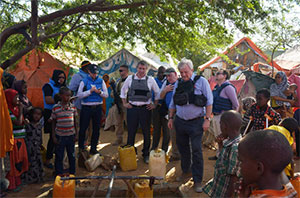 UN Emergency Relief Coordinator Visits Somalia. Credit: UN Photo/Tobin Jones
In recent years, conflicts have broken out across the world with no sign of slowing down or stopping. In times like this, millions of people globally are in dire need of humanitarian aid. Famine, warfare, natural disasters, and economic decline plague a host of nations, including Palestine, Sudan, Chad, Lebanon, and Haiti, to name a few. Humanitarian aid provides millions of people with critical services including healthcare, food, clean drinking water, psychosocial support, housing, and access to education. UN agencies such as the UNDP, UNICEF, the World Food Programme (WFP), UNHCR, UNRWA, and UNEP work with the UN Office for the Coordination of Humanitarian Aid (OCHA) and local organizations to come up with the best possible strategies to support affected communities. At the same time, humanitarian aid and those working on the frontlines are consistently threatened by both actors directly involved in conflict as well as those who are meant to contribute to the international humanitarian regime at large. The near-collapse of United States international aid structures in 2025, including the termination of 83% of USAID’s 6,300 global initiatives, has left millions of people without access to vital humanitarian assistance. 98 million people in 2025, only 65% of people targeted for humanitarian assistance, received the help they needed. In contrast, 123 million people received some form of humanitarian assistance in 2024, and OCHA’s 2026 Global Humanitarian Overview estimates that 239 million people are in need of assistance in 2026. IPS is well-positioned to discuss current initiatives to provide aid and relief through in-depth reporting and opinion content.

The Week with IPS

NEXT STOP - SDGs
Tracking global progress towards a sustainable world
Tracking global progress towards a sustainable world
