Languages
Saturday, November 7, 2026



News and Views from the Global South
Armed Conflicts

US has Provided Over 130 Billion Dollars in Aid & Weapons to Israel– the Largest Ever
As one of America’s closest allies, Israel has remained heavily dependent on the US —politically, economically, and militarily—since its creation in 1948. US arms supplies, mostly provided gratis, are channeled via US Foreign Military Financing (FMF), Military Assistance Program (MAP) and Excess Defense Articles (EDA).
The Carnage in Gaza: Here Are Steps to Rein In
The reason I wanted to speak to you was to outline something very specific about Gaza, of course, which is about the approach being taken and planned by the United Nations and other humanitarian agencies to provide aid to Gaza.
Deaths in the Israel-Hamas Conflict
Tragically, the numbers of deaths of men, women and children in Israel and the Gaza Strip have surged to unprecedented levels following the Hamas attack on Israel on 7 October 2023.
What Is Israel’s End-Game in Gaza?
Unless Israel establishes an exit strategy and an end-game that will lead to a solution to the Israeli-Palestinian conflict in full coordination with the US and Saudi Arabia, the war against Hamas will only be another brutal violent episode that will prepare the ground for the next conflagration that will engulf the West Bank and potentially set the entire region on fire.
‘Taking Palestine Back to 2005’ — UN Warns of Socioeconomic Impacts of Gaza War
One month into the war in Gaza, Palestine has already seen major setbacks in development that will have severe ramifications for the people of Palestine that will impact any future efforts toward its economic recovery.
Israel’s Military Is Part of the U.S. War Machine
The governments of Israel and the United States are now in disagreement over how many Palestinian civilians it’s okay to kill. Last week -- as the death toll from massive Israeli bombardment of Gaza neared 10,000 people, including several thousand children -- top U.S. officials began to worry about the rising horrified outcry at home and abroad. So, they went public with muted misgivings and calls for a “humanitarian pause.” But Israel’s Prime Minister Benjamin Netanyahu made clear that he would have none of it.
Arms Suppliers to Israel & Hamas Should Face War Crime Charges—But Will They?
The killings of thousands of civilians in the ongoing Middle East conflict are largely the result of an uneven battle—a nuclear-armed Israel, equipped with some of the most sophisticated American weapons systems, fighting a rag-tag militant group, Hamas.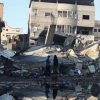
Where Do We Go Once the Israel-Hamas War Ends? – PART II
There are five measures the Israeli government, along with the US and Saudi Arabia, should put in place to move the peace process forward. First, Israel must limit its ground invasion to northern Gaza, as a large-scale war will inevitably inflict massive destruction and thousands of casualties on both sides, especially Palestinian civilians, and put the lives of the hostages at a much greater risk.
Where Do We Go Once the Israel-Hamas War Ends? – Part I
Since the 1967 Six Day War, many efforts have been made to reach a peace agreement between Israel and the Palestinians through mediation conducted by an impartial mediator, face-to face negotiations, international conferences, offering incentives, back-channel talks, interim agreements (in particular the Oslo Accords), and occasionally by an influential party exerting pressure on both sides, especially the US.
Gaza Spells Jungle
During her 2013 visit to Sri Lanka, then UN Human Rights Commissioner Navi Pillay wanted to lay a wreath to commemorate the war-dead. "When I go to a country, I like to honour the victims, all victims, victims of LTTE, soldiers, families,” she explained.
The Killings in Gaza Should Stain Our Moral Conscience
Thank you for your presence here with us in New York, and for the special dedication that Brazil has given to peace in our region. I also pay special tribute to our briefers, and to their teams’ dedicated work in the most unimaginable circumstances on the ground in the Gaza Strip.
Can Creativity Change the World?
It all fits into an off-road vehicle that can reach even the most remote parts of Southern Africa to bring cinema where the essentials are lacking, where there's no electricity to power a projector, and where perhaps no one has ever sat in front of a screen to watch a movie. With just the sun and a solar panel, a theater can be set up in areas where people struggle to access food and water and make a decent living. But what it truly requires is the courage to not view creativity as a luxury. Sydelle and Rowand, the founders of Sunshine Cinema, a network of mobile movie theaters, are not just entertaining people; they are crossing a bridge.
Biden Is a Genocide Denier and “Enabler in Chief” for Israel’s Ongoing War Crimes
For three weeks, President Biden has played a key role in backing Israel’s war crimes while touting himself as a compassionate advocate of restraint. That pretense is lethal nonsense as Israel persists with mass killing of civilians in Gaza.
Women and War
In 1968, the tobacco company Philip Morris introduced a new cigarette brand called Virginia Slims. Under the slogan “You’ve come a long way, baby” it was exclusively marketed to women. The advertising campaign exploited the civil rights movements of the 1960s, indicating that those cigarettes were enjoyed by strong, independent, and liberated women. A blatant lie – why would “independent” women choose to poison themselves with a commodity which each year causes more than 480,000 deaths in the US alone – nearly one in five deaths? Another question arising from this deceitful ad is: “How far have women come on their way to independence and liberation?”
Violent Conflict in Sudan Has Impacted on Nearly Every Aspect of Women’s Lives
I had the privilege to speak at the UN Security Council open debate last week on Women, Peace, and Security (WPS), an important opportunity to reflect on the urgency of this work and why women’s rights must be central to addressing any conflict or crisis.
A World, Mostly Dominated by Men, in Turmoil
This year – 2023 - started with a commemoration of one year of war in, and on Ukraine, which has dramatically impacted the price of basic needs for the world’s populations in every corner of the world. It is an ongoing calamity for a world already living its worst collective food, public health and conflict-based insecurities.
What is Happening in Gaza is “Inhumane, illegal, and Unacceptable”
Last August, 91 UN member states, “in a demonstration of solidarity and commitment”, signed a U.S.-Led Joint Communiqué condemning the Use of Food as a Weapon of War. Roughly 345 million people – in 79 countries – face acute food insecurity, often caused or exacerbated by armed conflicts, the US said, pointing out that the joint communiqué was born out of the United States’ resolve to once again use its UN Security Council presidency to draw attention to conflict-induced food insecurity.
A Tug of War and Peace in Yemen
For the first time since the beginning of a war that claimed the lives of over 220,000 people, a senior Houthi delegation travelled from Yemen to Saudi Arabia’s capital Riyadh in mid-September.
The Hamas-Israel Conflict
The world and the Middle East do not need another violent conflict. This is a region that has experienced far too much violence over the years. Hamas’ desperate attacks on innocent civilians was intended to provoke an Israeli overreaction that would, among other things, jeopardise Israeli diplomatic negotiations with the Gulf States and Saudi Arabia and create generalised anxiety within Israel. It was also aimed at demonstrating Hamas’ military capacity and vengeance for years of a humiliating blockade of Gaza. Kidnapping Israeli civilians was callous and brutal but part of a plan to use hostages as bargaining chips around the release of Palestinian prisoners in Israel.
The Palestinians Subject to 56 Years of Suffocating Occupation
The situation in the Middle East is growing more dire by the hour. The war in Gaza is raging and risks spiralling throughout the region. Divisions are splintering societies. Tensions threaten to boil over. At a crucial moment like this, it is vital to be clear on principles -- starting with the fundamental principle of respecting and protecting civilians.
The Power of Humanity
Today, as we commemorate United Nations Day, more than 224 million children and adolescents are in need of quality education, and the hope, protection and opportunity it provides. Their numbers are increasing by the day. From Afghanistan and Sudan to Ukraine; from South Sudan, Latin America and across sub-Saharan Africa; and in Gaza, where 50% of the total population of 2.2 million are children under siege.« Previous Page — Next Page »





Armed conflicts are a sad constant on daily front pages worldwide. Wars, civil wars, revolts, coups, genocides, ethnic and political violence, and global terrorism capture our attention for the geopolitical landslides, human suffering, food crises and streams of migration that follow in their wake. As in times of natural disaster, man-made crises claim frequent casualties among the poor, women and children. IPS examines emerging and ongoing armed conflicts around the world with an eye on the underlying social and political dynamics, and special focus on the lived experiences of those most affected by armed conflict.

The Week with IPS

NEXT STOP - SDGs
Tracking global progress towards a sustainable world
Tracking global progress towards a sustainable world
