
Sunday, October 11, 2026



News and Views from the Global South
Climate Change
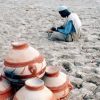
Floods and Droughts are Two Sides of the Same Crisis
Water emergencies are deeply personal to us. Coming from Southeast Asia and southern Africa—two regions that struggle with water challenges—we have witnessed firsthand how water defines the fate of communities and nations.
Global Community in Busan to Define Sustainable Future for Life Under Water
“As the son of a haenyeo, a traditional Korean female diver, I grew up by the sea, often watching the ocean with my mother. Captivated by the beauty and majesty of the sea, I chose to study marine science and have devoted my entire career to the ocean,” said Do-hyung Kang, Minister of the Ministry of Oceans and Fisheries of the Republic of Korea.
Korea’s Troubled Waters: Traditional Women Divers Protecting an Ocean in Crisis
Ahead of the 10th Our Ocean Conference, with the theme "Our Ocean, Our Action," comes a global call to protect the world's oceans.
Rampant Tourism, Climate Change Threatens Varkala’s Unique Geodiversity
From the top of the cliff, the beach down below appears like a box of sand, with people scattered on it like tiny ants. This is Varkala, arguably the most sought-after coastal tourism spot in Kerala, India, right now. The Varkala cliff—spanning across Edava Cliff, North Cliff, and South Cliff—is 7.5 km long and has a maximum height of 40 m. Religious rituals take place at the part of Papanasam beach that divides the North and South Cliffs.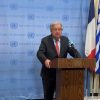
UN Chief, Brazil Gather World Leaders to Reaffirm Commitments Paris Agreement
UN Secretary-General António Guterres and President Lula da Silva of Brazil on Wednesday, April 23, held a closed-door meeting with heads of state to discuss strengthening global efforts against the climate crisis and to ensure a just energy transition.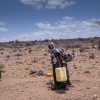
Climate Groups Report 2025 Is Unlikely To Be Hotter Than 2024
On March 19, the World Meteorological Organization (WMO) and the Copernicus Climate Change Service (C3S) issued a report on the State of Global Climate in 2024, detailing the numerous heightened natural disasters that were a consequence of human-induced climate change. With the past three years having been recorded as the three hottest years in human history, climate scientists are optimistic that 2025 will see slightly cooler global temperatures.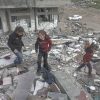
Children at the Center
Creativity and innovation are essential to finding extraordinary solutions to abnormal problems. Now more than ever we must continue finding creative solutions to protect the world’s most vulnerable children from the excruciating pain of war, dispossession and destruction of their last hope: a quality education. The current humanitarian and development funding levels are falling. However, with creativity we can prevent further deterioration and instead turn towards an upward direction.
Smallholder Farmers Are Not ‘Beneficiaries’, but the ‘Co-Creators of Change’
Eliud Rugut comes from generations of farmers, yet his family expected him to move out of their home and pursue another career.
The ‘Plastic Man’: Turning Trash into Treasure
In a quiet corner of Medina Gounass, on the outskirts of Dakar, Senegal, one man has taken it upon himself to breathe new life into a place many had abandoned.
Standing Firm: Civil Society at the Forefront of the Climate Resistance
The recent US court case that ordered three Greenpeace organisations to pay damages of over US$660 million to an oil and gas company was a stunning blow against civil society’s efforts to stop runaway climate change and environmental degradation. The verdict, following a trial independent witnesses assessed to be grossly unfair, came in reaction to Indigenous-led anti-pipeline protests. It’s vital for any prospects of tackling the climate crisis that Greenpeace’s appeal succeeds, because without civil society pressure, there’s simply no hope of governments and corporations taking the action required.
Europe Is Now the Fastest Warming Continent—Report
It is now official that the European continent is experiencing the fastest rate of global warming, according to a new scientific report released by Europe’s Copernicus Climate Change Service and the World Meteorological Organization (WMO). Last year record temperatures, heatwaves, and floods unleashed a massive toll on infrastructure, cities, economies, and people’s lives and livelihoods in the region.
Want To Fix the World, Ubuntu (Humanity to Others) Can Help
The world needs an urgent fix and humanity could just be it.
Reflections on CGIAR’s Week-Long Discussions on Food System Science
More than 13,600 participants from around the world registered for the inaugural CGIAR Science Week at the UN Complex, Nairobi, April 7-12, 2025. Dr. Ismahane Elouafi, the organization’s Executive Managing Director, said, “This is a testament that people are thirsty for science and for good news.”
How to Put the ‘Sexy’ Back into Agriculture – Thoughts From CGIAR Science Week
This week presented a beacon of hope for young people so that the “girl from the South and the boy, of course” could stay in the developing world, Dr Ismahane Elouafi, Executive Managing Director of CGIAR, said during a press conference on the final day of the CGIAR Science Week.
Insight to Impact: CGIAR Inaugural Flagship Report for Decision Makers Navigating Food System Science
"To have impact, it was crucial to understand what impact was wanted," CGIAR's Executive Managing Director Dr. Ismahane Elouafi said at the launch of the organization's flagship report, Insight to Impact: A decision-maker’s guide to navigating food system science.
Rohingya Refugees Are Not Safe in Bangladesh or Myanmar
On April 4, it was confirmed by Myanmar authorities that there were approximately 180,000 Rohingya refugees residing in Bangladesh that are eligible to return. Following numerous cuts in funding as a result of President Donald Trump’s reduction of USAID, as well as the increasingly volatile humanitarian crisis in Myanmar, it is uncertain if repatriation will best serve Rohingya refugee communities.
Strengthening One Health Approach in Agriculture Requires Cross-Sectoral Partnerships, Information
Increasingly, experts in the global health and agricultural sectors are finding the One Health approach effective for identifying and addressing health concerns that can influence facets of health. Implementing this approach worldwide will require partnerships across different sectors.
‘Act Before It Gets Worse’ – Experts Warn as Agrifood Problems in Global South Intensify
As agrifood systems in the Global South buckle under the weight of climate change, biodiversity, and even pollution, experts such as Dr. Himanshu Pathak call for urgent innovative solutions, as, at the current pace, the problems of the Global South are going to intensify with escalating climate change.
‘With Science, We Can Feed the World of 9.7 Billion by 2050′
Animal scientist Lindiwe Majele Sibanda became what her grandmother earnestly prayed for when she was growing up on a farm in southern Zimbabwe.
Lessons from the Global South on Transforming AgriFood Systems
The state of food and nutrition security in the Global South masks the great strides and investments made to increase agricultural yields to feed a rapidly growing population. As discussions deepen at the ongoing CGIAR Science Week, plenary discussions on Wednesday (April 9) explored transformative strategies and innovations driving agricultural resilience across Africa, the Caribbean, and Latin America.
Partnerships Expected to Enhance Agricultural Development
Two crucial partnerships were signed at the CGIAR Science Week in Nairobi today (April 9, 2025), aimed at delivering research for development at scale across Africa.« Previous Page — Next Page »





As unsustainable human consumption and production systems are driving changes in average temperatures and weather patterns, "abnormal" is increasingly becoming the norm. So far, a lack of financing has been standing in the way of a comprehensive global plan for climate adaptation, and a global financial crisis has contributed to an increasing reliance on public-private partnerships. Our Climate Change page provides you with the latest news about international and local efforts to address what's frequently been called "the challenge of our time", the forces behind the climate change and the impact it has on the world's most vulnerable populations. Along the way, we bring you stories on growing citizen awareness, new scientific data, and emerging climate policies towards sustainable development.

The Week with IPS

Tracking global progress towards a sustainable world

