Languages
Saturday, October 24, 2026



News and Views from the Global South
Education

Breaking the Cycle of Child Labor in Peru
Most laborers in Peru are forced into a vicious cycle by circumstance. Faced with low-paying, high-intensity work, they have no choice but to make their children work as well. Having spent their lives neglecting education for labor, those children in turn grow up with no options for income besides low-paying, high-intensity positions - and so on. But in classrooms across one region, a handful of teachers are trying to break that cycle while the children are still young.
The Long and Short of The Digital Revolution
Digital platforms are recasting the relationships between customers, workers, and employers as the silicon chip’s reach permeates almost everything we do—from buying groceries online to finding a partner on a dating website.
EU Urged to Ban Early & Forced Child Marriages
Something historic was initiated at the European Development Days (EDD) in early June: the EDD placed women and girls at the forefront of Sustainable Development. Since its inception in 2006, EDD has become a barometer for ideas in global development.
Food Sustainability, Migration, Nutrition and Women
We worry about how we can continue to put food on our tables; and yet one-third of food is never eaten, instead being lost or wasted. We worry about eating properly, and yet in many countries, poor nutrition, obesity and micronutrient deficiencies are increasingly common. This trend is taking place in the Americas, Oceania, Asia, Africa and in Europe.
Trump is Here to Stay and Change the World
Donald John Trump, 45th and current president of the United States, has been seen in many illustrious circles as an anomaly that cannot last. Well, it is time to look at reality. If we put on the glasses of people who have seen their level of income reduced and are afraid of the future, Trump is here to stay, and he is a result and not a cause.
Fertility Struggles More Open – and Shared on Social Media
Fertility health is an incredibly personal – and often vulnerable – topic. Fertility, infertility, and fertility preservation have gained increased public interest over the past few years. Infertility is formally defined as the inability to achieve pregnancy after one year of unprotected intercourse.
Kenya Can End the Moral Indignity of Child Labour
On 12 June every year is the World Day Against Child Labour. In the world's poorest countries, around one in four children are engaged in work that is potentially harmful to their health.
Afghan Electorate: Basic Needs Must be met Before Political Progress can be Ensured
After four decades of perpetual conflict, Afghanistan rolls into two consecutive election years – parliamentary this year, presidential the next. But the country and its people are going through even tougher times than usual with continued displacement and a looming hunger crisis.
Harnessing the Blue Economy Must Consider Social Inclusion and Responsible Stewardship
In April 2018, Commonwealth leaders met in a retreat at a royal residence in the English county of Berkshire and agreed on strategies to deepen trade in their 53-member organisation, improve security, tackle climate change, and work together for the betterment of the lives of the people of the Commonwealth.
Digital Revolution Holds Bright Promises for Africa
Internet penetration is creeping up in Africa, bringing the prospect of digital dividends to a continent long marked by digital divides.
Indigenous Peoples Recover Native Languages in Mexico
Ángel Santiago is a Mexican teenager who speaks one of the variations of the Zapotec language that exists in the state of Oaxaca, in the southwest of Mexico. Standing next to the presidential candidate who is the favorite for the July elections, he calls for an educational curriculum that "respects our culture and our languages."
Fighting Inequality in Asia and the Pacific
Inequality is increasing in Asia and the Pacific. Our region’s remarkable economic success story belies a widening gap between rich and poor. A gap that’s trapping people in poverty and, if not tackled urgently, could thwart our ambition to achieve sustainable development. This is the central challenge heads of state and government will be considering this week at the Economic and Social Commission for Asia and the Pacific (ESCAP). A strengthened regional approach to more sustainable, inclusive growth must be this Commission’s outcome.
We Need a Gender Shift to save Our Girls from the Jaws of Extremism
Consider this. Boko Haram, the ISIS-affiliated insurgent group has sent 80 women to their deaths in 2017 alone. The majority of suicide bombers used by terror group Boko Haram to kill innocent victims are women and children, US study reveals.
To Have Children or Not: The Importance of Finding a Balance
While the world’s population has changed dramatically over the last 50 years, little is still understood about fertility transition and the reasons behind it. Over the last half a century, the global fertility rate has halved, reaching a level of 2.5 births per woman.
“I Wake Up Screaming”: Gaza’s Children Bear the Brunt of Violence
Reham Qudaih wakes up nightly to the same nightmare: her father shot, lying on the ground in a pool of blood. “In my dreams he is on the ground shot. When I have that dream – which I’ve had more than once I wake up screaming,” she told the Norwegian Refugee Council (NRC).
Despite Setbacks, Africa Viewed as Continent of Hope, Promise & Vast Potential
Africa has long been one of the world’s most beleaguered continents – singled out mostly for its conflicts, political and economic instability, rising poverty and hunger, inequalities and its environmental challenges. And in international circles, it is described as “Afro-pessimism.”
Protests, Strikes, Solidarity – France Revisits May ‘68
“It’s good to be in Paris on a sunny May day and see many universities occupied … and the strikes against neo-liberalism,” declared British Pakistani writer and activist Tariq Ali at an event in the Paris suburb of Nanterre on May 3. “That’s very pleasing.”
Kenya- Overcoming Rivalry & Conflict Through Cultural Diplomacy
Cultural diplomacy is a soft power that promotes the exchange of ideas, information, art, and culture to strengthen friendship and cooperation among nations and communities.
Africa’s Millennials Using Technology to Drive Change
When some 276 teenage girls were kidnapped from their boarding school in northeastern Nigeria in April 2014, Oby Ezekwesili, a civil society activist and former World Bank vice president, was disheartened by the lacklustre response of her government and local television stations.
Over to You, Children! Zambia’s ‘Plant a Million Trees’ Takes Root
Trees are a vital component in the ecosystem—they not only give oxygen, store carbon, stabilise the soil and give refuge to wildlife, but also provide materials for tools, shelter and ultimately, food for both animals and human beings.
Child Soldiers Released, But Risk Remains
More than 200 child soldiers were released by armed groups in war-torn South Sudan, and help will be needed to ensure their safe and bright future, according to a UN agency. The release took place in Western Equatoria State and follows a similar release last month that saw 300 children freed.« Previous Page — Next Page »





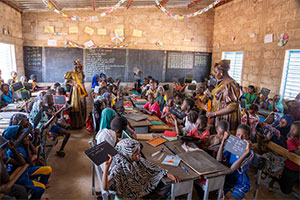 Two teachers work in a classroom in Forces Vives School in Dori, Burkina Faso. Credit: UNICEF/UNI978361
Safe and uninterrupted education is a fundamental right for all children. Education is paramount to global development, as it has been proven that investing in education – especially for girls and children – contributes significantly to economic growth and prosperity. Although more than 1 billion children go to school, many are subjected to conditions that are not conducive to a proper learning environment, including makeshift facilities, a lack of supplies, violence in classrooms, inadequate sanitation, untrained instructors, and widespread school closures. Since 2015, there have been immense gains in education with an increase of 109 million children in school. However, as of 2023, 272 million children are still out of school.
High poverty levels in developing countries also impede children’s access to a proper education. For example, from the early to mid 2000s, Sub-Saharan African nations witnessed a dramatic decline in trained teachers due to inadequate funding in the education sector. Furthermore, major cuts to United States international aid threaten an estimated 23 million additional children's access to education, as USAID‑funded school programmes across Africa and Asia face closure.
Various other factors contribute to the decline of education, notably hunger, which has increased as conflict and climate change interfere with global food production and dissemination. Meanwhile, certain social and cultural practices also impede children’s access to education, with gender inequality, discrimination, child labour, and child marriages preventing millions of children from attending school. Economic conditions such as the inaccessibility of higher education also affect disenfranchised communities across the world. In extreme situations, such as warfare where educational facilities are destroyed in their totality, notably in Gaza and Sudan, entire generations of children might grow up without access to education. Rebuilding educational infrastructure is a long and arduous process, especially when violence persists across generations, and this significantly stunts the development of societal prosperity and stability.
IPS is dedicated to telling the shocking truths about worldwide education through impassioned opinion pieces and comprehensive articles, highlighting global issues that impede worldwide education and the courses of action being taken by organizations such as UNICEF and Education Cannot Wait.

The Week with IPS

NEXT STOP - SDGs
Tracking global progress towards a sustainable world
Tracking global progress towards a sustainable world
