Languages
Monday, September 28, 2026



News and Views from the Global South
Energy

Q & A: Why Switching to Renewable Energy Sources is No Longer a Matter of Morality, But of Economics
When the Global Green Growth Institute (GGGI) was founded eight years ago, the general public thought that renewable energies would never replace oil and coal. Today, the tables have turned.
Indigenous Peoples Link Their Development to Clean Energies
Achuar indigenous communities in Ecuador are turning to the sun to generate electricity for their homes and transport themselves in canoes with solar panels along the rivers of their territory in the Amazon rainforest, just one illustration of how indigenous people are seeking clean energies as a partner for sustainable development.
New Rules for High Seas Must Include Needs of Poorest Nations
Over-fishing, warming oceans and plastic pollution dominate the headlines when it comes to the state of the seas. Most of the efforts to protect the life of the ocean and the livelihoods of those who depend on it are limited to exclusive economic zones – the band of water up to 200 nautical miles from the coast.
Mixed Signals as Guyana Develops its Green Economy Strategy
Guyana is forging ahead with plans to exploit vast offshore reserves of oil and gas, even while speaking eloquently of its leadership in transitioning to a green economy at a recent political party congress addressed by the country's president.
New Relationship Evolves Between Society and Energy in Brazil
“We want to make history," agreed the teachers at the Chiquinho Cartaxo Comprehensive Technical Citizen School. They are the first to teach adolescents about generating power from bad weather in the semi-arid Northeast region of Brazil.
Use of Water for Electricity Generation Triggers Outcry in Mexico
One of the fears of the people of the Sierra Huasteca mountains in the state of San Luis Potosi in northeast Mexico is the construction of combined cycle power plants, which would threaten the availability of water.
Undertaking One of the Largest Solar Water Initiatives in Yemen
Yemen has one of the lowest supplies of freshwater per capita in the world. The effects of a growing population and limited water resources have been exacerbated a great deal by climate change and the escalating conflict.
Sousa, a Solar Power Capital in an Increasingly Arid Brazil
Sousa, a municipality of 70,000 people in the west of Paraíba, the state in Brazil most threatened by desertification, has become the country's capital of solar energy, with a Catholic church, various businesses, households and even a cemetery generating solar power.
Amidst Rising Heat Waves, UN says Cooling is a Human Right, not a Luxury
The rising heat waves in the world’s middle income and poorer nations are threatening the health and prosperity of about 1.1 billion people, including 470 million in rural areas without access to safe food and medicines, and 630 million in hotter, poor urban slums, with little or no cooling to protect them, according to the latest figures released by the United Nations.
War, High Tariffs and Nationalisation – their Cost to Africa’s Climate
Africa’s political instability, its armed conflicts and regulatory issues are placing at risk investment needed to tackle climate change and reduce greenhouse gas (GHG) emissions on the continent.
Bamboo, A Sustainability Powerhouse
A landmark conference bringing more than 1,200 people from across the world together to promote and explain the importance of bamboo and rattan to global sustainable development and tackling climate change has ended with a raft of agreements and project launches.
Solar Energy in Social Housing, a Discarded Solution in Brazil
“Our main challenge is to get the project back on track," agreed the administrators of two affordable housing complexes, where a small solar power plant was installed for social purposes in Juazeiro, a city in northeast Brazil.
West Africa Moves Ahead with Renewable Energy Despite Unpredictable Challenges
The West African nation of Guinea may be a signatory of the Paris Agreement, a global undertaking by countries around the world to reduce climate change, but as it tries to provide electricity to some three quarters of its 12 million people who are without, the commitment is proving a struggle.
Building West Africa’s Capacity to Access Climate Funding
When Senegalese president Macky Sall opened the 30MW Santhiou Mékhé solar plant last June, the country gained the title of having West Africa's largest such plant. But the distinction was short lived.
When a Grass Towers over the Trees
As governments scramble for corrective options to the worsening land degradation set to cost the global economy a whopping 23 trillion dollars within the next 30 years, a humble grass species, the bamboo, is emerging as the unlikely hero.
China Generates Energy and Controversy in Argentina
As in other Latin American countries, in recent years China has been a strong investor in Argentina. The environmental impact and economic benefits of this phenomenon, however, are a subject of discussion among local stakeholders.
Q&A: Greening Colombia’s Energy Mix
Colombia is a global power in biodiversity and water resources, but at the same time it depends on exports of fossil fuels, coal and oil, to the world. But don't panic: in the green economy there are also incomes and jobs - says a world expert on the subject, Juhern Kim.
Latin America Begins to Discover Electric Mobility
With 80 percent of the population living in urban areas and a vehicle fleet that is growing at the fastest rate in the world, Latin America has the conditions to begin the transition to electric mobility - but public policies are not, at least for now, up to the task.
Valuing the Food System
Many factors contribute to the cost of a tomato. For example, what inputs were used (water, soil, fertilizer, pesticides, as well as machinery and/or labor) to grow it? What kind of energy and materials were used to process and package it? Or how much did transportation cost to get it to the shelf?
Chile Debates Whether Citizens Should Profit from Generating Energy
Chile has become a model country for its advances in non-conventional energy, and is now debating whether citizens who individually or as a group generate electricity can profit from the sale of the surplus from their self-consumption - a factor that will be decisive when it comes to encouraging their contribution to the energy supply.
Public-Private Pacts Open Doors to Climate Finance in Rwanda and Ethiopia
The Global Green Growth Institute (GGGI) presented the African model of a National Financing Vehicle in which the governments of Rwanda and Ethiopia have successfully promoted green growth and climate resilience, at an event May 25 on the sidelines of the annual meetings of the Board of Governors of the African Development Bank (AfDB) in Busan, South Korea.« Previous Page — Next Page »


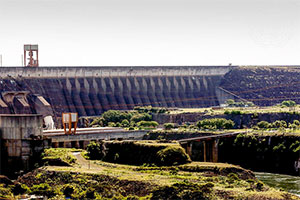 UN Power Plant, Paraguay. Credit: UN Photo/Evan Schneider
Energy has posed a great challenge for economies around the world. As global energy consumption skyrockets throughout the years, so does the need for sustainable solutions. The Sustainable Development Goals are essential in providing people with access to safe, affordable, and sustainable energy sources that minimize harm on the planet. Progress towards these goals opens the door for an advancement in modernization for communities on a global level and allows for a potential mitigation of tensions between nations.
The UN’s Summit of the Future in 2024 offered new initiatives that are being taken to achieve these goals, including a decreased reliance on fossil fuels, a switch to renewable energy sources, and improved climate financing.
IPS is well positioned to provide relevant, insightful, and compelling analysis of recent updates and measures being taken around the world to achieve a cleaner future.

The Week with IPS

NEXT STOP - SDGs
Tracking global progress towards a sustainable world
Tracking global progress towards a sustainable world
