Languages
Tuesday, September 29, 2026



News and Views from the Global South
Energy
Public-Private Pacts Open Doors to Climate Finance in Rwanda and Ethiopia
The Global Green Growth Institute (GGGI) presented the African model of a National Financing Vehicle in which the governments of Rwanda and Ethiopia have successfully promoted green growth and climate resilience, at an event May 25 on the sidelines of the annual meetings of the Board of Governors of the African Development Bank (AfDB) in Busan, South Korea.
Energy Cooperatives, Fogged Mirrors for Latin America
“It made me angry that a company from outside the region was making money from renewable energy and I wondered why people weren't getting involved," says Petra Gruner-Bauer, president of the German co-operative SolixEnergie.
Unlocking Private Finance for Developing Countries’ Green Growth
Climate finance has never been more urgently needed, with massive investments in climate action required to meet the goals of the Paris Agreement and avoid the devastating effects of a warmer planet.
When Two Becomes One: Blending Public and Private Climate Finance
With the landmark Paris Agreement now almost two years old, funding for climate-related activities continues to be a challenge. However, efforts have been underway to bring two seemingly very different sectors together to address climate change.
Africa Gains Momentum in Green Climate Solutions
Promoting the widespread use of innovative technologies will be critical to combat the hostile effects of climate change and reduce greenhouse gas emissions, and many African countries are already leading the way with science-based solutions.
Climate Finance: The Paris Agreement’s “Lifeblood”
As negotiators concluded ten days of climate talks in Bonn last week, climate finance was underlined as a key element without which the Paris Agreement’s operational guidelines would be meaningless.
United Arab Emirates: Entering into a Sustainable Future
The end of the oil age In the early 1970’s the United Arab Emirates (UAE) was an impoverished desert, with little access to food, water and well-paying jobs. Today, this country looks nothing like it was fifty years ago. Thanks to oil, the UAE has completely transformed and now is one of the most developed economies in the Middle East, if not the world: its per capita GDP is equal to those of highly developed European nations ($68,000 - 2017 est.).

Sustainable Food Systems; Why We do Not Need New Recipes
Many believe that the food and agricultural sector is different to all other economic sectors, that it is unique, and that it requires special economic models to thrive. After all, we expect the global food and agricultural system to respond to many different goals. It needs to deliver abundant, safe, and nutritious food. It needs to create employment in rural areas while protecting forests and wildlife, improving landscapes, and preventing climate change through lower food production emissions. Well-functioning food systems are also considered essential for social stability and conflict prevention. In fact many politicians today go as far as to argue that food systems need to thrive so as to stem rural-to-urban migration and the cross-border flow of desperate people fleeing food insecure nations.
“Green Development Has to Be Equal for All”
IPS caught up with Dr. Frank Rijsberman, director-general of the Global Green Growth Institute (GGGI), at the end of the flagship side event of the GGGI during the 51st Annual Meeting of the Asian Development Bank (ADB) in Manila on May 4, 2018, which featured the Belt and Road Initiative (BRI) and its potential to create sustainable infrastructure and promote green growth pathways.
Belt and Road Initiative Vows Green Infrastructure with Connectivity
"My son in primary school did not attend a birthday celebration because it was cancelled due to bad air -- and we live in Seoul, a great place to live," said Dr. Frank Rijsberman, director-general of the Global Green Growth Institute (GGGI).
Low Awareness Restrains Growth of Solar Technologies
Every year, Amos Chandiringa, 43, a farmer in Nemaire village in Makoni district in northeastern Zimbabwe, laboriously waters his tobacco nursery with a watering can. The toil of the job often leaves him without the energy or time to do other household chores.
FAO Releases Alarming Report on Soil Pollution
Soil pollution is posing a serious threat to our environment, to our sources of food and ultimately to our health. The Food and Agriculture Organization of the United Nations (FAO) warns that there is still a lack of awareness about the scale and severity of this threat.
From Mega to Micro, a Transition that Will Democratise Energy in Brazil
An energy transition is spreading around the globe. But in Brazil it will be characterised by sharp contrasts, with large hydroelectric plants being replaced by solar microgenerators and government decisions being replaced by family and community decision-making.
Over to You, Children! Zambia’s ‘Plant a Million Trees’ Takes Root
Trees are a vital component in the ecosystem—they not only give oxygen, store carbon, stabilise the soil and give refuge to wildlife, but also provide materials for tools, shelter and ultimately, food for both animals and human beings.
What’s Changing As Countries Turn INDCs into NDCs?
In the lead up to the historic Paris Agreement on climate change, adopted in 2015, more than 160 countries and the European Union submitted their own plans to address climate change, known as Intended Nationally Determined Contributions (INDCs).
Dreaming of A New Sustainable Economy
Officials from around the world came together to create and support a vision for a new, sustainable economy: a bioeconomy. Almost 1000 bioeconomy experts, from former heads of state to civil society leaders, convened in Berlin for the second Global BIoeconomy Summit to discuss best practices and challenges.
Argentina Aims for a Delicate Climate Balance in the G20
As president this year of the Group of 20 (G20) developed and emerging nations, Argentina has now formally begun the task of trying to rebuild a consensus around climate change. It will be an uphill climb, since the position taken by the United States in 2017 led to a noisy failure in the group with regard to the issue.
Latin America Faces Uphill Energy Transition
Latin America is facing challenges in energy efficiency, transportation and power generation to move towards a low carbon economy and thus accelerate that transition, which is essential to cut emissions in order to reduce global warming before it reaches a critical level.
New GCF Project Signals Paradigm Shift for Water-Scarce Barbados
At the start of 2017, the Caribbean Drought and Precipitation Monitoring Network (CDPN) warned eastern Caribbean countries that they were facing “abnormal climate conditions” and possibly another full-blown drought.
Caribbean Eyes Untapped Potential of World’s Largest Climate Fund
The Caribbean Community Climate Change Centre (CCCCC) also known as the 5Cs, is looking for ways to boost the region’s access to the Green Climate Fund (GCF).
Drowning for Progress in Cambodia
Suddenly the road ends. The cart track disappears under the water. A vast lake stretches out in front of me. I have to transfer from a motorbike to a canoe. "Tuk laang," my guide says coolly. "The water is rising."« Previous Page — Next Page »


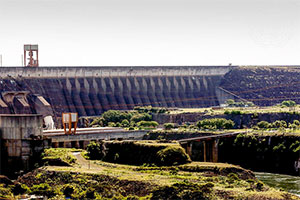 UN Power Plant, Paraguay. Credit: UN Photo/Evan Schneider
Energy has posed a great challenge for economies around the world. As global energy consumption skyrockets throughout the years, so does the need for sustainable solutions. The Sustainable Development Goals are essential in providing people with access to safe, affordable, and sustainable energy sources that minimize harm on the planet. Progress towards these goals opens the door for an advancement in modernization for communities on a global level and allows for a potential mitigation of tensions between nations.
The UN’s Summit of the Future in 2024 offered new initiatives that are being taken to achieve these goals, including a decreased reliance on fossil fuels, a switch to renewable energy sources, and improved climate financing.
IPS is well positioned to provide relevant, insightful, and compelling analysis of recent updates and measures being taken around the world to achieve a cleaner future.

The Week with IPS

NEXT STOP - SDGs
Tracking global progress towards a sustainable world
Tracking global progress towards a sustainable world
