Languages
Thursday, October 15, 2026



News and Views from the Global South
Energy

A Storm Brews in Doha
While the Philippines copes with the aftermath of powerful super-typhoon Bopha, which killed more than 300 people this week, tempers flared at the U.N. climate summit here.U.S. Senate Passes New Sanctions on Iran
The U.S. Senate approved a new round of economic sanctions against Iran Friday, ignoring warnings by the White House that the additional measures could prove counter-productive to the goal of persuading Iran to curb its nuclear programme.
Fossil Fuel Lobby in the Driver’s Seat at Doha
A new scientific report shows that global warming can be kept well under two degrees C, but only if most of the known deposits of coal, oil and gas remain in the ground.
South Sudan Oiling Up for Self-Reliance
As South Sudan continues negotiations with Sudan regarding the resumption of oil production and transit, the South Sudanese government says that it is developing its own industry and will start producing fuel for domestic consumption within the next eight months in order to avoid continued reliance on its neighbour.
Local Opposition Rises Against Fracking Proposal
Efforts to promote the use of hydraulic fracturing, a controversial method of obtaining oil and natural gas, face stiff opposition from researchers and citizens who say that in its present form, the technology's risks far outweigh its worth.
Chinese and Brazilian Firms Building the New Angola
"In Luanda there are no matches." This was the first line of a report written by Nobel Literature laureate Gabriel García Márquez in the Angolan capital in 1977.
In Post-Fukushima Japan, Civil Society Turns up Heat on Officials
For the former industrial engineer Yastel Yamada, retirement does not mean he intends to sit back. Instead, the 73-year-old and about 700 other skilled seniors across Japan are eager to volunteer to tackle the most dangerous part of the Fukushima Dai-ichi nuclear plant cleanup and spare a younger generation from the effects of extreme radiation.
Deep Emissions Cuts Urged at Climate Summit
Extreme weather disasters, including floods and droughts intensified by climate change, have totalled many billions of dollars in damages this year.IAEA Data on Sensitive Iranian Stockpile Mislead News Media
News stories on the latest International Atomic Energy Agency (IAEA) report suggested new reasons to fear that Iran is closer to a “breakout” capability than ever before, citing a nearly 50-percent increase in its stockpile of 20-percent enriched uranium and the installation of hundreds of additional centrifuges at the Fordow enrichment installation.Planet on Path to Four C Warming, World Bank Warns
Coal, oil and gas companies and their backers in the financial and investment industry must stop putting billions of dollars into finding and extracting new sources of fossil fuels. If they don't shift their investments, temperatures will soar four to 10 degrees C higher, devastating many parts of the world, the World Bank said Monday.
U.S. Escalation Against Iran Would Carry High Cost for Global Economy
The world economy would bear substantial costs if the United States took steps to significantly escalate the conflict with Iran over its controversial nuclear programme, according to the findings of a Federation of American Scientists’ (FAS) special report released here Friday.
Aluminium Industry Has Its Defenders in Brazil
Aluminium, opposed by environmentalists mainly because of the amount of energy needed to produce it, is one of the targets of the heated campaign against hydroelectric dams in Brazil’s Amazon jungle region.
“Writing Is on the Wall” at Upcoming Climate Summit
Two-thirds of the world's proven fossil fuel reserves cannot be used without risking dangerous climate change, the International Energy Agency (IEA) warned this week.
Nanotechnology Could Lighten Venezuela’s Oil Footprint
Venezuela is studying the use of nanotechnology as a means of reducing emissions of greenhouse gases caused by the oil industry.
People’s Tribunal Defends Native Villages from Dams
"What do we stand to lose because of the dam? We will lose everything!" said Maria Abigail Agredani, a member of the committee for this indigenous community in the western Mexican state of Jalisco, reporting the damage that will be caused by the hydroelectric complex being built nearby.
OP-ED: Hurricane Sandy Says, “Welcome to the New Normal”
I am aware that my arrival last week helped re-elect U.S. President Barack Obama. Superstorms like me don't play politics, but it should be clear by now that your refusal to tackle global warming has serious consequences. Higher sea levels and amped-up hurricanes like me are just two of them.
The Sun Rescues Rural Cameroonians from “Incessant Darkness”
In the small farming village of Sabongari, in Cameroon’s North West Region, the need for kerosene to light bush lamps and petrol to run electric generators has been replaced by the need for something much cheaper and cleaner: sunshine.
For Champions of Degrowth, Less Is Much More
The concept of degrowth is not a very comfortable one in overdeveloped countries such as the United States.
U.S. Concerned over Lao Approval for Huge Mekong Dam
The U.S. government is directly cautioning the Laotian government following Monday's announcement that the latter will move forward with contentious construction plans for a massive hydroelectric dam on the Mekong River.
Mankind Approaching ‘Carbon Cliff’, Report Warns
A new international business report warns fossil fuel use is pushing humanity towards a catastrophic overheating of the planet, with temperature increases of four or even six degrees Celsius. No major developed or developing country is doing anything close to what's needed to prevent large parts of the planet from becoming uninhabitable, the report found.
A Posthumous Message from Hurricane Sandy*
Hi, this is Sandy. By the time you read this, I’ll be gone, after dissipating into increasingly weaker remnants of strong winds, heavy rains and snowfall in the Great Lakes region of North America.**« Previous Page — Next Page »





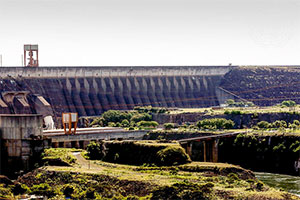 UN Power Plant, Paraguay. Credit: UN Photo/Evan Schneider
Energy has posed a great challenge for economies around the world. As global energy consumption skyrockets throughout the years, so does the need for sustainable solutions. The Sustainable Development Goals are essential in providing people with access to safe, affordable, and sustainable energy sources that minimize harm on the planet. Progress towards these goals opens the door for an advancement in modernization for communities on a global level and allows for a potential mitigation of tensions between nations.
The UN’s Summit of the Future in 2024 offered new initiatives that are being taken to achieve these goals, including a decreased reliance on fossil fuels, a switch to renewable energy sources, and improved climate financing.
IPS is well positioned to provide relevant, insightful, and compelling analysis of recent updates and measures being taken around the world to achieve a cleaner future.

The Week with IPS

NEXT STOP - SDGs
Tracking global progress towards a sustainable world
Tracking global progress towards a sustainable world
