Languages
Tuesday, August 25, 2026



News and Views from the Global South
Food and Agriculture

Maggot Farming Creates Entrepreneurs, Saves Farming Costs in Zimbabwe
Three years ago, 43-year-old Benard Munondo was an "ordinary" Zimbabwean teacher at a local primary school, but now he has turned maggots into gold. Thanks to maggot farming, Munondo, who has never owned a home nor driven a car, now has both. In 2020, a week’s training on maggot farming changed his world.
Dissenting Voices at Nairobi Soil Health Forum Over Increased Fertilizer Use
As the Africa Fertilizer and Soil Health Summit convened in Nairobi to review the progress made in terms of increasing fertilizer use in line with the 2006 Abuja Declaration, experts, practitioners, activists, and even government officials pointed out that accelerated fertilizer use may not be the magic bullet for increased food production in Africa.
Beyond the Fields: Unraveling Zambia’s Drought Crisis and the Urgent Call for Climate-Health Solutions
For most families in Zambia, April is traditionally a month of plenty—it is typically the beginning of a harvest season for various food and cash crops. Both fresh and dried maize, groundnuts, pumpkins, and a whole variety of both traditional and exotic food crops are usually in full supply and readily available for consumption, supporting household food security and nutrition.
Trade Liberalisation Kicked Away African Development Ladder
Africans have long been promised trade liberalisation would accelerate growth and structural transformation. Instead, it has cut its modest production capacities, industry and food security.
Rainy Chiloé, in Southern Chile, Faces Drinking Water Crisis
The drinking water supply in the southern island of Chiloé, one of Chile's rainiest areas, is threatened by damage to its peatlands, affected by sales of peat and by a series of electricity projects, especially wind farms.
Drought and Unequal Water Rights Threaten Family Farms in Chile
Lack of water threatens the very existence of family farming in Chile, forcing farmers to adopt new techniques or to leave their land. The shortage is caused by a 15-year drought and exacerbated by the unequal distribution arising from the Water Code decreed in 1981 by the 1973-1990 dictatorship of General Augusto Pinochet, which turned water into a tradable commodity and gave its owners rights in perpetuity.
Using Industrial Waste to Fight Pollution in Brazil
Biogas sounds like redemption, the conversion of the sinner. Its production involves extracting energy from filth, from the most disgusting environmental pollution, and at the same time avoiding the worsening of the global climate crisis.
Cuban Family Harnesses Biogas and Promotes its Benefits
Just to obtain a good fertilizer it was worth building a biodigester, says Cuban farmer Alexis García, who proudly shows the vegetables in his family's garden, as well as the wide variety of fruit trees that have benefited from biol, the end product of biogas technology.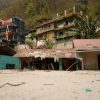
Climate Crisis in Mountains: Borderless Struggle for Frontline Communities
For the last three years, Sambhunath Guragain has been waking up every morning to a view he doesn't want to see: discarded agricultural land where he and his family used to grow food, including rice, but the flood in 2021 changed everything. “We don’t have any crops now, but we are farmers,” Guragain said in November 2021, while looking towards a quietly flowing Melamchi river. This was six months after the massive flash flood in Helambu-Melamchi in Sindhupalchowk district in Nepal. After three years, the situation hasn’t changed.
Urgent Global Action Is Essential To Stop Wave of Plastic Pollution
There is a growing wave of plastics, smothering our countryside and lapping at our shores.
Solar Power and Biogas Empower Women Farmers in Brazil
A bakery, fruit pulp processing and water pumped from springs are empowering women farmers in Goiás, a central-eastern state of Brazil. New renewable energy sources are driving the process.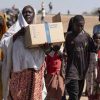
Conflict’s Long Shadow Has a Name: It’s Hunger
Scarce food and drinking water. Limited and inconsistent healthcare. Rapidly deteriorating mental health. With conflict on the rise globally, this is the grim reality for millions around the world.
Food Security and Food Safety in Africa Must Go Hand in Hand
Russia’s invasion of Ukraine has restricted international exports and sent food costs soaring – particularly for vulnerable populations still experiencing shocks from the pandemic and who can least afford to pay more to feed their families. Two years on, global food supply chains are still just as susceptible to serious disruptions caused by war, disease, and climate change. Those inevitable disruptions are leaving those on the African continent particularly vulnerable.
Women Affected by ‘Gender-Biased’ Climate Change Deserve Justice
While research into the unequal impacts of climate change on women is growing, more is needed to enable them to realize their rights to climate justice. Researchers argue that women and girls have unequal access to food, water, health, education, and even income, thanks to climate change. This makes them more vulnerable.
To Mitigate Climate Change Associated Disasters That Impact the Agricultural Sector – Launch Multipronged Efforts
Recently, the United Nations in collaboration with the World Meteorological Organization released a report that highlighted the impacts of climate change including on agriculture.
Senegal’s Democracy Passes Crucial Test
The fact that Senegal’s election took place on 24 March was in itself a triumph for civil society. That an opposition candidate, campaigning on an anti-establishment and anti-corruption agenda, emerged from jail to become the continent’s youngest leader offered fresh hope for democracy.
Social Protection, a Key Solution for Directing Climate Finance To Poor Small-Scale Farmers
Climate change is exacerbating inequalities between and within countries, disproportionately affecting poor households in rural areas. In fact, we know that more than half of the resources of the poor – a large part of whom are small-scale farmers - are lost due to climatic hazards. This has negative impacts on the incomes of these people and their ability to meet their essential needs, including food.
No Turning a Blind Eye to Protection of Dominican Republic’s Natural Resources, Says Environment Minister
In 2020, general elections were held in the Dominican Republic. This took place while the COVID pandemic was becoming an increasingly serious threat, causing severe social and economic disruption. The elections were two months late as a result of the initial chaos COVID caused. The governing Dominican Liberation Party’s 16-year rule ended after the Modern Revolutionary Party’s candidate, Luis Abinader, received a majority of the votes. Elections are now scheduled for May 19 this year and IPS took the opportunity to ask Miguel Ceara Hatton, the country’s Minister of Environment and Natural Resources, how he perceived the past four years' efforts to mitigate a global crisis that now threatens us all, namely climate change and environmental degradation.
Can Preserving Goa’s Khazans Address Climate Threats?
Growing up in a khazan ecosystem, the traditional agricultural practice followed in the south-western Indian state of Goa, Elsa Fernandes would love sitting in a koddo, a woven bamboo structure for storing paddy. Her family members would pour paddy around her and with the growing pile, she would rise to the top and then jump down with joy.
India’s Farmers Could Use Better Monsoon Forecasts
Agriculture in India need not 'gamble' with the monsoons if accurate weather and climate forecasts are proactively made available to farmers, according to the results of a new experimental study conducted by the University of Chicago.
Food Security Issues in Asia
Asia has about 60% of the World’s population but only about a third of the world’s arable land. This region additionally has some of the most economically active countries with increasing urbanisation and a growing middle class. Asia is also home to some of the most affected countries by climate change. For these and other reasons, food security in Asia affects global food security through many inter-links. A new book, “Food Security Issues in Asia”, edited by Paul Teng and with multiple authors, explicates many of the key issues continuing to cause food insecurity in Asia as well as discourses on exciting developments. Through its twenty-seven chapters, the book, published by World Scientific Publishers Singapore was launched on 27 March 2024 in Singapore by Ambassador Ong Keng Yong, former ASEAN Secretary General.« Previous Page — Next Page »


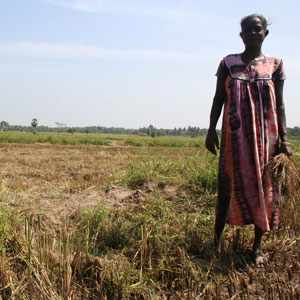
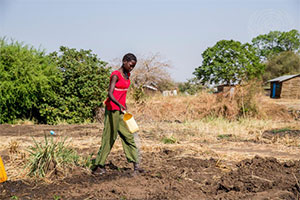 Farming on the Outskirts of Juba. Credit: UN Photo/JC McIlwaine
Promoting human and planetary health is a central focus of the United Nations, as laid out in the 2030 Sustainable Development Goals (SDGs). World hunger and unsustainable farming practices continue to be pressing concerns for the world. According to the 2025 State of Food Security and Nutrition in the World report by the Food and Agriculture Organization (FAO), 673 million people faced hunger in 2024. There are stark regional disparities, with the FAO projecting that 60% of the world population facing hunger will reside in Africa by 2030. Globally, the prevalence of food insecurity has remained consistently higher for women than men.
Sustainable and efficient national food systems are essential in preserving health, education, environmental well-being, peace, economy, and security. However, creating sustainable food systems can be a challenging endeavor, as food production takes a heavy toll on the environment. The agricultural sector accounts for a significant portion of greenhouse gases. Finding safe, sustainable, and ethical strategies to feed the world is crucial in ensuring planetary longevity. A recent initiative from 2023, the EU Regulation on Deforestation-free Products (EUDR), seeks to advocate for sustainable food systems. The main driver of deforestation is the expansion of agricultural land used to produce commodities like cattle, wood, cocoa, coffee, etc. The EUDR is part of the 2020 European Green New Deal and the EU Biodiversity Strategy for 2030 and aims to limit Europe’s consumption of products linked with deforestation by requiring that companies prove that their products are deforestation-free. Despite aiming to achieve major strides in sustainability, policies such as EUDR also raise socioeconomic concerns for targeted countries. Many emerging Latin American economies are impacted by the policy, and have raised the question of how developing countries can grapple with the tensions between economic development and advancing sustainability.
IPS has been at the forefront of providing compelling and insightful stories on communities facing hunger as well as the cost of food production. IPS uses statistics from FAO, the World Food Programme (WFP) and the International Fund for Agricultural Development (IFAD) to bring relevant and hard-hitting facts to readers. This gathering of information and data from such organizations helps bring the best stories from IPS journalists working in the different regions in consultation with experts on the ground.

The Week with IPS

NEXT STOP - SDGs
Tracking global progress towards a sustainable world
Tracking global progress towards a sustainable world