Languages
Saturday, November 21, 2026



News and Views from the Global South
Green Economy
Experts Fear Collapse of Global Civilisation
Experts on the health of our planet are terrified of the future. They can clearly see the coming collapse of global civilisation from an array of interconnected environmental problems.
U.N. Aims at Sustainable Energy for All by 2024
When the General Assembly wound down its 67th session in late December, it underscored the key role for energy in the U.N.'s post-2015 economic agenda by declaring 2014-2024 the "Decade of Sustainable Energy for All".
More Aging U.S. Coal Plants Hit the Chopping Block
Georgia Power, a subsidiary of Southern Company, one of the largest utilities in the U.S. south, plans to retire 15 coal and oil-fired energy generating units at four different plants, in the latest sign that a national campaign against coal is gaining traction.
OP-ED: Climate Inaction Is a Clear Failure of Democracy
Around the world, 2012 was the year of extreme weather, when we unequivocally learned that the fossil fuel energy that powers our societies is destroying them. Accepting this reality is the biggest challenge of the brand new year.
Guyana Hits Paydirt on Low Carbon Development Path
Imagine Guyana and Dominica without forests and rivers, or Antigua, Barbados and St. Lucia without beaches.
Frolic Barefoot, But Don’t Leave a Carbon Footprint
As the world’s most tourism-dependent region, with the sector accounting for one in every eight jobs, the Caribbean has much to fear from climate change.
OP-ED: A Universal Climate Change Agreement Is Necessary and Possible
The results of the United Nations climate change conference that closed in Doha, Qatar on Dec. 8 show once again that the international negotiations are moving steadily in the right direction, but alarmingly slow.
Caribbean Islands Find Economic Advantages in Sustainable Energy
With the exception of oil rich Trinidad and Tobago, most, if not all, other Caribbean islands are extremely vulnerable when it comes to the high costs of imported fuels that are easily disrupted by natural disasters and other phenomena.
Dreams of a ‘Green Utopia’ Wither in the Maghreb
When the Desertec Industrial Initiative (DII), an alliance of 21 major European corporations, first unveiled plans to install a network of solar thermal, photovoltaic, and wind plants across the North African Maghreb region to generate electricity, the project was greeted as a ‘green utopia’.
Tunisia Gears Up to Host World Social Forum
Following in the wake of the wave of revolutions dubbed the ‘Arab Spring’, which originated here nearly two years ago, North Africa is gearing up to host the World Social Forum (WSF) for the first time.
Youth Call for ‘Change of Course’ to Solve Climate Crisis
While world leaders were wrapping up the United Nations conference on climate change (COP 18) in Doha, Qatar this past weekend with the annual vague promise to tackle the enormous crises brought on by extreme weather and global warming, a delegation of youth gathered far from the high-level conference halls to say “no” to advocacy without action.
Chile Follows South Africa’s Lead in Climate Change Mitigation
Chile is turning to South-South cooperation to help define the most effective strategies and options for reducing its greenhouse gas (GHG) emissions in the face of global climate change.
Critics Brand Climate Talks Another Lost Opportunity
Rich countries came to the U.N. climate talks in Doha intent on delaying needed action on climate change for another three years and a still to be hammered out new global treaty.
Doha Climate Summit Ends With No New CO2 Cuts or Funding
The United Nations climate talks in Doha went a full extra 24 hours and ended without increased cuts in fossil fuel emissions and without financial commitments between 2013 and 2015.
Farming in the Sky in Singapore
With a population of five million crammed on a landmass of just 715 square kilometres, the tiny republic of Singapore has been forced to expand upwards, building high-rise residential complexes to house the country’s many inhabitants.
Small Rural Businesses in Brazil Set Sights on Domestic Market
"Canjinjin has special powers," said Deize Coelho de Barros. The recipe for this local liquor, made from a mixture of herbs, was handed down from her African ancestors, and is seen as a sort of traditional "Viagra" in her homeland, the western Brazilian state of Mato Grosso.
The Big Fight in Doha Is Over Climate Finance
The new Green Climate Fund to help developing countries cope with climate change may one day have a bigger budget than the World Bank. At the moment, however, the Fund is empty.Doha Faces an Indonesian Test
To most people, holes in the ozone layer or the melting of polar ice caps can sound like distant catastrophes. “But let's talk about concrete examples,” says an Indonesian director whose documentary film captures the lives of local farmers affected by a dramatically changing environment.
Fossil Fuel Lobby in the Driver’s Seat at Doha
A new scientific report shows that global warming can be kept well under two degrees C, but only if most of the known deposits of coal, oil and gas remain in the ground.
OP-ED: Loss and Damage from Climate Change Must Not Become the “New Normal”
As United Nations climate talks get underway this week in Doha, Qatar, they show a subtle, unsettling shift in the global climate change debate.
African Negotiators Saving Kyoto from the Grave
African negotiators attending the United Nations climate change talks in Doha, Qatar say they are determined to ensure that developed countries do not let the Kyoto Protocol die as its commitment period comes to an end.« Previous Page — Next Page »


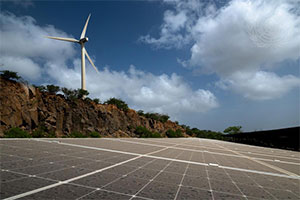 Renewable Energy in Cabo Verde. Credit: UN Photo/Mark Garten
A green economy is an economic model that aims to reduce environmental risks and build a sustainable future. Many of the UN SDGs seek to facilitate a green economy, such as ensuring access to affordable and reliable clean energy, building sustainable cities and communities, and implementing urgent action to combat climate change. Various key negotiations have strived to achieve a green economy, such as the Green New Deal and the Inflation Act of 2022. COP30, held in Belém, Brazil in 2025, agreed to mobilize $1.3 trillion annually for climate action and launched the Belém Mission to 1.5°C. However, the conference was not able to develop a fossil fuel reduction roadmap. Recent years have witnessed a sharp transformation in the geopolitical landscape of international sustainability cooperation. In March 2025, the United States stepped back from formal multilateral support for the SDGs, while China is on the rise as an international leader in renewable energy production. The actions of these global powers may shape shifting alliances on environmental governance. IPS is dedicated to sharing timely news on international developments in building a sustainable future.

The Week with IPS

NEXT STOP - SDGs
Tracking global progress towards a sustainable world
Tracking global progress towards a sustainable world
