Languages
Saturday, November 21, 2026



News and Views from the Global South
Green Economy

Carnival Food Carts Go Solar in Northern Argentina
It’s carnival time in sunny northwest Argentina, and as usual, food vending carts are everywhere. But some of the carts are different this year: they offer food cooked on the spot – by the sun.
Q&A: Venerable Sierra Club Gets Radical on Tar Sands
The term “civil disobedience” takes its roots from an 1849 essay by U.S. poet, philosopher and environmentalist, Henry David Thoreau, originally entitled “Resistance to Civil Government”.
Energy, Economy Key in Major Obama Address
In a major annual address Tuesday night, President Barack Obama offered further details on a broad and ambitious range of policy priorities, taking advantage of perhaps his single most significant opportunity to guide the public conversation on his second-term agenda.
U.S. Environment Agency Releases First Climate Adaptation Plan
For the first time, the U.S. Environmental Protection Agency (EPA) has publicly released a draft plan on how the department’s programmes will adapt to global warming, in a move that could lay additional groundwork for important new emissions rulemaking the agency may announce in coming months.
Congested and Polluted, Mexico City Embraces Carpooling
In a megacity like the Mexican capital, plagued by air pollution and traffic jams, carsharing and carpooling initiatives offer obvious advantages in addition to the economic benefits enjoyed by users.
U.S. Missing Goal on Critical Emission Cuts
Environmentalists here are warning that the United States is not on track to meet a target of a 17-percent reduction in carbon emissions by 2020, despite President Barack Obama’s stated commitment.
Solar Streetlights Light the Way Toward Green Energy in Caribbean
The tiny federation of St. Kitts-Nevis and its larger neighbour to the north, Jamaica, are leading the Caribbean's search for new ways to become more energy efficient by installing new solar streetlights, a green alternative to traditional ones.
New U.S. Biofuel Proposals Could Draw Heavily from Food Sources
New biofuel requirements proposed by the U.S. Environmental Protection Agency (EPA) are being met with concern by a spectrum of interest groups from environmentalists to the oil industry, with some warning that a gap between the proposal and existing law could force the government to draw on food-based alternative fuels.
The Open and Rocky Road Post-2015
What values does a Yemeni journalist who fuelled the Arab Spring hold in common with a former principal of the U.S. National Security Council? And how in turn will they see eye to eye with a Jordanian queen, or the president of Indonesia?
OP-ED: Weird, and Getting Weirder
Weird is the only way to describe January temperatures whipsawing between record warm and arctic cold over a span of a few days. Experts say that is what climate change looks like: weird, record-shattering weather.Bangladesh Must Pause Down the Nuclear Path
Few critical questions have been raised so far by Bangladesh’s intellectual community over the deal towards construction of two nuclear power plants in Rooppur, 180km from capital Dhaka.Dubious Awards Presented at Davos
Only a stone's throw from the Davos World Economic Forum meeting, a group of non-governmental organisations presented the annual Public Eye Awards this week to Goldman Sachs and Royal Dutch Shell.
Expanding Coal Exports Test Obama’s Inaugural Climate Pledges
Following surprisingly forceful statements on the threat of global climate change by President Barack Obama during his second inaugural address on Monday, campaigners here are expressing cautious optimism that a second Obama administration will be able to see through some of the substantive actions on carbon reduction that largely eluded the president’s first term.
Dominica Sees Geothermal as Key to Carbon-Negative Economy
What a difference a trip makes. Before visiting the French island of Guadeloupe, Alfred Rolle had vocally expressed fears about the possible health effects of a decision to drill geothermal wells in the village of Laduat on the outskirts of Dominica's capital.
Are the Masdarians the new Jetsons?
 Back in 2006, when the government of Abu Dhabi — a Middle Eastern emirate that controls eight percent of the world's oil reserves — announced that it would build "the world's first zero-carbon city," skeptics took it with a pinch of salt. Few believed it would be possible.

‘Green’ Approaches to Water Gaining Ground Around World
After Hurricane Sandy swept through the northeast of the United States late October 2012, millions of New Yorkers were left for days without electricity. But they still had access to drinking water, thanks to New York City's reliance on protected watershed areas for potable water.
Peering into the Energy Crystal Ball
Trying to predict the future of the energy sector is like trying to predict the weather in London in an era of global warming. But delegates had a go at it during the three-day World Future Energy Summit that ended in Abu Dhabi on Jan. 17.
Sustainable Transport Gets a Boost in Latin America
Latin America's big cities should cooperate with each other in order to overcome shared challenges in transport issues, such as sustainability and a more human-centered approach to urban development, experts say.
Solar-Powered Water Pumps Struggle to See the Light
When twenty-nine-year-old Kartik Wahi graduated from the Kellogg School of Management in Chicago, Illinois in 2010, he wasted no time in returning to India to self-finance a start-up company to market solar-powered irrigation pumps.
National Legislation Key to Combating Climate Change
A majority of major economies have made significant progress in addressing climate change, with countries like South Korea and China taking aggressive action so they can benefit from energy- and resource-efficient economies, a new report released Monday found.
Mideast Energy Crisis Looks For Light at the End of the Tunnel
When Jordan's Queen Rania Al Abdullah took the podium to address world political and business leaders at a back-to-back energy and water summit here, she said she was representing a country that relies on imports for over 90 percent of its energy needs.« Previous Page — Next Page »


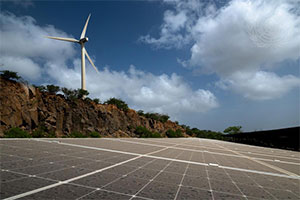 Renewable Energy in Cabo Verde. Credit: UN Photo/Mark Garten
A green economy is an economic model that aims to reduce environmental risks and build a sustainable future. Many of the UN SDGs seek to facilitate a green economy, such as ensuring access to affordable and reliable clean energy, building sustainable cities and communities, and implementing urgent action to combat climate change. Various key negotiations have strived to achieve a green economy, such as the Green New Deal and the Inflation Act of 2022. COP30, held in Belém, Brazil in 2025, agreed to mobilize $1.3 trillion annually for climate action and launched the Belém Mission to 1.5°C. However, the conference was not able to develop a fossil fuel reduction roadmap. Recent years have witnessed a sharp transformation in the geopolitical landscape of international sustainability cooperation. In March 2025, the United States stepped back from formal multilateral support for the SDGs, while China is on the rise as an international leader in renewable energy production. The actions of these global powers may shape shifting alliances on environmental governance. IPS is dedicated to sharing timely news on international developments in building a sustainable future.

The Week with IPS

NEXT STOP - SDGs
Tracking global progress towards a sustainable world
Tracking global progress towards a sustainable world
