Languages
Saturday, November 21, 2026



News and Views from the Global South
Green Economy

A Green Needle in the Haystack of Cuban Small Enterprise
Oasis Nelva is a refreshing green space in the midst of the grey asphalt landscape of Old Havana. The ornamental plant shop is also one of only a handful of eco-friendly initiatives among the upsurge of private small businesses in Cuba.
Q&A: COP18, Another ‘Conference of Polluters’
There is no political will among rich nations to find funding for developing countries experiencing the brunt of changes in global weather patterns, and the current climate change conference will fail to do so, according to Professor Patrick Bond, a leading thinker and analyst on climate change issues.

The Planet’s Thermostat Moves to Doha
The upcoming United Nations climate talks may have a renewed sense of urgency with a new World Bank report warning that the planet is on a dangerous path to four degrees Celsius of global warming by 2100.
Deep Emissions Cuts Urged at Climate Summit
Extreme weather disasters, including floods and droughts intensified by climate change, have totalled many billions of dollars in damages this year.Planet on Path to Four C Warming, World Bank Warns
Coal, oil and gas companies and their backers in the financial and investment industry must stop putting billions of dollars into finding and extracting new sources of fossil fuels. If they don't shift their investments, temperatures will soar four to 10 degrees C higher, devastating many parts of the world, the World Bank said Monday.
Aluminium Industry Has Its Defenders in Brazil
Aluminium, opposed by environmentalists mainly because of the amount of energy needed to produce it, is one of the targets of the heated campaign against hydroelectric dams in Brazil’s Amazon jungle region.
“Writing Is on the Wall” at Upcoming Climate Summit
Two-thirds of the world's proven fossil fuel reserves cannot be used without risking dangerous climate change, the International Energy Agency (IEA) warned this week.
OP-ED: Hurricane Sandy Says, “Welcome to the New Normal”
I am aware that my arrival last week helped re-elect U.S. President Barack Obama. Superstorms like me don't play politics, but it should be clear by now that your refusal to tackle global warming has serious consequences. Higher sea levels and amped-up hurricanes like me are just two of them.
For Champions of Degrowth, Less Is Much More
The concept of degrowth is not a very comfortable one in overdeveloped countries such as the United States.Mankind Approaching ‘Carbon Cliff’, Report Warns
A new international business report warns fossil fuel use is pushing humanity towards a catastrophic overheating of the planet, with temperature increases of four or even six degrees Celsius. No major developed or developing country is doing anything close to what's needed to prevent large parts of the planet from becoming uninhabitable, the report found.
Southern U.S. States Inch Towards Renewable Energy
With the U.S. East Coast virtually shutting down Monday with the arrival of Hurricane Sandy, the broader debate over transitioning to cleaner energy sources and slowing, if not halting, climate change is taking on ever greater urgency.
Wrangling Begins Over New Sustainable Development Blueprint
As the Millennium Development Goals (MDGs) limp towards their target date of 2015, the United Nations is shifting its focus to another long-term action plan: a new set of Sustainable Development Goals (SDGs).
Q&A: Companies Study Climate Risks and Opportunities
Investors and corporations have become increasingly concerned over the effects of climate change, which are being felt in vast areas of the planet and have begun to impact on the profitability of their operations.
Climate Change, the Taboo Phrase in U.S. Electoral Politics
The United States endured its hottest summer in history this year, with droughts and wildfires ravaging the country. And according to a new report from the global reinsurance giant Munich Re, insurance losses related to extreme weather have nearly quadrupled in the U.S. since 1980.
Worms, Termites, Microbes Offer Food Security
Worms and termites are not likely to win hearts and minds, but they, along with lichens and microbes, are vital to food security, say biodiversity specialists who attended this month’s United Nations conference on the Convention on Biological Diversity (CBD) in this south Indian city.
Cooperatives Cushion the Blows of Hunger
“One in eight people goes to sleep hungry every day,” according to the ‘State of Food Insecurity in the World 2012’, a document released annually by the Food and Agriculture Organisation (FAO).
Palau Proves Sharks Worth More Alive Than Dead
Sharks have a safe haven the size of France, and the Republic of Palau that protects them is making millions of dollars from shark tourism.
The Face of Food Security Is Female
In a major endorsement for investment in women - the bulk of food growers in the developing world - United Nations Secretary General Ban Ki-moon said food security could not be achieved without women, and that the world's hungry also needed leaders to prioritise actions.
‘Urban Planning Must Factor in Biodiversity’
“With more than 60 percent of the world projected to be urban by 2030 why not prepare for it and build cities that include biodiversity preservation into planning?” asks Kobie Brand of ICLEI Local Governments for Sustainability in Cape Town, South Africa.
Shadow Over Aichi Biodiversity Targets
With negotiations to mobilise resources for preservation of biodiversity at a major United Nations conference going nowhere, the Group of 77 and China have hinted at possible suspension of the ‘Aichi targets’ under the Nagoya Protocol.
Agricultural Waste Boosts Energy Production in Argentina
A joint project by the energy and agriculture authorities in Argentina is seeking to boost electricity generation from forestry waste and other rural products which have enormous potential, according to experts.« Previous Page — Next Page »


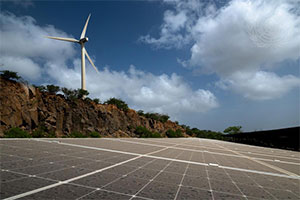 Renewable Energy in Cabo Verde. Credit: UN Photo/Mark Garten
A green economy is an economic model that aims to reduce environmental risks and build a sustainable future. Many of the UN SDGs seek to facilitate a green economy, such as ensuring access to affordable and reliable clean energy, building sustainable cities and communities, and implementing urgent action to combat climate change. Various key negotiations have strived to achieve a green economy, such as the Green New Deal and the Inflation Act of 2022. COP30, held in Belém, Brazil in 2025, agreed to mobilize $1.3 trillion annually for climate action and launched the Belém Mission to 1.5°C. However, the conference was not able to develop a fossil fuel reduction roadmap. Recent years have witnessed a sharp transformation in the geopolitical landscape of international sustainability cooperation. In March 2025, the United States stepped back from formal multilateral support for the SDGs, while China is on the rise as an international leader in renewable energy production. The actions of these global powers may shape shifting alliances on environmental governance. IPS is dedicated to sharing timely news on international developments in building a sustainable future.

The Week with IPS

NEXT STOP - SDGs
Tracking global progress towards a sustainable world
Tracking global progress towards a sustainable world
