Languages
Thursday, November 19, 2026



News and Views from the Global South
Humanitarian Emergencies
Opinion: Minsk Agreements, the Only Path to Peace in Ukraine
The “U.N. Report on the human rights situation in Ukraine”, which was referred to in an Inter Press Service (IPS) article of Jun. 2, does not, in my view, reflect many salient points.
Fishing and Farming in Gaza is a Deadly Business
Three Palestinian fishermen were injured last week after Israeli naval forces opened fire on fishing boats off the coast of al-Sudaniyya in the northern Gaza Strip, bringing to 15 the number of farmers and fishermen shot and injured by Israeli security forces recently as they attempted to earn a living.
Exodus in the Bay of Bengal
For a while it went unnoticed: a boatload of migrants here, a vessel full of refugees there. But since 2012, the complex and unregulated movement of human beings through South and Southeast Asia– and the fate of those who put their lives in the hands of smugglers and at the mercy of the high seas – is becoming bleaker with each passing day.
The U.N. at 70: A Time for Reflection and Reform
Seventy years since its inception, the United Nations remains at the core of the multilateral system. The world body, together with the Bretton Woods institutions, was conceived in the mid-1940s by the architects of the postwar order with the central aim of saving succeeding generations from the scourge of war on the one hand, and the need to reconstruct and revive the global economy on the other.
8.2 Million Iraqis In Need of Emergency Humanitarian Assistance
As fighting drags on between Iraqi armed forces and the Islamic State in Iraq and the Levant (ISIL), millions of refugees caught between the warring groups are in dire need of humanitarian assistance.
U.N. Sets Up Independent Panel to Probe Sexual Abuses in CAR
The United Nations, which came under heavy fire for its failure to act swiftly on charges of sexual abuse by French troops in the Central African Republic (CAR) last year, has decided to set up an External Independent Review (EIR) to probe these allegations.
Leaked Internal Documents Show U.N. Ignored Child Abuse
Leaked United Nations documents show high-level staff knew of abuses by soldiers in the Central African Republic and failed to act, all while planning the removal of U.N. whistleblower Anders Kompass.
Relief Organisation Urges Mandatory Funding for Humanitarian Appeals
The United Nations is not only overwhelmed by a spreading humanitarian crisis, largely in Africa and the Middle East, but also remains hamstrung by a severe shortfall in funds, mostly from Western donors.
U.N. Security Council Takes “Historic” Stand on Killings of Journalists
When war breaks out, most non-combatants run the other way. But a handful of courageous reporters see it as their duty to tell the world what's happening on the ground. And many pay a high price.
Humanitarian Crisis in South Sudan Continues to Worsen
After peace talks failed earlier this month, the ongoing conflict in South Sudan between government forces and opposition forces that began at the end of 2013 is having a severe impact on the country’s food security and civilian safety.
Opinion: Let’s End Chronic Hunger
At the 1996 World Food Summit (WFS), heads of government and the international community committed to reducing the number of hungry people in the world by half. Five years later, the Millennium Development Goals (MDGs) lowered this level of ambition by only seeking to halve the proportion of the hungry.
The U.N. at 70: A Glass Half Full
As the U.N. enters its 70th year, it is legitimate to ask whether it has been a success so far. Over the years, the media, in particular the Western media, has tended to highlight the U.N.'s failures.
Failure of Review Conference Brings World Close to Nuclear Cataclysm, Warn Activists
After nearly four weeks of negotiations, the Nuclear Non-Proliferation Treaty (NPT) Review Conference ended in a predictable outcome: a text overwhelmingly reflecting the views and interests of the nuclear-armed states and some of their nuclear-dependent allies.
Germany’s Asylum Seekers – You Can’t Evict a Movement
In a move to take their message of solidarity to refugees across the country and calling for their voices to be heard in Europe’s ongoing debate on migration, Germany's asylum seekers have taken their nationwide protest movement for change on the road under the slogan: “You Can't Evict a Movement!”.
The U.N. at 70: The Past and Future of U.N. Peacekeeping
When the Cold War ended in 1991, there was hope the U.N. Security Council would be able to take decisive action to create a more peaceful world. Early blue helmet successes in Cambodia, Namibia, Mozambique, and El Salvador seemed to vindicate that assessment.
Boatloads of Migrants Could Soon Be ‘Floating Graveyard’ on Southeast Asian Waters
On Thursday, May 14, a group of journalists rented a boat from Ko Lipe, a small island in Thailand’s southwest Satun Province, and headed out into the Andaman Sea – a water body in the northeastern Indian Ocean bounded by Myanmar, Thailand, Malaysia, Indonesia and the Strait of Malacca.
The U.N. at 70: Is It Still Fit for the Purpose?
Events are being organised around the world to celebrate the 70th anniversary of the founding of the United Nations, but a recent seminar held in the Austrian capital was not held to applaud the body’s past contributions.
Campaign to End Sexual Violence Targets Civilian Peacekeepers First
“We can really argue as much as we want but if we put ourselves in the skin of victims, we just have to do something to stop this.”
Reviving Dignity: The Remarkable Perseverance of Myanmar’s Displaced
In Myanmar’s Western Rakhine State, over a hundred thousand people displaced by inter communal violence that broke out nearly three years ago remain interned in camps on torrid plains and coastal marshes, struggling to survive.A Nightmare Comes to a Close in Liberia as MDs Declare It ‘Ebola-Free’
With no new infections in 42 days, Liberia has been declared free and clear of Ebola by the World Health Organization.EU to Focus on Human Smuggling Amid Mediterranean Crisis
Speaking at the U.N. Security Council, Federica Mogherini, High Representative of the European Union for Foreign Affairs, called on the international community to take urgent steps to end the Mediterranean crisis and dismantle the human smuggling rings that facilitate it.« Previous Page — Next Page »


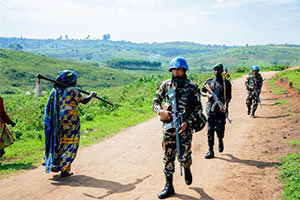 MONUSCO Peacekeepers and FARDC Soldiers Patrol Fataki Area. Credit: UN Photo/Jorkim Jotham Pituwa
Conflict, human rights violations, natural disasters, and famine have been at the forefront of concerns for humanitarian organizations. The escalation of humanitarian crises has led to over 239 million people in need of humanitarian assistance at the start of 2026, as estimated by OCHA’s Global Humanitarian Overview. The 2025 humanitarian appeal received only $12 billion, the lowest funding in over a decade, which has left 24 million fewer people reached in comparison to 2024. Conflict has remained the primary driver of crisis.
Humanitarian emergencies massively impact progress towards the Sustainable Development Goals (SDGs), adversely affecting economic development, inequality, education, planetary well-being, and poverty. Millions of people are faced with reduced access to essential services, including shelter, food, healthcare, and access to clean drinking water. UN Organizations such as UNHCR and the United Nations Children’s Fund (UNICEF) are committed to providing direct relief to affected communities when state governments cannot.
The United Nations 2024 Summit of the Future discussed measures that will be taken to reduce global inequality and promote peacekeeping efforts around the world. The recent UN Climate Change Conference (COP30) in Belém, Brazil, agreed to mobilize $1.3 trillion annually for climate action by 2035, operationalize the loss and damage fund, and triple adaptation finance. However, a fossil fuel transition commitment was not secured, despite climate change and the greenhouse effect being major contributors to humanitarian crises worldwide.
Countries across the world have also rallied to end humanitarian crises, as witnessed in conflicts such as Palestine and Ukraine. IPS is committed to providing relevant and in-depth reports of humanitarian emergencies around the world and their implications.

The Week with IPS

NEXT STOP - SDGs
Tracking global progress towards a sustainable world
Tracking global progress towards a sustainable world