Languages
Wednesday, September 23, 2026



News and Views from the Global South
Labour

The Adolescent Girl Holds the Key to Kenya’s Economic Transformation and Prosperity
Teenage pregnancy in Kenya is a crisis of hope, education and opportunity. The countdown to a New Year has begun. Can 2019 be a year of affirmative action to ensure hope and opportunity for Kenya’s adolescent girl?Aborted Fuel Tax Initiative in France: Its Ramifications for Green Growth
Emmanuel Macron was voted to French Presidency in 2017 with the mission of strengthening the integration of the European Union and pursuing economic and ecological reforms. So from the outset, he was set to distinguish himself, not just in Europe but on the world stage, especially after President Trump pulled the United States out of the Paris Agreement. So Macron held the summit meeting on `One Planet’ in Paris last December to push for stronger environment and climate policy. He also spoke of the environment when he addressed the Congress in April 2018, stating that “Let us face it: There is no Planet B.”i
Human Trafficking – Hidden in Plain Sight
The media globally tends to have a bias to negative, sensational and headline grabbing stories and events and this certainly applies to reporting related to human trafficking in the third world. With the abundance of stories around sweat shops, massage parlours and organ trafficking networks happening ‘somewhere else’, the West is generally desensitised, lacks empathy and fails to fully appreciate the scale of the problem which sits right under their noses and in plain sight.
What the COP24 Needs: A New Emerging Mindset
An alternative framework of international development and new forms of consumption of good/services are implicit in achieving the goals of UN climate conference recently held in Poland.
Global Anti-Human Trafficking Coalition
Entire human history is one great struggle for freedom. To many, slavery is a synonym for something in the past, for transatlantic slave trade, but, unfortunately, slavery still exists in many different forms.
Tunisia – the Exception
Eight years have passed since the Arab Spring. In many countries, the uprising was crushed, but in Tunisia democracy gained a foothold. Arbetet Global travelled to the small country town Side Bouzid to find out why.
Pakistan: Food Security and Reducing the Price of Wheat
Robert W. Fogel, the 1993 Nobel Prize Laureate for Economics, through his work on “efficiency wages”, pointed out that hungry and undernourished workers are not as productive as well fed and healthy workers. At the level of an individual firm, it would thus make sense for an employer to pay wages that are high enough to allow workers access to food and other necessities – even if such wages are higher than the going market rate.
Political Commitment Key to Health for All
One of my proudest accomplishments as the former UN secretary-general was playing a part in the ambitious global agenda for sustainable development (SDGs), including the goal of universal health coverage (UHC) by 2030.
Lives of the poor
The past few weeks in Karachi have seen an anti-encroachment drive that has affected livelihoods and living. Those spearheading the drive justify their actions, saying they are legal, and those using the spaces are painted as land grabbers. Meanwhile, another cause for concern is the intended clearing of land along the route of the moribund Karachi Circular Railways.
AI to map Chinese strikes
29 years ago, Han Dongfang survived the hail of bullets at Tiananmen Square. Now, he lives in Hong Kong and maps Chinese labour market strikes. Arbetet Global caught up with him at the ITUC World Congress in Copenhagen.
Big Business Capturing UN SDG Agenda?
Over the last two decades since the Global Compact, the United Nations has increasingly embraced the corporate sector, most recently to raise finance needed to achieve the Sustainable Development Goals (SDGs), i.e., for Agenda 2030. But growing big business influence has also compromised analyses, recommendations, policies and programme implementation, undermining the SDGs.
Havana Charter’s Progressive Trade Vision Subverted
In criticizing the ‘free trade delusion’, UNCTAD’s 2018 Trade and Development Report proposes an alternative to both reactionary nationalism, recently revived by President Trump, and the corporate cosmopolitanism of neoliberal multilateral discourse in recent decades by revisiting the Havana Charter on its 70th anniversary.
ITUC at a Crossroads as Sharan Burrow is Challenged
A fight for the position of Secretary-General divides the ITUC ahead of the World Congress in December. Where some see a choice between diplomacy and activism, others say it’s a question of internal democracy.
Asia-Pacific Takes Stock of Ambitious Development Targets
Ministers and senior policymakers across Asia and the Pacific are gathered in Bangkok this week to focus on population dynamics at a crucial time for the region. Their goal: to keep people and rights at the heart of the region’s push for sustainable development. They will be considering how successful we have been in balancing economic growth with social imperatives, underpinned by rights and choices for all as enshrined in the landmark Programme of Action stemming from the 1994 International Conference on Population and Development, or ICPD.
Gender Inequality is Stunting Economic Progress
‘Do not let us off the hook; keep our feet to the fire’. These were the words of the UN Secretary General Mr. Antonio Guterres when he promised to personally lead the global body towards greater gender equality.
Teenage Pregnancy in Kenya: A Crisis of Health, Education and Opportunity
That almost one in five Kenyan teenage girls is a mother represents not only a huge cost to the health sector, but also a betrayal of potential on a shocking scale.
Bringing Informal Workers to the Forefront of Our Economy
The image of the ‘struggling’ daily wage labourer in India is one that stakeholders from across the development sector aspire to transform. Financial security, quality living conditions, and opportunity to thrive are the buzzwords in a conversation about the needs of this bracket. These workers—usually associated with the informal or unorganised sector—are assumed to represent the outliers of the national economy.
Africa’s Giant Blue Economy Potential
With good reason, Africa is excited over the prospects of sharing in the multi-trillion maritime industry, with the continent’s Agenda 2063 envisioning the blue economy as a foremost contributor to transformation and growth.
Is the United Nations in Kenya Fit For Purpose?
The United Nations globally is witnessing some of the most ambitious reforms led by the UN Secretary General Mr. Antonio Guterres. Most relevant to us in Kenya is the entire reform of the development system and how the UN will adapt to a fast-changing development environment.
The Invisible, Hungry Hand
The very people who help put food on our tables often face numerous human rights violations, forcing them go to bed hungry.
”Like a TripAdvisor for migrant workers”
“The idea is to integrate technology into the fight for workers’ rights,” says Ira Rachmawati. As project manager with ITUC’s division for human and workers’ rights, she has led the development of the digital tool Recruitment Advisor, which the global trade union confederation hopes will improve conditions for the world’s 150 million migrant workers.« Previous Page — Next Page »


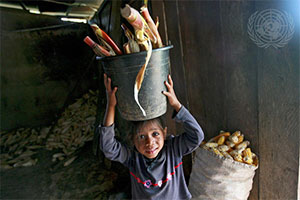 Timorese Girl with Fresh-Picked Corn. Credit: UN Photo/Martine Perret
A global common denominator is the need for a decent job. The economic realities of each country determine just how difficult it is to find one. Despite the labour movement's achievements, serious challenges persist: gender discrimination, child labour, worker migration, the digital divide and AI automation, evaporating pensions, unsafe workplaces, corporate pressure against union organising, negative impacts of trade agreements, and the precariousness of informal employment. The 2025 UN SDG Report identifies jobs and social protections as one of the six priority areas requiring urgent action, with progress either stalled or reversing in many developing nations.
In recent years, the fight to protect labour equality has taken on new dimensions with the rise of Environmental, Social and Governance standards. With the Social aspect aiming to promote equality and human rights, ESG principles have strengthened labour advocacy within corporate and governmental regulatory landscapes. In particular, ESG has become much more institutionalized in emerging economies such as Brazil and China. IPS follows the world’s workers as they confront these challenges - their setbacks and their successes.

The Week with IPS

NEXT STOP - SDGs
Tracking global progress towards a sustainable world
Tracking global progress towards a sustainable world
