Languages
Wednesday, November 18, 2026



News and Views from the Global South
Natural Resources

MINING-INDIA: Woman Leads Tribals Against World’s Steel Maker
The fight against the world's biggest steel maker, ArcelorMittal, is being waged from a tiny tea stall in Ranchi, eastern India.ECONOMY: Speculators Undermining Recovery, Report Says
The current economic meltdown will continue for years if the world community does not take firm and coordinated action to regulate the flow of capital, say researchers who have just concluded a new study for the United Nations.BRAZIL: More Growth, Less Carbon
Achieving sustainable growth is one of the major challenges facing Brazil, an emerging power and the fourth largest emitter of greenhouse gases in the world. To do this it will have to curb emissions, 30 percent of which are caused by industry and power generation.BRAZIL: New Law Would Put Oil Revenue into Development
On what he referred to as "a new independence day for Brazil," President Luiz Inacio Lula da Silva announced Monday proposed new legislation that would increase state control over the management of the country's enormous offshore oil finds, with the aim of channeling much of the state's oil revenue into a national social fund.VENEZUELA: Alarm over First Contraction of GDP in Five Years
The Venezuelan economy, which has grown steadily for more than five years, contracted by 2.4 percent in the second quarter of this year, heightening fears of stagflation, an unwelcome combination of recession and high inflation.
ENERGY-CANADA: “It’s Like the Wild West Out Here”
The once serene road to Tim and Linda Ewert's organic farm near Tomslake in northeastern British Columbia has become a mess of dust clouds, drilling rigs and hordes of pick-up trucks as the area transforms into the newest frontier of Canada's natural gas boom.
ENERGY: Pipeline Sabotage Blows Image of Stable Canada
North America's largest natural gas corporation hopes a one-million-dollar bounty will take down the saboteur who is blowing up their pipelines in northern Canada.
MALAWI: Activists Look Askance at New Mine
"We are serious about the integrity of the environment," says Neville Huxham, the country director for Paladin Energy Africa. "We're taking the uranium out of the ground, we're exporting it to be used for productive purposes, so we should be getting a medal for cleaning up the environment."
ENVIRONMENT: New Maritime Rules Target Oil Spills in Antarctica
The ships that bring thousands of tourists to Antarctica to take in some of the most pristine landscapes in the world will have to adapt to new marine environmental standards, which could be stricter than those requested by the members of the Antarctic Treaty.TRADE-VENEZUELA: Out with Colombia, In with Argentina
Ten thousands cars, 80,000 tons of beef, 100,000 tons of corn, 18,000 tons of milk, 9,000 tons of beans, 18 million eggs, two million pairs of shoes: Argentina has agreed to 1.1 billion dollars worth of sales to Venezuela, which has decided to stop importing goods from Colombia and get its supplies from other sources.EGYPT: Israel Gas Deal Inflames Opposition
Opposition figures and political activists have slammed a new deal to sell Egyptian liquefied natural gas (LNG) to Israel at what they say are vastly reduced prices.
NIGERIA: Slow Start for Niger Delta Amnesty
Nigeria’s president Umaru Yar’Adua is embarking on an ambitious move to end armed insurgency in the country’s oil-rich Niger Delta region.ENVIRONMENT-CHILE: Anti-Coal Plant Activists Get Death Threats
Five social activists and community leaders opposed to the construction of coal-fired thermoelectric plants near fishing villages in northern Chile filed a complaint with the prosecution service denouncing that they had received anonymous death threats warning them to stop their struggle.RIGHTS-SUDAN: ‘We Really Need Some Political Will’
The civil war in Darfur, a six-year conflict that has killed up to 300,000 Sudanese civilians thus far, is now virtually out of U.N. Secretary-General Ban Ki-Moon’s hands.
COLOMBIA: Women Lead Opposition to Gold Mine
Women in the small Andean town of Cajamarca and the nearby city of Ibagué, in the central-west Colombian province of Tolima, are leading the struggle against a major gold mining venture that threatens to alter their way of life.CHINA: U.S. Nervous About China's Growing Footprint Across Africa
China’s "no strings attached" financial assistance to developing countries in Africa and Asia has come under scrutiny during the recent high-level talks between Chinese and US leaders.
ENVIRONMENT: Open Pit Disasters in Mexico and Peru
Mariana Rangel is filled with nostalgia as she gazes at the abandoned installations of the Dos Estrellas mine, where she worked as a secretary for six years. "Those were years of prosperity; this is all there is left," she tells IPS, pointing to what used to be the local hospital.TRADE: African Producers Press Rich Nations on Cotton Subsidies
Representatives from four major cotton-producing African countries came to Washington this week to engage in a dialogue about what they consider to be unfair U.S. trade practices.ARGENTINA: Mining Funds Pose Ethical Conflict for Universities
An Argentine non-governmental organisation has warned that a mining consortium under scrutiny for polluting the environment has been funding public universities for the past two years, bringing into question the independence of any technical reports the universities may be asked to submit.ENVIRONMENT-GUATEMALA: Mines Bring No Benefits to Local People
The new draft law on mining before the Guatemalan parliament does not strictly regulate water use and environmental protection, does not provide for community consultation, and sets royalties payable to the state at too low a level, say environmental and social organisations.SUDAN: Ruling on Oil-Rich Border Area Fraught With Tension
The international community, in particular the U.S., has a responsibility to ensure that this week's upcoming legal decision on the boundary of Abyei, an oil-rich and contested region along the disputed north-south border within Sudan, is respected and that the residents of Abyei and the affected surrounding areas are protected from violence, said a strategy paper by the Enough Project released Monday.« Previous Page — Next Page »


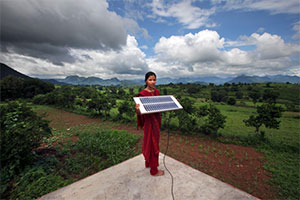 Bringing clean energy to rural India. Credit: Abbie Trayler-Smith / Panos Pictures / Department for International Development
Large reserves of oil, gas and minerals in developing countries generate opulent revenues. They could be used to stimulate economic growth and reduce poverty, but often result in environmental destruction and conflict, benefiting large companies and corrupt governments. Furthermore, competition over natural resources often manifests through geopolitical conflict. For example, before the US-Iraq war, Iraq’s domestic oil industry was nationalized. With US aggression came weakened Iraqi institutions and foreign intervention, thus eventually leading to the privatization of Iraqi oil, leaving the industry now largely dominated by Western companies. As another example, China’s rising investments within the lithium sector in South America are increasing the US-China rivalry across the Western Hemisphere. Notably, Bolivia has the largest reserves of lithium in the world, and the nation’s state-owned lithium extraction firm recently signed a contract with China’s CBC Consortium, while rejecting the entry of Western firms into the nation. In Bolivia’s case, rising Chinese investment in the nation’s lithium sector also raises concerns about environmental sustainability and the sociopolitical rights of Indigenous communities. More broadly, Sub-Saharan Africa holds nearly 30% of global reserves of critical minerals required for low-carbon technologies. Despite this, the region attracts less than 10% of global exploration investment, depicting a critical barrier to both the clean energy transitions and Sub-Saharan Africa’s economic development. Furthermore, resource wealth continues to fuel conflict like Sudan’s civil war, which has led to 9.1 million internally displaced people and is intensely connected to competition over gold, water, and agricultural land. IPS covers news about major oil, gas, and mining projects, their effects on the environment and local communities, and the ideas and actions of the interest groups involved.

The Week with IPS

NEXT STOP - SDGs
Tracking global progress towards a sustainable world
Tracking global progress towards a sustainable world
