Languages
Wednesday, November 18, 2026



News and Views from the Global South
Natural Resources
SOUTH AMERICA: Calls for Justice for Peru’s Native Peoples
Social organisations in South America are backing the struggle against opening up Peru’s Amazon jungle to mining and oil companies, which resulted in clashes in which at least nine indigenous people and 25 police officers died.
PERU: Native Protesters Search for Their Dead
Indigenous people taking part in protests near this town in the northern Peruvian province of Amazonas that ended in a bloody clash with the police last week are now focusing on drawing up a list of the dead and missing, amidst a climate of fear and mistrust.ECONOMY-AFRICA: Economies Must Diversify, Reduce Focus on Mining
The global financial crisis has taught African governments a lesson. More than ever, they recognise the need to diversify their countries’ mining operations as a key defence against economic instability and cyclical swings.RIGHTS: Saro-Wiwa Settlement Latest Vindication of 1789 Law
Monday's settlement of a long-pending case by Royal Dutch Shell marks the latest successful use by human rights groups of a 1789 anti-piracy law to gain redress in U.S. courts on behalf of foreign victims of serious abuses committed overseas – in this case, Nigeria.
PERU: ‘Police Are Throwing Bodies in the River,’ Say Native Protesters
There are conflicting reports on a violent incident in Peru’s Amazon jungle region in which both police officers and indigenous protesters were killed.ENVIRONMENT-COLOMBIA: Coal Mine Hurts Highlands Lake, Farms
Protests by indigenous farmers in the Colombian village of Cuayá, 75 km north of Bogotá, have failed to bring to a halt the unregulated extraction of coal, which has had disastrous environmental effects on Lake Suesca, 3,000 metres above sea level.
/CORRECTED REPEAT*/INDIA: Cheapest Car Rides on Govt Subsidies
India’s Tata Motors, makers of the ‘cheapest car ever made’, say they have received more than a million bookings for the first batch of cars said to roll out of its factory in a few months.
CLIMATE CHANGE: Twilight of the Fossil Fuel Era?
The world has turned a green corner toward a more sustainable future, with investments in clean energy outpacing fossil fuel power generation for the first time.ENERGY: Oil Economy Driving Growth of Controversial Tar Sands
A report from one of the world’s top energy consultancies says oil production in Canada’s tar sands could see a five-fold increase by 2035.BRAZIL: Murder, Death Threats Amid Environmental Protests
Environmentalists and human rights activists in Brazil are demanding clarification of the murder of Paulo Santos Souza, a fisherman and trade unionist who was fighting irregularities in the construction of a gas pipeline for Petrobras.ENVIRONMENT: Preserve Peru’s Biodiversity, Save the World
Peru, second in Latin America for total area of tropical forests, has adopted international laws, instruments and strategies to protect its wealth of flora and fauna. But those tools have not yet had much effect.RIGHTS: Indigenous Lands Plundered in Oil and Gas Rush
Leaders of the world’s 370 million indigenous peoples who are attending an international meeting here this week say they want governments to stop oil and gas corporations from further extraction on their lands.
U.S.: Green Groups Hail Plan to Slash Transport Emissions
Environmental groups are applauding President Barack Obama’s new nationwide rules for car emissions and mileage standards, announced Tuesday.DEVELOPMENT: Lifting the ‘Resource Curse’
Four new countries have joined the Extractive Industries Transparency Initiative (EITI), a global effort to set concrete standards for the transparent management of revenues from the oil, gas and mining sectors.ENVIRONMENT-CHILE: Activists Try to Block Start of Pascua Lama Mine
As Canadian mining giant Barrick Gold gets ready to start construction at the Pascua Lama mine, straddling the Argentine-Chilean border, activists in Chile are scrambling to block the ambitious mining project while calling for an investigation of supposed irregularities committed in the approval process.
ENVIRONMENT-TANZANIA: Villagers Fearful After Mine Water Discharged Into River
Water from a storage pond at Barrick Gold's North Mara mine in Tanzania is seeping through containing walls, leading local villagers to fear their water sources are contaminated.FINANCE: ExxonMobil Faces Growing Dissent in the Ranks
After years of boycotts and protests, the pressure on the world’s largest oil company to change its practices might soon be coming from the mutual funds that invest in it, some shareholders hope.
PERU: Talks Fall Flat; Indigenous Protests Rage On
The Peruvian government resumed talks with indigenous groups after a violent crackdown on protests left 10 injured and around 20 under arrest. But the dialogue has not yet brought results, and the demonstrations against decrees that affect indigenous lands and the rainforest continue, while a state of emergency remains in place in several Amazon regions.ENERGY-BRAZIL: Two-Pronged Policy
The Brazilian government announced it is overhauling the country's energy basket with more emphasis on renewable resources, while continuing to plan for future expansion of local production of traditional fossil fuels, like oil and gas.ENERGY-LATIN AMERICA: US Proposes “Variable Geometry”
The United States will work on energy issues with the other countries of the Americas based on "a variable geometry," allowing governments to choose to cooperate in some areas but not others, said Jeremy Martin, head of the energy programme at the Institute of the Americas at the University of California San Diego.CHILE: Scientist Warns of Threats to Rock Glaciers
A new government policy on glaciers adopted by Chile "is a step forward, but it doesn’t resolve all of the problems," German geographer Alexander Brenning, who blames mining companies for threats to this South American country’s rock glaciers, told IPS.« Previous Page — Next Page »


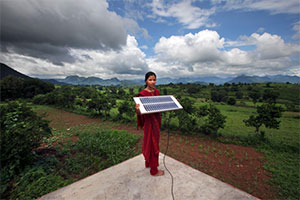 Bringing clean energy to rural India. Credit: Abbie Trayler-Smith / Panos Pictures / Department for International Development
Large reserves of oil, gas and minerals in developing countries generate opulent revenues. They could be used to stimulate economic growth and reduce poverty, but often result in environmental destruction and conflict, benefiting large companies and corrupt governments. Furthermore, competition over natural resources often manifests through geopolitical conflict. For example, before the US-Iraq war, Iraq’s domestic oil industry was nationalized. With US aggression came weakened Iraqi institutions and foreign intervention, thus eventually leading to the privatization of Iraqi oil, leaving the industry now largely dominated by Western companies. As another example, China’s rising investments within the lithium sector in South America are increasing the US-China rivalry across the Western Hemisphere. Notably, Bolivia has the largest reserves of lithium in the world, and the nation’s state-owned lithium extraction firm recently signed a contract with China’s CBC Consortium, while rejecting the entry of Western firms into the nation. In Bolivia’s case, rising Chinese investment in the nation’s lithium sector also raises concerns about environmental sustainability and the sociopolitical rights of Indigenous communities. More broadly, Sub-Saharan Africa holds nearly 30% of global reserves of critical minerals required for low-carbon technologies. Despite this, the region attracts less than 10% of global exploration investment, depicting a critical barrier to both the clean energy transitions and Sub-Saharan Africa’s economic development. Furthermore, resource wealth continues to fuel conflict like Sudan’s civil war, which has led to 9.1 million internally displaced people and is intensely connected to competition over gold, water, and agricultural land. IPS covers news about major oil, gas, and mining projects, their effects on the environment and local communities, and the ideas and actions of the interest groups involved.

The Week with IPS

NEXT STOP - SDGs
Tracking global progress towards a sustainable world
Tracking global progress towards a sustainable world
