Languages
Thursday, November 19, 2026



News and Views from the Global South
Human Rights

Trump’s 1st State of the Union: Refugee Policy & What Will Likely Go Unsaid
It is unlikely that President Trump will reverse his policies toward refugees in his State of the Union address on 30 January. Despite his expected silence on the state of U.S. and global refugee policy, there is a lot to say about how refugee policy has changed and will change in the future.
For Millions of Indian Women, Marriage Means Migration
Rekha Rajagopalan, a 26-year-old schoolteacher, migrated to the Indian capital city of New Delhi from southern Chennai in 2015 after her marriage. The reason was simple. Rekha's husband and his family were based in Delhi, so like millions of other married Indian women, she left her maternal home to relocate to a new city with her new family.
Press Crucial to Nation-building and Must Be Protected Vs Foreign Meddling
What I found very sad in the controversy over the website Rappler is that there really has been little outrage over its vile deed, which is indisputably as follows: Its profit-hungry owners, influence-seeking foreigners, and its fame-lusting editor-in-chief were so willing to violate the Constitution’s provision that is intended to shield media from foreigners and ensure its freedom to help develop our people’s consciousness as a nation.
Where We Stand
On the evening of Jan 23, Dawn had the following lead news items on its website: the rape and murder of an eight-year-old child, a follow-up on the death of a young man murdered in a fake encounter, a student’s attack on a teacher, the ‘alleged’ gang rape of a transgender, a follow-up on the death of a professor and another on the death of a student beaten by his teacher, and the murder of a college principal. These were the ‘top’ stories of Jan 23.
Why Release of Two Journalists in Ethiopia Does not Signal End to Press Crackdown
On January 10, radio journalists Darsema Sori and Khalid Mohammed were released from prison after serving lengthy sentences related to their work at the Ethiopian faith-based station Radio Bilal. Despite their release and Prime Minister Hailemariam Desalegn's promise earlier this month to free political prisoners, Ethiopia's use of imprisonment, harassment, and surveillance means that the country continues to be a hostile environment for journalists.
Closure of Ethiopia’s Most Notorious Prison: A Sign of Real Reform or Smokescreen?
Ethiopia’s most notorious prison lurks within the capital’s atmospheric Piazza, the city’s old quarter popular for its party scene at the weekend when the neon signs, loud discos and merry abandon at night continue into the early hours of the morning.
FAO, IOM Boost Cooperation on Migration
In view of the co-chairmanship of the Global Migration Group (GMG) this year and to further strengthen their collaboration, the Food and Agriculture Organization (FAO) and the International Organization for Migration (IOM) have signed a new Memorandum of Understanding (MoU).IOM DG Discusses Migration with Greek, Italian and Nigerians Leaders at WEF Annual Meeting
IOM Director General William Lacy Swing, joined Paolo Gentiloni, Prime Minister of Italy, Alex Tsipras, Prime Minister of Greece and Yemi Osinbajo, Vice President of Nigeria to discuss mass migration across the Mediterranean and how policy-makers can move towards a strategic partnership between Europe and its southern neighbours.
Indigenous Peoples & Local Communities Vital to the Global Environment
Indigenous Peoples and local communities are some of the best environmental stewards. Their livelihoods and cultures depend on forests, clean water and other natural resources, so they have strong incentives to sustainably manage their lands.
Aid Group Shines Spotlight on the Neglected
Though 2017 was marked by stories of humanitarian disasters around the world, many crises remain under the radar with devastating consequences for those affected, a new report says.
Investing in Better Migration Data Could be Worth Over USD 35 Billion
Could better use of data help turn human mobility into an asset worth tens of billions of dollars? That’s the finding of a study by the UN Migration Agency’s (IOM) Global Migration Data Analysis Centre (GMDAC), working with the McKinsey Centre for Government (MCG), being released today at Davos’ World Economic Forum.
Migrants Without Shoes
Addis Ababa, Ethiopia, 2013. It is past midnight. The aircraft come in from Saudi Arabia carrying workers who had been hastily ejected. They had gone from Ethiopia to work in a variety of jobs in a Kingdom flush with oil wealth.
Mediterranean Migrant Arrivals Reach 4,485 in 2018; Deaths Reach 201
IOM, the UN Migration Agency, reports that 4,485 migrants and refugees entered Europe by sea through 21 January. This compares with 3,335 coming ashore during a similar period in 2017. Italy accounts for approximately 60 per cent of the total, with the remainder split between Spain (19 per cent) and Greece (20 per cent).
Argentina Continues to Seek Truth and Justice, Despite the Hurdles
Thirty-four years after Argentina’s return to democracy, more than 500 cases involving human rights abuses committed during the 1976-1983 military dictatorship are making their way through the courts. This high number not only shows that the process of truth and justice is ongoing, but also reflects the delays and the slow process of justice.
Left Behind: Families of Migrants Wait in Limbo
Wahid Haider talks about his son’s departure to Italy almost seven years ago without regret or hesitation. Haider has not seen Nayeem, now 30 years old, since he left Nankar in search of better economic prospects, travelling through Romania, where he spent several months, before entering Italy.
Reinstating the Death Penalty a Violation of International Law
AS a consequence of President Duterte’s war on drugs, there has been in the Philippines a move to reinstate death as capital punishment. On March 7, 2017, the House of Representatives approved the reimposition of the death penalty for drug-related crimes, among others, by a vote of 217 yeses and 54 no’s. The bill is pending in the Senate. As might be expected from the chamber that approves the ratification of international treaties, certain Senators have raised objections to the bill on the ground that it is violative of international law.
Address the Prime Concerns
We welcome the recent agreement between Bangladesh and Myanmar for the repatriation of Rohingya refugees in Bangladesh. However, there is ample ground for scepticism regarding the real concerns of the Rohingyas fully addressed by Myanmar. Now, as the date and timeframe have been fixed, a further concern—the rate of repatriation—has been added.
Groups Condemn U.S. Cuts to Palestinian Refugee Agency
International organizations have criticized the United States’ decision to cut more than half of planned funding to a UN agency serving Palestinian refugees.
Davos: a Tale of Two Mountains
As the elite in the world of finance gather in the Swiss luxury town of Davos, rallies are taking place around the world as citizens demand for solutions to rising inequality. At the same time as the World Economic Forum’s rich and powerful hold forth about fixing the crisis of inequality they created, a new movement called the Fight Inequality Alliance is telling another story that is growing around the world.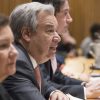
“The World Has Gone in Reverse”
A year into his position, the United Nations Secretary-General António Guterres said that peace remains elusive and that renewed action must be taken in 2018 to set the world on track for a better future.
Caught Between Two Countries
Three friends are relaxing in a quiet courtyard. They speak English with a strong American accent and talk about their disadvantaged neighborhoods. Their tattoos depict a rough life on the street. One of them calls Massachusetts home, while the others grew up in Georgia.« Previous Page — Next Page »


One world, one humanity, now one court to defend its rights. Another step towards universal human rights, but not remotely a step far enough. The United Nations adopted the Universal Declaration of Human Rights more than half a century ago, but that has done little to stop violations the world over, just as the Geneva Convention has not protected prisoners of war enough. Democracy itself and the freedom it presupposes has not been protective enough. This is the century to move from politicisation of human rights towards humanising political ways. IPS keeps an eye on that difficult path.

The Week with IPS

NEXT STOP - SDGs
Tracking global progress towards a sustainable world
Tracking global progress towards a sustainable world
