Languages
Sunday, October 25, 2026



News and Views from the Global South
Population

Mexico Looks to the Heavens for a Solution to Its Water Crisis
In neighbourhoods like Tehuixtitla in southern Mexico City, rain brings joy, because it provides water for showering, washing dishes and clothes, and cooking, by means of rainwater harvesting systems (RHS).
Developing Countries COVID-19 Debt Crisis Could Put SDGs & Climate Agreement Completely Out of Reach
The inability of developing nations to spend on post COVID-19 recovery and resilience has placed the world on the "the verge of a debt crisis". “We face the spectre of a divided world and a lost decade for development,” United Nations Secretary-General António Guterres said on Monday, Mar. 29, during a high-level meeting on financing development post COVID-19.
Why Rehabilitation is as Vital as Rescue for Child Trafficking Survivors
Twelve-year-old Babloo’s (Name changed) parents, who worked as daily wage agricultural labourers in the eastern Indian state of Bihar, were finding it difficult to feed their family of six. They had recently lost their eldest son to sudden illness, when a distant relative convinced them to send Babloo with him to work in a city. He promised to pay Rs 5000 ($70) a month, a significant amount for the impoverished family.
After the Fire: Rebuilding of Rohingya Camp a Race Against Time Ahead of Monsoon Season
 The building that was once the largest health centre in the Kutupalong refugee camp, serving some 55,000 Rohingya refugees 24/7, is now a burnt, distorted shell after a massive fire spread through the Cox’s Bazar camp in Bangladesh this week.
And as the tens of thousands of affected Rohingya return to the empty pieces of land that where once their homes, the need to rebuild — both the health facility and their homes — has added impetus because of the current COVID-19 pandemic and the coming monsoon season.
The building that was once the largest health centre in the Kutupalong refugee camp, serving some 55,000 Rohingya refugees 24/7, is now a burnt, distorted shell after a massive fire spread through the Cox’s Bazar camp in Bangladesh this week.
And as the tens of thousands of affected Rohingya return to the empty pieces of land that where once their homes, the need to rebuild — both the health facility and their homes — has added impetus because of the current COVID-19 pandemic and the coming monsoon season. 
Hope & Numbers: What will it take to Tip the Scales on Climate Action?
We should be well on the way to solving the climate crisis by now. According to the Paris Agreement, last year should have been the year that all countries presented their commitments to cut carbon emissions for limiting global climate heating to within 1.5oC of pre-industrial levels.
Tech Savvy Youth with High Social-Emotional Skills Succeed in Agriculture – Study Shows
Saheed Babajide, a young animal production graduate and a manager at a national milk production company in Iseyin, Nigeria, is a beneficiary of the government's youth agriculture intervention programme. But he feels he received almost no training during the three years he participated.
Why Water & Sanitation Systems are Vital for the Economy
This World Water Day, we celebrate the value of water, which at first might be a given: after all, water is the basis of all life. Without water we have no health, wealth, equality, or education.
The Value of Water Goes Far Beyond its Stock Price
In the midst of a global pandemic, when the presence of water in our lives has never seemed more important, its future availability has also never been more uncertain.
Access to Safe Water Never Loses Value
The global community is celebrating World Water Day 2021. In the COVID-19 pandemic era, the importance and value of water for all people has never been clearer. Access to safe water is essential for public health and thriving communities.
A Moral Failure: Billions of People with No Access to Clean Drinking Water
Water is integral to sustainable development, but we are well behind on the goals and targets that we have set ourselves.
Clean Water Vital for Protecting Those on the Frontline of Climate Change in Post-Pandemic World
For many, the last year will be remembered as the time our day-to-day lives screeched to a halt. As Covid-19 spread mercilessly across the world, wreaking havoc on health and livelihoods, world leaders, health experts and scientists grappled with how to protect populations and stem the tide of the virus.
Achieving Gender Equality for Women’s Re-entry to the Labour Force Post COVID-19
During the height of the COVID-19 lockdowns, while many sought safety being at home, women in the healthcare, child care, aged care, teaching and services fields — who hold the majority of jobs in those occupations — went to work everyday.
Only Small Percentage of COVID-19 Recovery Allocated to Green Initiatives
Last year, only $368 billion of a $14.6tn budget geared towards COVID-19 recovery measures across the world’s largest 50 countries took into account green recovery initiatives, according to a report launched yesterday, Mar. 10.
More ‘Can & Must be Done’ to Eradicate Caste-Based Discrimination, Says UN Rights Chief
There is hardly a better way to promote human rights in Nepal than celebrating Muskan Khatun for being one of the winners of the prestigious International Women of Courage (IWOC) Award, released on the International Women’s Day by the Government of the United States of America.
Malawian Youth Wipe Away Unemployment Tears with Agribusiness
After getting tired of searching for employment for seven years, Feston Zale from Chileka area in Malawi’s Southern Region decided to venture into agribusiness.
International Women’s Day, 2021
Removing Barriers to Women’s Leading Role in African Agriculture
Africa’s population will double by 2050 if growth rates continue their trajectory, but the creation of jobs is not keeping pace, with up to five times more young people seeking employment each year as there are new posts to fill. And, on top of this, the COVID pandemic is plunging Africa into its first recession in 25 years.

Demographic Impact of Coronavirus Pandemic: An Overview
The demographic impact of the coronavirus one year after being declared a pandemic on 11 March 2020 has been enormous. The picture that emerges is one of significant consequences on the levels and trends of the key components of demographic change: mortality, fertility and migration.
Protests by Indian Farmers Spread Panic in Image-Conscious Modi Government
Indian Prime Minister Narendra Modi does not really like attending parliament – except on special occasions. Budget session was one such occasion. Unsurprisingly, he tried to reach out to farmers still protesting at the border of the capital Delhi, against his government’s new farm laws.
The Global Insecurity of Climate Change
For Sudanese youth, climate change is synonymous with insecurity. “We are living in a continuous insecurity due to many factors that puts Sudan on top of the list when it comes to climate vulnerability,” said Nisreen Elsaim, Sudanese climate activist and chair of United Nations Secretary General's Youth Advisory Group on Climate Change.
Q&A: UN Environment Assembly Kicks Off With a Call to Make Peace with Nature
Its time for the world to radically change our ways if we are to make peace with the planet and create the environmental conditions so that all of humanity can thrive, delegates attending the Fifth Session of the United Nations Environment Assembly (UNEA-5) heard this morning.
UN Blueprint that Could Urgently Solve Earth’s Triple Climate Emergencies
“Our war on nature has left the planet broken. This is senseless and suicidal. The consequences of our recklessness are already apparent in human suffering, towering economic losses and the accelerating erosion of life on Earth,” António Guterres Secretary-General of the United Nations said.« Previous Page — Next Page »





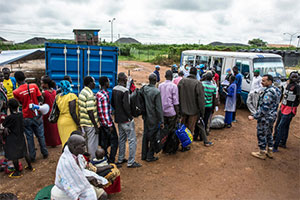 One Thousand Internally Displaced Persons (IDPs) Relocated from Tomping Camp in South Sudan. Credit: UN Photo/Isaac Billy
It took hundreds of thousands of years for the world’s human population to cross one billion in 1804. Approximately 200 years later, the population has multiplied sevenfold. In 2023, the global population crossed 8 billion, and is expected to reach 9 billion before 2050. With the planet more crowded than ever, it is essential to keep track of population trends, urbanization, migration, and reproduction across the world.
Life expectancy has seen significant strides in the past century, largely due to economic development and increased standards of living. On the contrary, trends in global fertility are shifting, with certain regions in Africa and Asia reporting higher rates, while parts of Europe and North America report stagnant or lower rates. This is in part due to differences in sexual and reproductive healthcare, as well as societal and economic conditions around the world. For example, child marriage is prevalent in certain societies, where childbearing is also considered a familial duty. Meanwhile, stagnating economies frequently experience lower marriage and childbearing rates.
The increase in migration and urban development around the world is also linked to global population trends. By 2050, it is expected that approximately 66 percent of all people will live in cities. Furthermore, global crises such as warfare and natural disasters also prompt transnational migration. Transnational migration is linked to a variety of socioeconomic issues in both host and receiving countries: migrants often leave developing countries with less access to educational and economic opportunities and arrive in developed countries where they are frequently the targets of ethnic, racial, and cultural discrimination, and economic exploitation. Recent crises in Europe and the United States demonstrate the importance of advocating for migrants worldwide. As migrants from the Global South are increasingly stripped of their legal and civic rights in unlawful deportations, or targeted in acts of identity-based violence, it is essential to keep track of population trends and protect the human rights of migrant populations. Climate-related disasters are now a major driver of displacement, with nearly half of all new internal displacements in 2025 being disaster-related.
IPS is devoted to covering issues surrounding population trends, migration, and reproduction through its compelling articles, which use both statistics and human stories to provide readers with robust and informative viewpoints.

The Week with IPS

NEXT STOP - SDGs
Tracking global progress towards a sustainable world
Tracking global progress towards a sustainable world
