
Tuesday, October 27, 2026



News and Views from the Global South
Population

UN Blueprint that Could Urgently Solve Earth’s Triple Climate Emergencies
“Our war on nature has left the planet broken. This is senseless and suicidal. The consequences of our recklessness are already apparent in human suffering, towering economic losses and the accelerating erosion of life on Earth,” António Guterres Secretary-General of the United Nations said.
Q&A: Tigray – the Fighting will Continue & Exacerbate Civilian Suffering
While Ethiopia’s federal government may have administrative control of the Tigrayan capital, Mekelle, and other main cities in the region, including Shire, Adwa, and Aksum, after removing the regional government from power in late November — armed resistance in Tigray is not over and could continue for months.
Switzerland Buys itself Good Sustainability Scores at the Expense of Other Countries
According to the Sustainable Development Report 2020, Switzerland ranks at a shameful 163 of 165 in terms of so-called spillover effects. This means that Switzerland buys better sustainability scores in a number of areas, placing considerable burdens on other countries and the global environment.
Transition to Digital Economy Must Ensure Access to Those in the Digital Gap
It is crucial to ensure that any transition to a digital economy has mechanisms in place that are non-digital to avoid “double exclusion”, according to Shahrashoub Razavi, director of the social protection department at the International Labour Organisation (ILO).
To Prevent Another Civil War South Sudan Must Create a New, Unique Political System
The threat of a full-blown civil war in South Sudan remains unless the country’s leaders can broaden power sharing, warns a new report by the International Crisis Group (ICG) released almost year into the country’s formation of a government of national unity.
Q&A: Documenting COVID-19 Effect on Youth Sexual and Reproductive Health
With the COVID-19 pandemic adding complex layers of challenges to the issue of sexual and reproductive health for the youth, governments should prioritise documenting these effects for data collection purposes, Dr. Simon Binezero Mambo co-founder and team leader of the Youth Alliance for Reproductive Health in the Democratic Republic of the Congo, told IPS in an interview.

Why it’s Crucial Not to Limit the Youth’s Access and Use of Family Planning
With the COVID-19 pandemic negatively affecting access to Adolescent and Youth Sexual and Reproductive Health (AYSRH) services, it’s imperative governments employ community-based initiatives and peer educators to ensure these services are still available to them.
Nepal Struggles to Preserve Its Indigenous Languages as Those Speaking Them Dwindle
At last count Nepal had 129 spoken languages, but even as new ones are identified, others are becoming extinct. At least 24 of the languages and dialects spoken in Nepal are ‘endangered’, and the next ones on the verge of disappearing are Dura, Kusunda, and Tillung, each of which have only one speaker left.
Internationally COVID-19 Extracted a Heavy Toll on Older People
Internationally COVID-19 extracted a heavy toll on older people – raising concerns in the Asia Pacific region where more than half of the world’s ageing population live.
60 Days on, India’s Biggest Farmers’ Protest Shows No Sign of Weakening
“This road is my home now and it will decide my future,” Sukhvinder Singh, a 27-year old farmer from the Moga district of Punjab, tells IPS. Last November, weeks after the government of India passed three farm bills he felt were anti-farmer, Singh travelled to Singhu, a village near Delhi, to demand the laws be repealed. Since then, he has been living in a tent he shares with five other fellow farmer-protesters.
We are Facing a Climate Emergency, Warns UN Chief
We begin this year with a heightened awareness of the importance of resilience. The COVID-19 pandemic has reminded us that we cannot afford to ignore known risks.
Change Financing Priorities to Address COVID-19, Conference Hears
Innovative financing to resolve COVID-19 crisis was needed, a joint African and Asian parliamentarians’ webinar heard this week. The webinar, facilitated by Asian Population and Development Association (APDA), was aimed at enhancing support for the implementation of International Conference on Population and Development (ICPD)commitments in the face of the pandemic.
If Covid-19 is Primarily a ‘First World’ Virus, Why is the Global South in Lockdown?
The currently available Covid-19 vaccines have been authorized for ‘emergency use ‘in Europe and North America. This is due to an apparent spike in Covid-19 flu cases in the northern hemisphere as winter advances. Highly advertised vaccines are being produced and rolled out at ‘warped speed’ by powerful pharmaceutical and bio-technology companies headquartered in Euro-America although their efficacy including how long their immunity lasts is not clear.
Uganda’s School Plan for Refugee Children Could Become a Global Template
Thirteen-year-old Wita Kasanganjo is a pupil at Maratatu Primary School in the Kyangwali Refugee Settlement based in Uganda’s Hoima district. But last month, when Uganda’s President Yoweri Museveni ordered the re-opening of schools for the first time since the mid-March nationwide closure, Kasanganjo was not part of the returning group of students. The government, in a cautious lifting of coronavirus lockdown restrictions, has allowed only pupils who are part of the final year or candidate classes to return to their schooling.
Drop in Remittances – a Financial Lifeline for 800 Million People – Could Impact Financial Stability of Numerous Countries
On Dec. 2 Gabriel Arias, 42, left a Washington Heights, New York, money transfer agency after sending money home to the Dominican Republic. For the past eight years, every fortnight he would come to this branch at 171st street after getting paid from his construction job. But things are different this year and he worries about his family back home. Arias lost his job in May, amid heightened COVID-19 restrictions in the state. He told IPS he has tried to work some odd jobs, but has barely earned enough for his monthly apartment rental. This early December visit to send money home was only his second since June.
Persons With Disabilities Among Worst Affected by Coronavirus
The 13th session of the Conference of States Parties (COSP) that was initially supposed to be held in New York back in June recently wrapped up with the final session coinciding with the International Day of People with Disabilities, whose theme, this year was on the issue of building back better inclusively.
Q&A: Mro Indigenous Community Plea for Halt of Construction of 5-Star Hotel
The construction of a five-star hotel in the Chittagong Hill Tracts, Bangladesh, could lead to the forced eviction of the Mro indigenous community from their ancestral lands and destroy “the social, economic, traditional and cultural fabric of the community”, warns Amnesty International.But local activist Reng Young Mro told IPS that the international community must rally behind the Mro indigenous community to halt the construction.

It’s Time for Results as Sudan Enters Second Year of NDC Partnership
Earlier this year, when heavy rains caused massive flooding in Sudan, a three-month state of emergency was declared in September. The floods which began in July, were the worst the country experienced in the last three decades and affected some 830,000 people, including 125,000 refugees and internally displaced people.
How UN Helped Benin Become World’s Fastest Place to Start a Business via a Mobile Phone
Until recently, Benin was best known for its cotton exports and its vibrant clothing designs. Since this year it is also the fastest place in the world to start a company. By providing a full online service, the government helped entrepreneurs create businesses and jobs during the pandemic. A third of Benin’s new entrepreneurs are women.
Youth Demand a ‘Fair Share’ from World Leaders Ahead of G20 Summit
Heads of youth movements and student unions are challenging the world’s richest nations to correct an ‘incredibly unequal’ global response to COVID-19, by considering the plight of the world’s most vulnerable children and young people.
Bringing Clean Water On Tap To Rural Villages In Polynesian Island Nation Of Tuvalu
Rural communities on one of the nine islands that make up the Polynesian nation of Tuvalu are anticipating how life will change when they are connected to piped clean water for the first time.
« Previous Page — Next Page »





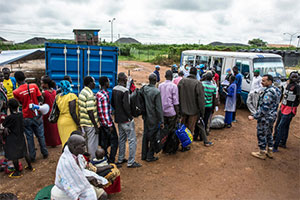 One Thousand Internally Displaced Persons (IDPs) Relocated from Tomping Camp in South Sudan. Credit: UN Photo/Isaac Billy
It took hundreds of thousands of years for the world’s human population to cross one billion in 1804. Approximately 200 years later, the population has multiplied sevenfold. In 2023, the global population crossed 8 billion, and is expected to reach 9 billion before 2050. With the planet more crowded than ever, it is essential to keep track of population trends, urbanization, migration, and reproduction across the world.
Life expectancy has seen significant strides in the past century, largely due to economic development and increased standards of living. On the contrary, trends in global fertility are shifting, with certain regions in Africa and Asia reporting higher rates, while parts of Europe and North America report stagnant or lower rates. This is in part due to differences in sexual and reproductive healthcare, as well as societal and economic conditions around the world. For example, child marriage is prevalent in certain societies, where childbearing is also considered a familial duty. Meanwhile, stagnating economies frequently experience lower marriage and childbearing rates.
The increase in migration and urban development around the world is also linked to global population trends. By 2050, it is expected that approximately 66 percent of all people will live in cities. Furthermore, global crises such as warfare and natural disasters also prompt transnational migration. Transnational migration is linked to a variety of socioeconomic issues in both host and receiving countries: migrants often leave developing countries with less access to educational and economic opportunities and arrive in developed countries where they are frequently the targets of ethnic, racial, and cultural discrimination, and economic exploitation. Recent crises in Europe and the United States demonstrate the importance of advocating for migrants worldwide. As migrants from the Global South are increasingly stripped of their legal and civic rights in unlawful deportations, or targeted in acts of identity-based violence, it is essential to keep track of population trends and protect the human rights of migrant populations. Climate-related disasters are now a major driver of displacement, with nearly half of all new internal displacements in 2025 being disaster-related.
IPS is devoted to covering issues surrounding population trends, migration, and reproduction through its compelling articles, which use both statistics and human stories to provide readers with robust and informative viewpoints.

The Week with IPS

Tracking global progress towards a sustainable world
