Languages
Thursday, November 19, 2026



News and Views from the Global South
Trade & Investment

‘Hate Is a Status Symbol. If You’re Not Being Hated You’re Not in the Game’ Says Celebrity Branding Guru Jeetendr Sehdev
New York Times bestselling author Jeetendr Sehdev believes that chief marketing officers need to start thinking differently about the younger generations they’re struggling to engage with. Ahead of his keynote, ‘Human 2.0: Sacrifice Everything If You Believe In Something’, at The Future of Marketing on November 22, Sehdev chats to The Drum about his book ‘The Kim Kardashian Principle’, how the Nike Colin Kaepernick campaign implemented his rules to create their success and why brands should embrace the hate from social media.
Venture Capital Can Turbo Charge Growth in Emerging Markets
Global poverty is undoubtedly the most critical economic and moral challenge of the 21st century. While economists debate how to raise up the world’s poorest – the more than 800 million people living on less than US$1.25 a day.-- entrepreneurs are spurring innovation and growth in emerging markets.
Creating Beauty and Worth from Bamboo Enhances the Livelihoods of Ghana’s Artisans
Yaw Owiredu Mintah from Ghana has been working as an all-round processor of bamboo and rattan since the 1980s. And while he says that he can do most things with bamboo like weaving, framing and finishing, he admits, “I need to improve my skills and designs because all of us are, most of the time, doing the same things.”
Lack of Funds Prevent Ugandan Communities from Investing in Cage Aquaculture
Colvince Mubiru had heard about cage fish farming on Uganda’s lakes. The small business owner decided to try his hand at it and spent USD8,000 to set up farming cages for Nile Tilapia on Lake Victoria, expecting to reap a huge profit. But just six months into his enterprise, he made huge losses.
Africa’s Giant Blue Economy Potential
With good reason, Africa is excited over the prospects of sharing in the multi-trillion maritime industry, with the continent’s Agenda 2063 envisioning the blue economy as a foremost contributor to transformation and growth.
Lessons for the ‘Rest’ from ersatz miracles
Of the ten fastest growing economies since 1960, eight are in East Asia. Two main competing explanations claimed to explain this regional concentration of catch up growth since the late 20th century, often referred to as the East Asian miracle.
Caribbean Looks to Protect its Seafood From Mercury
Four Caribbean countries have done an inventory of the major sources of mercury contamination in their islands, but a great deal of work still needs to be done to determine where and what impact this mercury is having on the region's seafood chain.
Is the United Nations in Kenya Fit For Purpose?
The United Nations globally is witnessing some of the most ambitious reforms led by the UN Secretary General Mr. Antonio Guterres. Most relevant to us in Kenya is the entire reform of the development system and how the UN will adapt to a fast-changing development environment.
North African Countries Need to Protect Their Economies From Illicit Trade
Since the 2011 revolution, Tunisia has been heralded as a model of democratic transition. However, nine governments in the past seven years have been struggling to revive the economy and the North African state faces the difficult task of maintaining faith in democracy amid a lagging economy, rising security challenges, and widespread corruption.
Seychelles Issues World’s First Blue Bond to Fund Fisheries Projects
The Republic of Seychelles announced on Monday that it has issued a 10-year blue bond to finance fisheries projects, making it the world’s first country to utilise capital markets for funding the sustainable use of marine resources.Big Brands Are Fuelling the Business of Nutrition
Food is an increasingly hot topic, no matter if you are rich or poor. Malnutrition – including undernutrition, overweight and obesity – affects 1 in 3 people around the world.
Africa’s Bumpy Road to Sustainable Energy
For years, Kenyans freely used and disposed of plastic bags. The bags were ubiquitous—in the markets, in the gutters and in the guts out of 3 out of every 10 animals taken to slaughter.
Perhaps Platform S?
When Accord and Alliance came to town, the brands and retailers had offered assurance of business continuity and were paying for the audits and assessments. Taking financial responsibility for factory remediation was, of course, the manufacturer's end of the bargain. In five years, out of Accord's initially inspected 1,620 factories, 420 had shut shop; for Alliance, out of the initial 829 factories, 173 closed business; National Action Plan, out of its first 1,549 factories, terminated 566. In total 1,159 factories have gone out of business. In response to growing demands of remediation, Bangladeshi manufacturers have either chosen to grow or quit. Those who have managed to stay afloat, in reality, have been able to afford expansion or consolidation.
Developing Countries Losing Out To Digital Giants
A new United Nations report warns that the potential benefits to developing countries of digital technologies are likely to be lost to a small number of successful first movers who have established digital monopolies.
What Accounts For Southeast Asia’s Phenomenal Success?
Southeast Asia has made extraordinary strides in recent decades. Growth in per capita incomes has been among the fastest in the world, and last year the region was the fourth largest contributor to global growth after China, India, and the United States. Living standards have improved dramatically. Poverty rates are down sharply.
Women & Youth Key to Achieving Agenda 2030 in South-South Cooperation
By 2050 Africa will have 830 million young people. Many countries in the global south, India included are seeing a youth(men and women) bulge. To reap a demographic dividend countries in the global south need to share and exchange knowledge to leapfrog socio-economic transformation.
Helping Ethiopia Achieve Green Growth and Avoid Industrialised Nations’ Environmental Mistakes
As Ethiopia undergoes a period of unprecedented change and reform, the Global Green Growth Institute(GGGI) is partnering with the Ethiopian government to try and ensure this vital period of transition includes the country embracing sustainable growth and avoiding the environmental mistakes made by Western nations.
New Agreement with Canada and U.S. Is Win-Lose for Mexico
Following the fanfare of the countries' leaders and the relief of the export and investment sectors, experts are analysing the renewed trilateral agreement with Canada and the United States, where Mexico made concessions in sectors such as e-commerce, biotechnology, automotive and agriculture.
Improving Infrastructure Planning In Developing Countries
Infrastructure investment is necessary, but hardly sufficient to enable developing countries to transform their economies to achieve sustainable prosperity, according to this year’s UNCTAD Trade and Development Report: Power, Platforms and the Free Trade Delusion (TDR 2018), released in late September.
Going Full Circle for Growth and the Planet
The business case for making our economy more sustainable is clear. Globally, transitioning to a circular economy - where materials are reused, re-manufactured or recycled-could significantly reduce carbon emissions and deliver over US$1 trillion in material cost savings by 2025.(1) The benefits for Asia and the Pacific would be huge. But to make this happen, the region needs to reconcile its need for economic growth with its ambition for sustainable business.
Investing in Arab and Asian Youth For a Sustainable Future
As the youth population has increased to unprecedented levels in Arab and Asian regions, governments need to do more to invest in them.« Previous Page — Next Page »


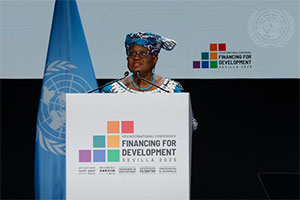 Opening of 4th International Conference on Financing for Development. Credit: UN Photo/Mariscal
International trade and investment are crucial elements of the world economy. While they can be powerful stimulators of development, they can also lead to global imbalances and dynamics of exploitation. In 2025, international trade entered a period of immense disruption, driven in part by a new wave of United States tariffs that reshaped global supply chains and investment flows. The increase in the US tariff rate, the highest since the 1930s, has forced bilateral renegotiations with global trading partners. Furthermore, the debt crisis in developing nations has accelerated while Official Development Assistance (ODA) has substantially dropped 7.3% in 2024.
In the 21st century, advancements in economic diversification in formerly colonized nations have propelled them into more central roles in the global economy. For example, both China and Mexico were able to develop their manufacturing sector and channel this development into booming export flows, thus advancing into the position of emerging economies. Foreign investment also plays an essential role in providing capital for developing countries, although they are oftentimes accompanied by social and environmental exploitation. For example, rising Chinese investments in natural resources in Latin America have often been met with tension as these investment projects fail to properly mitigate environmental risks and protect workers’ rights. In a more multifaceted vein, Sino-African relations have led to infrastructure development in Sub-Saharan Africa while also heightening the region’s economic dependency on China. IPS reports on global news in trade and investment, while shining a light on the nuanced nature of these endeavors.

The Week with IPS

NEXT STOP - SDGs
Tracking global progress towards a sustainable world
Tracking global progress towards a sustainable world
