
Tuesday, October 27, 2026



News and Views from the Global South

Chile Follows South Africa’s Lead in Climate Change Mitigation
Chile is turning to South-South cooperation to help define the most effective strategies and options for reducing its greenhouse gas (GHG) emissions in the face of global climate change.
Doha Climate Summit Ends With No New CO2 Cuts or Funding
The United Nations climate talks in Doha went a full extra 24 hours and ended without increased cuts in fossil fuel emissions and without financial commitments between 2013 and 2015.Ecobreves – BRAZIL: Researchers Preserve Genes of Threatened Amazon Monkeys
Researchers at the Federal University of Pará in Brazil are collecting and storing genetic material from monkeys in the genus Saimiri, commonly known as squirrel monkeys, to prevent the extinction of a sub-species endemic to the Amazon rainforest.Ecobreves – HONDURAS: In Search of Greater Transparency in the Extractive Industries
The World Bank will be advising Honduras on the requirements to join the Extractive Industries Transparency Initiative (EITI).Ecobreves – CHILE: Approval of Thermoelectric Plant Sparks Protest
Environmental organizations in Chile have expressed outrage over the ministerial approval granted for the construction of the Punta Alcalde thermoelectric power plant in the municipality of Huasco, 645 km north of Santiago.
Chile Follows in South Africa’s Footsteps for Climate Change Mitigation
The Chilean government has decided to adopt a model developed by South Africa to explore pathways to a low-carbon economy.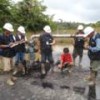
Peruvian Indigenous Communities Take Charge of Environmental Monitoring
They work with the precision of technicians and the enthusiasm of volunteers. They are indigenous inspectors documenting the damages caused by oil industry activity in three river basins in the Peruvian Amazon region.
Brazilian Communities Revitalise the São Francisco River
José Geraldo Matos fondly recalls the massive traíras (Hoplias sp), carnivorous freshwater fish found in the lagoons and rivers of Brazil, that he used to catch in the Dos Cochos River just a few metres from his house.
The Big Fight in Doha Is Over Climate Finance
The new Green Climate Fund to help developing countries cope with climate change may one day have a bigger budget than the World Bank. At the moment, however, the Fund is empty.Ecobreves – HONDURAS: Municipalities Confront Climate Change
Some 45 municipalities in the so-called dry corridor of Honduras have begun work on a project to promote reforestation, food security and climate change resilience in order to improve living conditions for their communities.Ecobreves – ARGENTINA : Stepping Up Resistance to Mega Mining
Residents of the southern province of Chubut, in the Patagonia region of Argentina, are fighting a proposed legal reform that would allow large-scale open-pit mining, involving the use of toxic substances, in this area.Ecobreves – MEXICO: Government of the Capital Wins Award for Urban Lighting Project
The French Environment and Energy Management Agency (ADEME) has granted a special recognition award to the “Energy, Innovation and Performance in Urban Lighting” project being implemented by the leftist government of Mexico City.Ecobreves – BRAZIL: Selective Waste Collection Available to Very Few
According to a survey conducted by the Brazilian Water Program, 64 percent of Brazilians still do not have access to selective waste collection as a means of recycling.
Brazilian Communities Revitalize the São Francisco River Through Its Tributaries
Communities along the banks of a tributary of the São Francisco adopt innovative measures to adapt to the diversion of the famous river’s course.
A Green Needle in the Haystack of Cuban Small Enterprise
Oasis Nelva is a refreshing green space in the midst of the grey asphalt landscape of Old Havana. The ornamental plant shop is also one of only a handful of eco-friendly initiatives among the upsurge of private small businesses in Cuba.
Q&A: COP18, Another ‘Conference of Polluters’
There is no political will among rich nations to find funding for developing countries experiencing the brunt of changes in global weather patterns, and the current climate change conference will fail to do so, according to Professor Patrick Bond, a leading thinker and analyst on climate change issues.

The Planet’s Thermostat Moves to Doha
The upcoming United Nations climate talks may have a renewed sense of urgency with a new World Bank report warning that the planet is on a dangerous path to four degrees Celsius of global warming by 2100.Ecobreves – BRAZIL: São Paulo Solar Plant Will Supply Electricity to Public Grid
The University of São Paulo will construct a photovoltaic power plant, in association with a local electric company, which will be the third solar power plant and the second to supply electricity to the public grid in Brazil.Ecobreves – HONDURAS: Women Farmers Producing Better Grains
Women farmers in seven departments of Honduras are working towards higher-quality, environmentally friendly agricultural production to gain better access to markets and fairer prices.Ecobreves – CUBA: Nuclear Technology for More Resistant Crops
Agricultural researchers in Cuba are using radiation in an attempt to develop banana, rice, avocado and tomato strains that are more resistant to drought and salinity, as part of a Latin American cooperation project.Ecobreves – CHILE: Cracks in Ralco Hydro Dam Raise Concern
The Aukin Wallmapu indigenous community in Alto Bíobío, 500 kilometers south of Santiago, has denounced the presence of cracks and leaks in the Ralco hydroelectric dam.« Previous Page — Next Page »





Tierramérica is the main communications platform on sustainable development and the environment in Latin America and the Caribbean. It is produced by IPS Noticias, the agency’s Spanish-language service, which created it jointly with the United Nations Development Programme (UNDP) and the United Nations Environment Programme (UNEP), with later support from the World Bank. The weekly editions of Tierramérica are published in Spanish, Portuguese and English and are picked up and printed by dozens of media outlets in the region. Follow us on Facebook and Twitter.

From the Frontline of Environment
Supported by

Tierramérica en Español

Terramérica em Portuguese

