Languages
Saturday, November 21, 2026



News and Views from the Global South
Africa
DEVELOPMENT: Microfinance Craze Conceals Multiple Problems
The microfinance industry is expanding at breakneck pace, with more banks and private equity firms now entering the fray. Yet there is growing unease about the naive assumptions, and evangelical predictions, of its advocates.Libya Dominates EU-Africa Talks
Facing unrest in the north and a struggle against poverty elsewhere, leaders of the African Union and their European counterparts are working as "equal partners" to spread democracy and economic opportunity across the African continent.
WORLD: Tropical Forest Summit Opens
Heads of state from the Amazon, Congo and Borneo-Mekong basins are meeting in the Congolese capital, Brazzaville: leaders hope to reach an accord on sound management of valuable rainforest ecoystems, but civil society actors believe the problems faced by local populations may be ignored.LIBYA: Zuma says Gaddafi Ready for Truce
Muammar Gaddafi is ready for a truce to stop the fighting in his country, Jacob Zuma, the South African president, has said.
SOUTH AFRICA: Sound Policy Key to Renewable Energy
A radical rethink of current energy policy can cut South Africa's greenhouse gas emissions by 80 percent in 2050 compared to 1990 levels. More than that - after an initial spike in investment - South Africans four decades down the line would pay 23 billion dollars per year less for their electricity compared to business as usual.HEALTH: Poor States Should Start Campaign to Extend Patent Rights
Pharmaceutical industries in emerging markets are shifting their focus away from poor to developed countries, which will affect access to cheap generic medicines. Poor states should tackle this development by capitalising on the international trade exemptions they still enjoy regarding medicines as "intellectual property".Explosions Greet Nigerian President’s New Term
Bomb blasts hit a military base in the northern Nigerian city of Bauchi on Sunday, killing ten and injuring more than a dozen just hours after the swearing in ceremony of President Goodluck Jonathan in the capital, Abuja. News reports also said three others died in a bombing in Zuba, just outside the capital.TANZANIA-INDIA: A Rewarding Relationship
The Indian prime minister, Dr Manmohan Singh, concludes a three-day visit to Tanzania on May 28. Singh arrived in Dar es Salaam from the Ethiopian capital, Addis Ababa, where he took part in the Second India-Africa Forum Summit, which began on May 20.LIBYA: Water Emerges as a Hidden Weapon
Libya’s enormous aquatic reserves could potentially become a new weapon of choice if government forces opt to starve coastal cities that heavily rely on free flowing freshwater.
ZAMBIA: Hope for Women Politicians
Mirriam Kauseni is on a quest to become her town’s first ever female parliamentarian. She has yet to be elected to run for the post by her party, the Patriotic Front (PF), but Kauseni has already been conducting door-to-door campaigns, telling people to vote for her in the country’s national elections.
AFRICA: ‘Bicycles Are For Good’
"Politicians may tell us that bicycles are a sign that we are not advancing," says Patrick Kayemba, managing director of the First African Bicycle Information Organization in Uganda, "but we ourselves have seen that cycling is a socio-economic tool. It works now - we don’t have to wait for someone to rescue us with better public transport, better this, or better that..."New Leadership for the ICC
As the International Criminal Court gears up to elect six judges and a new prosecutor, observers are warning that political rather than merit-based considerations could govern the evaluation of candidates.ZIMBABWE: Rural Women Voting With Their Feet
At independence in 1980, Loyce Tshuma (55), a villager in rural Tsholotsho in Matebeleland North, was a loyal believer in politics as a powerful vehicle to change and better lives. Since then she never missed an opportunity to cast her vote.
Arab Spring Solidarity Defies National Boundaries
Ever since the ousting of Tunisian president Zine El Abidine Ben Ali, ordinary citizens have been leading uprisings all over North Africa and the Middle East against unwanted rulers. But what is now known as the "Arab Awakening" is not confined to people resisting within their own borders. Some Arabs are helping the fight in neighbouring countries too.ZIMBABWE: Cross-Border Traders Don’t Trust Banks With Their Money
A newly available electronic banking service has received a lukewarm reception from cross-border traders in Zimbabwe’s second largest city Bulawayo, despite it alleviating the need to move around with large sums of cash.MALAWI: Rural Areas Still Struggle to Access Medicines
In the shade of a leafy mango tree at the rural Chipho Health Centre in Thyolo, southern Malawi, Melifa Faison sits looking frequently down the road hoping to see an ambulance. Lying beside her is her 6-year-old daughter, weak with malaria.
Violence Threatening South Sudan Independence
Escalating violence in Abyei, the largest of several towns in the disputed borders between North and South Sudan, has displaced thousands of people and, according to U.S. officials, is threatening the viability of both the 2005 Comprehensive Peace Agreement (CPA) and the soon-to-be independence of Southern Sudan, set for Jul. 9, as the potential for civil war between the two sides grows.
SOUTH AFRICA : Women Candidates Struggle in Local Government Elections
Political parties should be forced, through changes in legislation, to bring more women into government.
TRADE: Istanbul Conference “a Setback” for Poor Countries
Some of the decisions taken on trade in the Istanbul Plan of Action are likely to disadvantage poor countries while others are so vague as to be meaningless, says Abdoulaye Sanoko, counsellor at the mission of Mali to the World Trade Organisation (WTO) in Geneva.
POLITICS: First Woman Speaker of Parliament Changing Politics
Very soon wives in Uganda will legally have the right to a share in their husband’s property, that’s if the country’s new speaker of parliament has her way.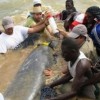
Protecting One of Africa’s Most Enigmatic Creatures
The manatee, or sea cow, is a torpedo-shaped marine mammal that moves languidly through the tepid waters of the Caribbean, South America and along the coast, rivers and wetlands from Senegal down to Angola. In the late 18th century, one of the manatee's closest and much larger relative, the Stellar Cow, were hunted to extinction. Today, the future of the West African manatee may not be far behind.« Previous Page — Next Page » *#*

The Week with IPS

NEXT STOP - SDGs
Tracking global progress towards a sustainable world
Tracking global progress towards a sustainable world
