Languages
Saturday, October 24, 2026



News and Views from the Global South
South-South

The Future of Food is in Our Hands
With its political and economic clout, the G20 should lead in delivering sustainable food systems as the world grapples with rising hunger, malnutrition and inequality.
Caribbean aims to Turn Foul-smelling, Enviro Problem Sargassum Seaweed into High-Value Products
 A regular visitor to the islands of the Caribbean has become a dreaded nuisance over the past ten years. The sargassum seaweed that typically washes ashore now arrives each year in overwhelming, extraordinary amounts for reasons that are not entirely clear.
A Global South Organization – a Sine Qua Non for Developing Nations’ Influence in World Arena
I observed the Group of 77 (G77) shortly after the 1964 Geneva Conference on Trade and Development (UNCTAD), the 1968 UNCTAD 2 in New Delhi and the 1972 UNCTAD 3 in Santiago. The Group was influential at the time, benefiting from several factors helpful for its functioning which are no longer present, namely:
What Role Can South-South Cooperation Play in Post COVID-19 Recovery?
Five years ago, at the 70th anniversary of the foundation of the United Nations, world leaders adopted the ambitious Agenda 2030 for Sustainable Development. The Agenda was to be accomplished through the achievement of 17 Sustainable Development Goals by 2030: eradicating poverty, ending hunger, addressing climate change – just to name a few.
The West vs the Global South: You Have the Numbers. We Have the Money
When the 134-member Group of 77, the largest single coalition of developing countries, was trying to strike a hard bargain in its negotiations with Western nations years ago, one of its envoys famously declared: “You have the numbers. We have the money.”
Youth Demand a ‘Fair Share’ from World Leaders Ahead of G20 Summit
Heads of youth movements and student unions are challenging the world’s richest nations to correct an ‘incredibly unequal’ global response to COVID-19, by considering the plight of the world’s most vulnerable children and young people.
Semiarid Regions of Latin America Cooperate to Adapt to Climate
After centuries of poverty, marginalisation from national development policies and a lack of support for positive local practices and projects, the semiarid regions of Latin America are preparing to forge their own agricultural paths by sharing knowledge, in a new and unprecedented initiative.
Genuine Reform Culture Lacking in Zimbabwe
Zimbabwe needs urgent economic and political reforms to transform its economy amidst a growing national crisis, researchers say in a new study that urges swift policy changes and a sound financial framework to attract investment.
Going with the Wind: Transition to Clean Energy in Latin America & the Caribbean
The UN Climate Action Summit 2019, which took place in the days leading up to the 74th UN General Assembly, delivered new pathways and practical actions for governments and private sector to intensify climate action.
Towards a Sustainable Future: Case of China’s Economic Transformation
The Asia-Pacific region is at a crossroads. The traditional export-oriented, manufacturing-driven growth is facing headwinds from sluggish external demand and rising protectionist trade measures.
Europeans Mobilising for New IMF Head
In the grand European political reshuffle of 2019, it turned out that Christine Lagarde was the answer to the conundrum of who should replace Mario Draghi at the European Central Bank. But her move opens another question. Who succeeds Lagarde at the International Monetary Fund?
Lessons From China: Fostering Agricultural Growth and Poverty Reduction
As China has moved from a poor isolated country to a major player in the world economic and political sphere, developing countries need to learn how to engage.
China and Developing Countries: Managing Chinese Investments
Fifty years ago China was a poor country with little influence in the international sphere and without even a seat at the United Nations. Since then rapid economic growth in China has made it an economic powerhouse that increasingly plays a leading role on the world stage as a trade partners as well as a source of investment.
Communication, a Key Tool for South-South Cooperation
Communication can be a key tool for the development of cooperation among the countries of the global South, but the ever closer relations between them do not receive the attention they deserve from the media.
A World Party
I have been a member of the first international party: the Transnational Radical Party, founded in 1956 by Marco Pannella and Emma Bonino. Then in 1988, I was a witness of the large protest, in Berlin West, against the meeting of the International Monetary Fund and the World Bank, a precursor of the “Battle of Seattle” in 1988, where 40.000 protesters disrupted the annual meeting of the two world’s financial institutions. I was even detained for a day by the police, even if was just a witness: my condition of foreigner made me automatically suspect.
Youth in Latin America Learn About Paths to Clean Energy
Young Peruvians plan to take advantage of the knowledge acquired in Brazil's semi-arid Northeast to bring water to segments of the population who suffer from shortages, after sharing experiences in that ecoregion on the multiple uses of renewable energies in communities affected by climatic phenomena.
Is There a Remittance Trap?
Workers’ remittances—the money migrants send home to their families—command the attention of economists and policymakers because of their potential to improve the lives of millions of people.
UN Vote on Palestine a Humiliating Defeat for US & its Envoy
Nikky Haley, the vociferously anti-Palestine US Ambassador to the United Nations, warned member states last year she will “take down names” of those who vote against American interests in the world body—perhaps with the implicit threat of cutting US aid to countries that refuse to play ball with the diplomatically-reckless Trump administration.
Caribbean-American Artist Blazes in New Show
When Jean-Michel Basquiat’s paintings were shown in France a few years ago, a visitor overheard a teenager remarking that the artwork seemed to have come from “a very angry little boy”.
Venezuela’s Surname Is Diaspora
They sell their houses, cars, motorcycles, household goods, clothes and ornaments - if they have any - even at derisory prices, save up a few dollars, take a bus and, in many cases, for the first time ever travel outside their country: they are the migrants who are fleeing Venezuela by the hundreds of thousands.
Palestine to Lead UN’s Largest Group of Developing Nations
The Group of 77 (G77) -- the largest single coalition of developing countries at the United Nations-- is to be chaired by Palestine, come January.« Previous Page — Next Page »





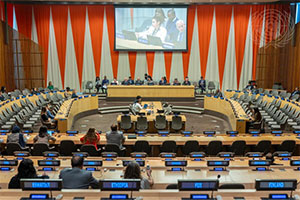 Panel Discussion on International Day for South-South Cooperation 2023. Credit: UN Photo/Cia Pak
South-South cooperation – collaboration between developing countries – is a growing and dynamic phenomenon, an important process that is vital in confronting shared challenges. Led by emerging giants, India, Brazil and South Africa (IBSA), the Global South is a tremendous source of tested solutions to development challenges, including the Millennium Development Goals (MDGs). China’s Belt and Road Initiative (BRI), launched in 2013, has further transformed South-South cooperation by enhancing infrastructure, trade, and investment linkages across Asia, Africa, and Latin America. Meanwhile, new platforms like the expansion of BRICS to include other countries such as Thailand, Nigeria, and Cuba are reshaping global economic governance and offering alternatives to traditional Western-led institutions. The Nairobi Outcome of the 2009 High-Level United Nations Conference on South-South Cooperation in Nairobi, Kenya highlights growing political and economic ties within the developing world, as countries from the Global South assume leading roles in decision-making on hot global issues ranging from economic recovery to food security, energy transitions, debt relief, and climate change. Today, the African Continental Free Trade Area and India’s “Voice of the Global South” summits have advanced frameworks for regional self-reliance, while G77 has reaffirmed commitments to resilient and inclusive economies ahead of the 16th UN Conference on Trade and Development.
Updated by Yilan Batista and Shuli Wong August 2026

The Week with IPS

NEXT STOP - SDGs
Tracking global progress towards a sustainable world
Tracking global progress towards a sustainable world
