Languages
Friday, September 18, 2026



News and Views from the Global South
South-South

Opinion: From European Union to Just a Common Market
The success in the recent Swiss elections of the UDC-SVP, a xenophobic, anti European Union, right wing party, opens a number of reflections.
Minorities Speak Out in Latin American Population Conference
“The countries of Latin America have not fully committed themselves to the international conventions and have not given indigenous peoples access. Nor have their contents been widely disseminated,” to help people demand compliance and enforcement, said Guatemalan activist Ángela Suc.
U.N. Launches Probe Amidst Charges of Bribery and Corruption
After initial hesitation, the United Nations has decided to probe allegations of bribery and corruption extending to the office of a past President of the UN General Assembly (UNGA), the highest policy-making body in the 70-year old Organisation.
Opinion: International Tax Cooperation Crucial for Development
It has become clear that the South, including the least developed countries, has little reason to expect any real progress to the almost half century old commitment to transfer 0.7 percent of developed countries’ income to developing countries. But to add insult to injury, developing countries have, once again, been denied full participation in inter-governmental discussions to enhance overall as well as national tax capacities.
United Arab Emirates and Cuba Forge Closer Ties
Cuba and the United Arab Emirates agreed to strengthen diplomatic ties and bilateral cooperation during an official visit to this Caribbean island nation by the UAE minister of foreign affairs, Sheikh Abdullah bin Zayed Al Nahyan.
The Global South Will Make Its Contribution to Fighting Climate Change
Seen for years as passive actors in the fight against global warming, more than 100 countries of the Global South have submitted their national contributions to reducing greenhouse gas emissions and decarbonising their economies.
Learning from Korea’s ‘Saemaul Undong’ to Achieve SDGs
More than 3.3 billion people live in rural areas around the world. Rural development is therefore of vital significance if the 2030 Agenda for Sustainable Development – “a plan of action for people, planet and prosperity” – is to become reality.
Opinion: Recognize the Aspirations of ACP Group of Developing Countries
The significance of the issues covered in the post-2015 development agenda, to be adopted at the United Nations Sustainable Development Summit on 25-27 September, cannot be over-emphasized.
Opinion: South-South Cooperation Crucial for Sustainable Development Goals
World leaders will meet at the United Nations summit from Sep. 25 to 27 in New York at a high-level plenary meeting of the General Assembly. This year’s summit is special in many respects.
Is Good Governance Good For Development?
Many well-meaning people who would like better governance have been misled into insisting on so-called ‘good governance’ reforms, with the expectation that this would lead to development.
G20 Finance Ministers Committed to Sustainable Development
Finance ministers and central bank governors of the world’s 20 major economies, accounting for 66 percent of world population, have pledged to “promote an enabling global economic environment for developing countries as they pursue their sustainable development agendas”.
Emerging Industrial Power Rises From Aid Beneficiary to Donor Nation
Back in 1996, when South Korea voluntarily quit the 132-member Group of 77 (G77) – described as the largest single coalition of developing nations -- it joined the 34-member Organisation for Economic Cooperation and Development (OECD), long known as the “rich man’s club” based in Paris.
China’s Economy Has Sounded the Alert; Will Latin America Listen?
For years, Latin America has exported its raw materials to China’s voracious factories, fuelling economic growth. But now that the Asian giant is putting a priority on domestic consumption over industrial production, how will this region react?
UAE Wins Hearts and Minds at World Exhibition in Milan
She only turned nine last June. But Mahra Mustafa has become a celebrity at the Expo Milan. She stars as Sara in ‘The Family Tree’, a short film on the UAE’s heritage being screened at the United Arab Emirates pavilion. Sara is in fact the face of young, dynamic and innovative Emirates.
Q&A: MDG Victories Take Spotlight at South-South Awards
Next month, the South-South Awards will be taking place for the fifth time, honouring the achievements and contributions of heads of state and government, as well as representatives from the private sector and civil society in promoting sustainable development in the Global South.
Opinion: Developing Nations Set to Challenge Rich Ahead of SDG Summit
The final round of negotiations on the Sustainable Development Goals – the successor to the Millennium Development Goals, due to be inaugurated in September at the U.N. General Assembly – is now underway in New York.
Opinion: A BRICS Bank to Challenge the Bretton Woods System?
The formal opening of the BRICS Bank in Shanghai on Jul. 21 following the seventh summit of the world’s five leading emerging economies held recently in the Russian city of Ufa, demonstrates the speed with which an alternative global financial architecture is emerging.
Opinion: From New York to Addis Ababa, Financing for Development on Life-Support – Part Two
The key priorities of the Group of 77 developing countries (G77) remain somewhat aligned around a set of issues that have been present from the beginning of the FfD negotiations in New York.
Opinion: ASEAN Must Unite Against Climate Change
The Association of Southeast Asian Nations (ASEAN) started as a cooperation bloc in 1968. Founded by five countries - Thailand, Singapore, Malaysia, Indonesia and the Philippines - ASEAN has since evolved into a regional force which is slowly changing the landscape in global politics.
Will the New BRICS Bank Break with Traditional Development Models, or Replicate Them?
Just days ahead of a summit of the BRICS group of emerging economies (Brazil, Russia, India, China and South Africa) in which the five countries are expected to formally launch their New Development Bank (NDB), 40 NGOs and civil society groups have penned an open letter to their respective governments urging transparency and accountability in the proposed banking process.
The U.N. at 70: United Nations Disappoints on Its 70th Anniversary – Part One
It is hard to imagine today the public enthusiasm that greeted the founding of the U.N. in 1945. After massive suffering and social collapse resulting from the Second World War, the U.N. seemed almost miraculous – a means at last to build peace, democracy, and a just society on a global scale.« Previous Page — Next Page »


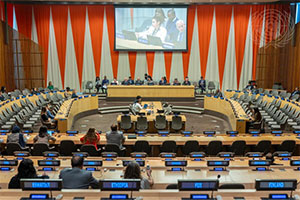 Panel Discussion on International Day for South-South Cooperation 2023. Credit: UN Photo/Cia Pak
South-South cooperation – collaboration between developing countries – is a growing and dynamic phenomenon, an important process that is vital in confronting shared challenges. Led by emerging giants, India, Brazil and South Africa (IBSA), the Global South is a tremendous source of tested solutions to development challenges, including the Millennium Development Goals (MDGs). China’s Belt and Road Initiative (BRI), launched in 2013, has further transformed South-South cooperation by enhancing infrastructure, trade, and investment linkages across Asia, Africa, and Latin America. Meanwhile, new platforms like the expansion of BRICS to include other countries such as Thailand, Nigeria, and Cuba are reshaping global economic governance and offering alternatives to traditional Western-led institutions. The Nairobi Outcome of the 2009 High-Level United Nations Conference on South-South Cooperation in Nairobi, Kenya highlights growing political and economic ties within the developing world, as countries from the Global South assume leading roles in decision-making on hot global issues ranging from economic recovery to food security, energy transitions, debt relief, and climate change. Today, the African Continental Free Trade Area and India’s “Voice of the Global South” summits have advanced frameworks for regional self-reliance, while G77 has reaffirmed commitments to resilient and inclusive economies ahead of the 16th UN Conference on Trade and Development.
Updated by Yilan Batista and Shuli Wong August 2026

The Week with IPS

NEXT STOP - SDGs
Tracking global progress towards a sustainable world
Tracking global progress towards a sustainable world
