Languages
Friday, September 18, 2026



News and Views from the Global South
South-South

Opinion: The Oceans Need the Spotlight Now
The international community must focus its energies immediately on addressing the grave challenges confronting the oceans. With implications for global order and peace, the oceans are also becoming another arena for national rivalry.International Cooperation is Key to Effective Public Services
“Civil service excellence can only be achieved if countries have access to an international forum where they can exchange innovative approaches and initiatives,” Patrick Keuleers, Director of the Governance and Peacebuilding Team of the United Nations Development Programme (UNDP), said Friday.
Opinion: Building Civil Service Excellence in the Post-2015 Development Agenda
This September, we usher in the post-2015 development agenda with a set of Sustainable Development Goals (SDGs) agreed upon by Member States, with civil society participation, based on national, regional and global consultations.
Chinese Public Most Worried About Climate Change
A new survey finds that China leads the world in public support for government action on climate change.
Opinion: G20 Turkish Presidency Keen to Benefit the Global Community
Turkey assumed the Presidency of the Group of 20 (G20) on Dec. 1, 2014. It will culminate in the Antalya Summit on Nov. 15-16. Our priorities build upon the G20 multi-year agenda, but also reflect particular themes we see as important for 2015.
Opinion: The Bumpy Road to an Asian Century
It has been apparent for some time that we are in the midst of a historic shift of the centre of gravity of the global economy from the trans-Atlantic to what is now becoming known as the Indo-Pacific.
ACP Aims to Make Voice of the Moral Majority Count in the Global Arena
“Four decades of existence is a milestone for the ACP as an international alliance of developing countries,” Dr Patrick I. Gomes of Guyana, newly appointed Secretary-General of the African, Caribbean and Pacific group of countries, said at the opening of the 101st Session of the group’s Council of Ministers.
Opinion: New World Information Order, Internet and the Global South – Part I
More than four decades ago, the Non-Aligned Movement (NAM) launched the concept of a New International Information Order (NIIO).
Opinion: South-South Cooperation Vital for Sustainable Development
Sustainable development is central to a range of key discussions at the United Nations and elsewhere at the moment.
Cash-Strapped Latin American Countries Turn to China for Credit
Angolans are generally grateful for China’s participation in the reconstruction of their central African country, in spite of the fact that some of the roads and buildings built by Chinese firms are of poor quality, and mainly Chinese labourers have been hired rather than local workers.
Afghanistan’s Economic Recovery: A New Horizon for South-South Partnerships?
First the centre of the silk route, then the epicenter of bloody conflicts, Afghanistan’s history can be charted through many diverse chapters, the most recent of which opened with the election of President Ashraf Ghani in September 2014.
Argentina Moves Towards Marriage of Convenience with China
The government of Argentina is building a marriage of convenience with China, which some see as uneven and others see as an indispensable alliance for a new level of insertion in the global economy.
OPINION: A New Era of Hemispheric Cooperation Is Possible
Two decades after the first Summit of the Americas, a lot has changed in the continent and it has been for the good. Today, a renewed hemispheric dialogue without exclusions is possible.
Rich Countries Pony Up (Some) for Climate Justice
It’s one of the oldest tricks in politics: Talk down expectations to the point that you can meet them.
The Future of the Planet and the Irresponsibility of Governments
Less than a week after everybody celebrated the historical agreement on Nov. 17 between the United States and China on reduction of CO2 emissions, a very cold shower has come from India.
Can China’s Silk Road Vision Coexist with a Eurasian Union?
There is a good chance that economic jockeying between China and Russia in Central Asia will intensify in the coming months. For Russia, Chinese economic expansion could put a crimp in President Vladimir Putin’s grand plan for the Eurasian Economic Union.
G20 Seeks to Streamline Private Investment in Infrastructure
Industrialised countries have agreed to collaborate on a new programme aimed at funnelling significant private-sector investment into global infrastructure projects, particularly in developing countries.
U.N. Chief Eyes Upcoming Summits to Resolve Development Crisis
The continued widespread economic recession - aggravated by the recent Ebola outbreak in West Africa - is threatening to undermine the U.N.'s highly-touted post-2015 development agenda.
OPINION: The Group of 77 & IPS at 50
When the Group of 77 commemorated its 50th anniversary recently, Inter Press Service (IPS) news agency was not far behind.
Outgunned by Rich Polluters, Africa to Bring United Front to Climate Talks
As climate change interest groups raise their voices across Africa to call for action at the COP20 climate meeting in December and the crucial COP21 in Paris in 2015, many worry that the continent may never have fair representation at the talks.
Brazil to Monitor Improvement of Water Quality in Latin America
Problems in access to quality drinking water, supply shortages and inadequate sanitation are challenges facing development and the fight against poverty in Latin America. A new regional centre based in Brazil will monitor water to improve its management.« Previous Page — Next Page »


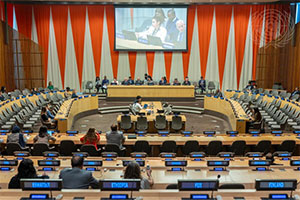 Panel Discussion on International Day for South-South Cooperation 2023. Credit: UN Photo/Cia Pak
South-South cooperation – collaboration between developing countries – is a growing and dynamic phenomenon, an important process that is vital in confronting shared challenges. Led by emerging giants, India, Brazil and South Africa (IBSA), the Global South is a tremendous source of tested solutions to development challenges, including the Millennium Development Goals (MDGs). China’s Belt and Road Initiative (BRI), launched in 2013, has further transformed South-South cooperation by enhancing infrastructure, trade, and investment linkages across Asia, Africa, and Latin America. Meanwhile, new platforms like the expansion of BRICS to include other countries such as Thailand, Nigeria, and Cuba are reshaping global economic governance and offering alternatives to traditional Western-led institutions. The Nairobi Outcome of the 2009 High-Level United Nations Conference on South-South Cooperation in Nairobi, Kenya highlights growing political and economic ties within the developing world, as countries from the Global South assume leading roles in decision-making on hot global issues ranging from economic recovery to food security, energy transitions, debt relief, and climate change. Today, the African Continental Free Trade Area and India’s “Voice of the Global South” summits have advanced frameworks for regional self-reliance, while G77 has reaffirmed commitments to resilient and inclusive economies ahead of the 16th UN Conference on Trade and Development.
Updated by Yilan Batista and Shuli Wong August 2026

The Week with IPS

NEXT STOP - SDGs
Tracking global progress towards a sustainable world
Tracking global progress towards a sustainable world
