Languages
Sunday, October 25, 2026



News and Views from the Global South
Amazon
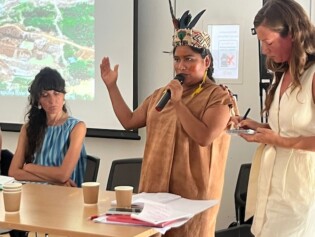
As Gold Prices Soar, Communities Pay the Price in Poisoned Rivers, Vanishing Forests and Organized Crime
The sweltering heat inside a London conference hall did not deter Indigenous leader Jackeline Mendoza Díaz from condemning the sheer destruction of the Peruvian Amazon. Her voice occasionally trembled with emotion but delivered a strong message — painting a picture far removed from the glittering gold bars traded in the world’s financial capitals.
Turning Indigenous Territories From ‘Sacrifice’ Zones to Thriving Forest Ecosystems
A report by the Global Alliance of Territorial Communities (GATC) and Earth Insight paints a stark picture of how extractive industries, deforestation, and climate change are converging to endanger the world’s last intact tropical forests and the Indigenous Peoples who protect them.
Financing Tropical Forests now is a COP30 Solution that’s Already Working
As the world prepares for COP30 in Belém, all eyes are on Brazil’s proposed Tropical Forests Forever Facility (TFFF)—a bold plan to reward countries for keeping forests standing. It represents a vital part of the long-term vision we need for global forest protection.
Strengthening Indigenous Lands Rights Key in Solving Deforestation in Amazon
Strengthening Indigenous land rights will protect more forest in Brazil’s Amazon and avoid large amounts of carbon emission, according to new research released ahead of COP30.
Intensified Legal, Political, and Grassroots Battles Over Amazon Oil Expansion
A report has warned about the risks of expanding oil and gas exploration in the Colombian Amazon, which may undermine environmental goals, Indigenous rights, and long-term economic stability, unless the government pivots toward sustainable development pathways.
Royalties, a New Indigenous Right for Hydroelectric Damages in Brazil
Indigenous peoples in Brazil have won a new right: a share in the profits of hydroelectric plants that cause them harm when built on or near their lands.
Power Arrives but the River Dries Up for Brazil’s Amazonian Dwellers
The flow of the igarapé always dropped for three months every year, but now it has been dry for two years in a row, complains Maria Aparecida dos Anjos, looking at the trickle of water that when flooded reaches the stilts of her wooden house, 50 metres away and on a slope of more than 10 metres high.
Life or Energy: The Hydroelectric Dilemma in Amazonian Brazil
The decade-and-a-half-long battle for life in the so-called Volta Grande (Big Bend) of the Xingu river, a stretch of the river dewatered by the Belo Monte hydroelectric power plant in the Brazilian Amazon, has a possible solution, albeit a partial one.
In Brazil, Indigenous Leaders and Youth Activists Fight To Protect Amazon
Raffaello Nava, a youth and student activist, has fled his home at the peak of the global Coronavirus pandemic after receiving death threats from multinational companies that invaded his ancestral lands in the Amazon rainforest.
The Energy Dilemmas of Roraima, a Unique Part of Brazil’s Amazon Region
"Roraima did not have a Caribbean character; now it does, because of its growing relations with Venezuela and Guyana," said Haroldo Amoras, a professor of economics at the Federal University of this state in the extreme north of Brazil.
Infrastructure Growth Threatens Brazilian Amazon with Further Deforestation
The mandatory initial permit granted by Brazil's environmental authority for the repaving of the BR-319 highway, in the heart of the Amazon jungle, intensified the alarm over the possible irreversible destruction of the rainforest.
Growing Amazon Deforestation a Grave Threat to Global Climate
For three weeks, the Brazilian government concealed the fact that deforestation in Brazil’s Amazon rainforest increased by nearly 22 percent last year, accentuating a trend that threatens to derail efforts to curb global warming.
Railroads Drive Expansion of Soybean Cultivation in Brazil’s Amazon Region
The sea of soybeans that sprouts every November will spread even further in the state of Mato Grosso if three new railway lines that would boost soy production in central-western Brazil and growing parts of the Amazon rainforest are built.
Infrastructure Expands in Brazil Despite Crises
Health, fiscal, environmental and political crises have not prevented Brazil from attracting private capital to expand infrastructure, according to the sector's minister, Tarcísio de Freitas.
Amazon Fires Heat Up Political Crisis in Brazil
August is the month of major political crises in Brazil, but no one suspected that an environmental issue would be the trigger for the storms threatening the government of President Jair Bolsonaro, just eight months into his term.
The Amazon Seeks Alternatives that Could Revolutionise Energy Production
A large steel wheel, 14 meters in diameter and 1.3 meters wide, could be the energy solution of the near future, generating 3.5 megawatts - enough to supply a city of 30,000 people, according to a company in the capital city of the state of Amazonas in northwest Brazil.
Militarised Government Attempts to Resume Mega-projects in Brazil
Two military-inspired initiatives are leading Brazil's new government, which includes a number of generals, down the path of mega-projects, which have had disastrous results in the last four decades.
Equality and Territory: the Common Struggle of Indigenous Women in the Andes
"At the age of 18 I was the first female leader in my organisation, my grandfather who was a male chauvinist demanded that I be beaten because I was sitting among men," said Teresita Antazú, an indigenous leader of the Yanesha people in Peru's Amazon region.
Latin American Indigenous People Fight New Plunder of Their Resources
Indigenous communities in Latin America, who have suffered the plunder of their natural resources since colonial times, are reliving that phenomenon again as mega infrastructure are jeopardising their habitat and their very survival.
Indigenous People, Guardians of Threatened Forests in Brazil
Indigenous peoples, recognised as the best guardians of the world's forests, are losing some battles in Brazil in the face of intensified pressure from the expansion of agriculture, mining and electricity generation.
Cycles of Wealth in Brazil’s Amazon: Gold, Lumber, Cattle and Now, Energy
The burning down of the local forest, on Jun. 29, 1979, was the first step towards the creation of the city of Paranaita, in a municipality that is now trying to shed its reputation as a major deforester of Brazil’s Amazon rainforest and has named itself “the energy capital.”Next Page »





The Week with IPS

NEXT STOP - SDGs
Tracking global progress towards a sustainable world
Tracking global progress towards a sustainable world
