Languages
Monday, October 12, 2026



News and Views from the Global South
Climate Justice
Governments Using Billions of Public Funds to Subsidize Climate-Destructive Industries—Report
A report examining corporate capture of public finance is accusing industries fueling the climate crisis, including fossil fuel ones, of draining public funds in the Global South, singling them out for squeezing out of governments USD 700 billion in public subsidies each year.
Explainer: Why Venezuela Needs To Reduce Its Gas Flaring
The most visible part of gas flaring in Venezuela is the so-called “Monagas illuminated nights.” These are red and orange skies, which are visible from the homes of the locals at night and which show the gas flaring in the oil fields of Monagas, a state located in the east of the Caribbean country and key in its oil production.
How Much is Too Much for Mount Everest? Isn’t it Time For Sagarmatha to Rest
"That’s Mt. Everest!" I overheard this from a trekking guide to his trekkers team. I stopped and asked him—which one! He was not our guide, but I approached. He pointed a finger and showed me Mt. Everest and I cried—I don't know why. I was overwhelmed and humbled to finally witness the world's tallest mountain—it was not from the base camp but from Thyangboche while returning.
Rural Survival: Guardians of Mother Earth Saving Mau, Revitalizing Native Lands
The Great Rift Valley is part of an intra-continental ridge system that runs through Kenya from north to south. A breathtaking, diverse mix of natural beauty that includes dramatic escarpments, highland mountains, cliffs and gorges, lakes and savannas. It is also home to one of Africa’s greatest wildlife reserves—the Maasai Mara National Reserve.
In Tonga the UN Secretary-General Declares a Global Climate Emergency
Three months ahead of the COP29 United Nations (UN) Climate Change Conference, the United Nations Secretary-General, António Guterres, has called for an emergency response from the international community as new data from the World Meteorological Organization (WMO) reveals a critical deterioration in the state of the climate.
Struggling at Sea: The Plight of Indian Fishworkers Amid Climate Change and Government Policies
Climate change forces millions of India’s fishworkers to venture beyond the country's exclusive economic zone into the perilous high seas.
Climate Change Poses Yet Another Stumbling Block for Pakistani Sportswomen
Goalkeeper Rehana Jamali, 17, is jubilant. Her team came in second in the All Sindh Women Hockey Tournament, held last month.
Gender Equality Has Everything To Do with Climate Change
After years of reporting on the frontlines of climate change, I have witnessed the devastating impact extreme weather events have on women and girls. In Kenya’s pastoralist communities in far-flung areas of Northern Kenya, West Pokot, Samburu and Narok counties, droughts mean a resurgence in harmful cultural practices such as outlawed female genital mutilation (FGM), beading and child marriages.
Pacific Community Photographic Winners Bring Impacts of Climate Change to Life
The Pacific Community’s photographic competition winners reflect the devastating climate impacts on beautiful and sensitive environments, documenting the most pressing issues the communities who live on the islands face today.
Explainer: Why Kenya is Considered a High Climate Risk for Development Banks
Kenya contributes less than 0.1 percent of global greenhouse gas emissions every year, yet development banks have flagged the East African nation as a high climate risk. This is due to extreme weather changes that are increasingly threatening the country’s development agenda, widening socio-economic inequalities, and deepening rural poverty and hunger.
Silenced: Women’s Many Layered Struggles for Climate Justice in Nepal
A group aligned with the mayor of Chhayanath Rara Municipality in the Mugu district of Nepal’s Karnali Province physically attacked Aishwarya Malla for simply asking for a budgetary review of the local government. “As a deputy mayor, I have the right to know where the budget is allocated, but the mayor’s team attacked me,” Malla said. “They did it only because I’m a woman, but they forget I’m also an elected representative with a responsibility to serve people, especially women and marginalized sections of our society.”
How Climate-Smart Strategies Revitalized Tanzania’s Livestock Sector
As the sun sets, its golden hues piece through the dusty haze, creating a dazzling display when a herd of livestock lazily roams on the arid landscape as they return home from grazing. Dressed in shiny red robes, the youthful Maasai pastoralists routinely whistle as they steer cattle, goats and sheep to maintain a unified path.
How Vote Reflects Farmers’ View on India’s BJP’s Agrarian Policy Amid Climate Change
On June 4, Ram Das, a 65-year-old farmer from India’s northern state of Haryana, was anxiously waiting for the results of the country’s general elections. It was early morning when he left his home and, along with his fellow villagers, congregated near a tea stall that had a transistor set playing the election results.
The Ocean People: Navigating Cyclones, Floods, and Climate Injustice in India
Cyclones and floods have become increasingly frequent across different parts of India, posing a significant threat to the country's population.
Kenya’s Cash-Strapped, Ambitious Climate Change Goals
Climate-related disasters have battered Kenya for years. Five failed rainy seasons resulted in a drought, the worst in 40 years, affecting at least 4,5 million people who require food assistance. Then came months of heavy rain, which led to riverine and flash flooding that impacted more than 306,520 (61,304 families) between March 1 and June 18, 2024, with an estimated 315 people killed, 188 injured, and 38 missing, while more than 293,200 people (about 58,641 families) were displaced, according to Reliefweb and Kenya’s National Disaster Operations Centre (NDOC).
Women Warriors Winning Fight to Bring Back Indigenous Food Traditions
As the school lunch bell goes off, 40 eager little bodies—41 if you count the school dog—burst out onto the veranda. Awaiting them are a stack of steel platters, into which will be ladled a nutritious and delicious lunch, all of it indigenous cuisine.
Climate Finance: The Planet is Speaking, Listen and Respond with Justice
As the planet groans under record-breaking temperatures and extreme weather events, Africa, which is responsible for only two to three percent of global emissions, stands out disproportionately as the most vulnerable region in the world. António Guterres, the United Nations Secretary-General’s special address on climate action titled ‘A Moment of Truth’ said 2024 was the hottest May in recorded history, and that this marks twelve straight months of the hottest months ever. For the past year, every turn of the calendar has turned up the heat.
Explainer: What You Need to Know About Climate Change and Blue Carbon
The area where land meets the sea, known as coastal ecosystems, could be the key to reducing the effects of climate change. What is blue carbon? Blue carbon refers to the carbon dioxide (CO2) stored within marine or coastal ecosystems worldwide. These ecosystems include coastal plants such as mangroves, seagrasses, and salt marshes, which trap CO2 in their seabeds.
Explainer: How India’s Political Parties Neglect Climate Change
As India's 968.8 million voters were gripped by election fever, the worst-ever heat wave held the country in its clutches.
Commonwealth Secretary-General Calls for Concrete Finance Commitments for Small Island Developing States
Commonwealth Secretary-General Baroness Patricia Scotland is calling for concrete commitments to climate finance that will acknowledge the multi-dimensional vulnerability faced by the world’s small island developing states (SIDS).
Explainer: Why Is It Important for Venezuela to Adopt Escazú Agreement in the Coming Year?
Venezuela is one of the few countries outside the Escazú Agreement, a treaty in Latin America and the Caribbean ratified by 16 member countries that guarantees access to environmental information, public participation in environmental decisions, and environmental justice.« Previous Page — Next Page »





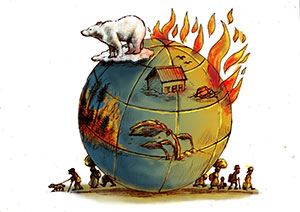
Climate justice, the act of ensuring that equity and human rights of communities and countries, especially those whose impacts from climate change are acute, are considered in decision-making and action, is at the forefront of IPS’ climate justice project.
The features, interviews, and opinion editorials published in this project are supported by the Open Society Foundations (OSF).

The Week with IPS

NEXT STOP - SDGs
Tracking global progress towards a sustainable world
Tracking global progress towards a sustainable world
