Languages
Thursday, November 12, 2026



News and Views from the Global South
Poverty & MDGs
LAOS: Land Legislation Disempowers Women – Part 1
Ki is seven years old but looks more like three. His legs are bowed and skull misshapen. He looked at me with a blank stare. The health worker, Kheo, suggests rickets.
ARGENTINA: Women Judges Not Enough; Gender Awareness Training Needed
For Argentina’s justice system to truly incorporate a gender perspective, more important than overcoming the male-female imbalance in the higher rungs of the judicial branch is providing gender-awareness training for judges of both sexes so that it is reflected in their rulings, experts say.
MEXICO: The Goal: Not a Drop Wasted
In his novel "México sediento" (Mexico in a Drought), author Francisco Moreno postulated that drought would lead to war in 2010, just as water shortages helped trigger the fight for Mexico's independence from Spain in 1810 and the Mexican Revolution in 1910.LATIN AMERICA: Desertification – an Invisible Cancer
"Desertification is the cancer of the earth," Argentine geographer Elena Abraham told IPS. "It is a process of degradation that does not manifest itself in spectacular ways but furtively advances, and by the time it is visible there is nothing to be done, and people have to move away, in search of an alternative."
Q&A: ‘Stiglitz-Sen Moving in the Right Direction, but Slowly’
Hazel Henderson is a futurist, an economic iconoclast, founder of Ethical Markets Media, and author of the books Building A Win-Win World, Beyond Globalization, Planetary Citizenship, and Ethical Markets: Growing the Green Economy. Her main focus is exploring the "blind spots" in conventional economic theory.PARAGUAY: Health Insurance for All (Registered) Domestics
It took 42 years for social security health care coverage for domestics to extend beyond the limits of the Paraguayan capital.FINANCE: Aid Losses Prompting “Development Emergency”
A new U.N. report warns that the world is likely to suffer more economic and environmental disasters if the richest countries fail to shoulder their share of development aid to poorer nations.
MOZAMBIQUE: Building Awareness to Reduce Maternal Mortality
In the Niassa province of northwest Mozambique, one doctor has been working with local communities to overcome the delays responsible for three-quarters of maternal deaths each year.
SWAZILAND: Educating Angels
It is not a typical classroom setup where pupils sit in rows facing the front with a teacher lecturing before them.FINANCE: World Bank, NGOs Exhort G20 Not to Forget the Poorest
The World Bank and major non-governmental organisations (NGOs) are calling on leaders who will gather for next week's Group of 20 (G20) Summit in Pittsburgh not to forget the needs of the world's poorest countries, which have been severely affected by the last year's financial crisis.ENVIRONMENT: U.N. Seeks Political Boost for Climate Summit
U.N. Secretary-General Ban Ki-moon, one of the strongest proponents of next week's summit on climate change, is confident that world leaders will provide a high political profile for an impending environmental crisis threatening to cause devastation worldwide in the next few decades.
MALAWI: Questions Over Water Stats
A set of new research data contests the Malawian government's claims that nearly all of the country’s urban citizens have access to clean water and sanitation.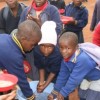
SWAZILAND: Sunshine Brings the Gift of Water
It is break time. A handful of pupils of Sitsatsaweni Primary School are crowded around a 25-litre bucket to wash their hands before tucking into a meal of samp and beans.
RIGHTS: U.N. Approves Long-Awaited New Women’s Agency
After more than three years of political foot-dragging, the 192-member General Assembly adopted a historic resolution Monday aimed at creating a new U.N. agency for women.
EDUCATION-BRAZIL: Public Schools Fend Off Invasion of New Ideas
Two non-governmental initiatives managed to penetrate the walls around public education in Brazil, temporarily assuming responsibility for the administration of schools where they left their seeds planted. But ultimately they discovered how resistant the school system is to innovation.HEALTH-KENYA: A Glove To Save a Mother’s Life
The need for gloves for health workers assisting with childbirth may be obvious, but in Yala Sub-District Hospital in western Kenya, obvious does not mean available.
HEALTH-SOUTHERN AFRICA: Learning From Criticism, U.S. Committed to AIDS Fight
The United States has embarked on a mission to restore Africa's trust in U.S. commitment to global AIDS relief.
NIGERIA: Investment in Primary Education Must Include Teachers
Nigeria has over the past 10 years recorded high enrolment and completion rates in primary school education.
MOZAMBIQUE: Local Leadership On Environmental Sustainability
Tucked away in the remote northwest corner of Mozambique is some of the most rugged and least developed terrain in the country. It was in this area that some of the most intense fighting took place during the civil war, which ended in 1992.HEALTH: WHO Data Underscores Pneumonia’s Deadly Toll
New data released by the World Health Organisation (WHO) sheds light on the leading causes of pneumonia and provides the first country-level information about the effects of pneumonia, the world's leading killer of children under five.GUATEMALA: Malnutrition Killing Children Again
The deaths of 25 children from severe malnutrition this year in Guatemala, mainly in the eastern province of Jalapa, shows that the specter of hunger is still haunting the country, aggravated by the global economic crisis and drought.« Previous Page — Next Page »





