
Monday, October 19, 2026



News and Views from the Global South
Climate Action
How Santa Marta Finally Made Fossil Fuel Phase-Out Politically Discussable
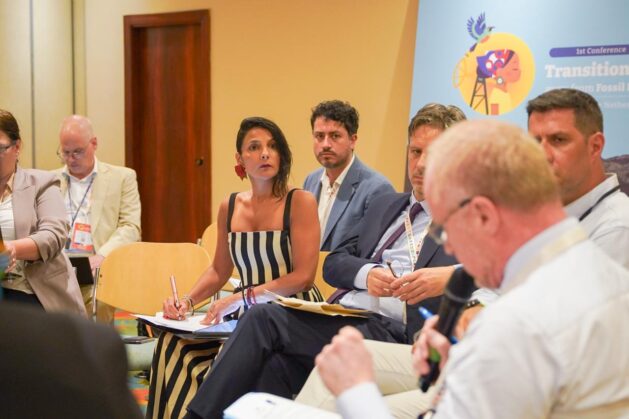
Irene Velez Torres, Director of the Colombian National Environmental Agency, during a panel discussion with policy experts at the Santa Marta Conference. Credit: Supplied
- The First Conference on Transitioning Away from Fossil Fuels in Santa Marta, Colombia, may eventually be remembered as a defining moment in global climate politics, not because it produced a treaty or a formal negotiation outcome, but because it changed the tone, structure, and ambition of the conversation itself.
For decades, international climate diplomacy has been about managing emissions, not addressing the source of those emissions: fossil fuels. Governments continued to discuss carbon markets, offsets and adaptation funds but so too did the growth in oil, gas and coal production. Within the UN climate process itself, producer nations and powerful economic interests often blocked direct discussion of phasing out fossil fuels. However, there was no such case as Santa Marta.
The conference, co-hosted by Colombia and the Netherlands and attended by delegates from almost 60 nations, was not intended to be another COP-style negotiation. It was explicitly designed as a political and practical platform for those countries willing to move faster on the fossil fuel phase-out. That makes a difference.
“This was not a negotiating conference. This is about dialogue and looking together at what we can do and how we can apply our creativity, our collaboration, and the science to find new opportunities,” said Stientje van Veldhoven-van der Meer, Dutch Climate and Green Growth Minister.
The conference’s most important accomplishment might be the single transition from negotiation to problem-solving.
Traditional COP summits often descend into exercises in diplomatic survival, with countries fighting over language late into the night and protecting narrow interests. In Santa Marta, ministers repeatedly stressed that participants were not there to defend positions but to create solutions.
“The contrast was stark,” said Minina Talia, Tuvalu’s Minister for Home Affairs, Climate Change and Environment.
“I’ve been to a lot of COPs over the years and I’ve never felt like this. More chilled, ready to go home. We are not here to bargain. We’re here to find solutions,” he told reporters on the concluding day of the conference.
For small island states like Tuvalu, where climate change is an existential threat now rather than a future risk, this difference is significant. It is the politics of survival.
Several Concrete Results
Ireland and Tuvalu will co-host a second conference, ensuring continuity and signalling a conscious North-South partnership. A dedicated science panel will support countries and regions in their transition away from fossil fuels. Three work streams were established: pathways to transition away from fossil fuels; decarbonisation of trade balances; and new financial mechanisms to finance the transition.
These are not symbols for deliverables. They went to the core of the politics of dependence on fossil fuels.
The biggest challenge in climate politics is no longer to prove that climate change is real. It’s trying to work out how countries that rely on fossil fuel revenues can survive the transition without economic collapse, social unrest or widening inequality.
That means dealing with debt, subsidies, tax systems, labour transitions, industrial planning and trade balances. The focus on financial architecture in Santa Marta is a sign of awareness on the part of the participants.
The debate over fossil fuel subsidies was particularly important. Ministers emphasised the need for transparency on the location of fossil fuel incentives, revenues and dependencies within national economies. This is important because fossil fuels are not just an energy issue. They’re so entrenched in national budgets, banking systems, foreign policy and power structures.
The war in the Middle East, the disruption of oil supplies and the general insecurity of world energy have hastened the need for change. But unlike previous oil crises, this time renewable energy is getting cheaper and cheaper compared to fossil fuels, and electric vehicles are scaling up very fast.
Participants argued that the war has revealed not the need for more oil drilling, but the danger of fossil fuel dependence itself.
“The war really opened up peoples’ eyes to how fragile the fossil fuel system is,” a speaker said. “And this war comes at a time when renewables are cheaper than fossil fuels.
This shifts the transition from a strictly environmental imperative to a strategic economic and security priority.
Action on climate is no longer simply about saving the planet. It’s about stabilising economies, reducing geopolitical vulnerability and avoiding the financial risks of stranded fossil assets.
The reason this is a powerful shift is that finance ministers tend to move faster than environment ministers.
Another remarkable strength of Santa Marta was its insistence on being inclusive. Indigenous Peoples, parliamentarians, peasants, women, NGOs and even children were brought into the heart of the conversation.
“This is a new climate democracy, where governments are no longer the only actors making climate decisions,” said Irene Velez Torres, Director of the Colombian National Environmental Agency.
One of the strongest interventions at the conference came from Indigenous representatives, who warned that a clean energy transition without land justice would simply mean another wave of colonial extraction. Their declaration rejects a future where extraction of fossil fuels is replaced by mining for transition minerals, mega dams or industrial projects imposed on Indigenous lands without consent.
“If we are not part of building the just transition and the phase-out of fossil fuels, it will not be just,” they said in a joint declaration at the end of the conference on April 29.
This revealed one of the deepest contradictions in global climate policy: many governments speak of a green transition but continue with extractive models under a new name.
Indigenous leaders demanded free, prior and informed consent, legal recognition of the rights to their territories, direct access to climate finance and protection for land defenders at risk of criminalisation and violence.
The Fossil Fuel Non-Proliferation Treaty initiative continues to be central. Tuvalu has been one of its earliest supporters, demanding a legally binding international framework to stop expansion and ensure a fair phase-out of fossil fuels.
Talia welcomed the treaty for raising the bar in terms of moral pressure and providing governments with clearer information but warned against limiting the whole transition conversation to one mechanism.
He said: “The treaty is an initiative. We want to look at all other initiatives so that we have a fair, balanced outcome.”
That’s a sign of strategic maturity. One treaty will not kill the most profitable industry in modern history.
These include UNFCCC processes, national policy, fossil fuel treaty mechanisms, regional declarations, central bank reforms and the involvement of financial institutions.
Participants highlighted China’s green lending strategies and said banking systems need to stop rewarding fossil fuel dependence and instead finance transition at scale.
Likewise, Pacific island nations are advocating for regional “fossil fuel-free zones”, supported by new declarations and intergovernmental task forces. These efforts matter because regional leadership often moves quicker than global consensus.
Hence, the choice of Tuvalu as the venue for the next conference is very significant. It’s shifting the discussion from the diplomatic capitals to one of the world’s most climate-vulnerable countries. It forces political leaders to confront the human reality of rising seas, disappearing land and threatened sovereignty.
History in the Making
Santa Marta won’t solve the fossil fuel crisis. It doesn’t stop new drilling. It does not yet impose binding obligations.But it may have done something more important, which is to make fossil fuel phase-out politically discussable at scale. For years, people saw talking straight about ending oil, gas, and coal as too radical, too unrealistic, or too politically dangerous. In Santa Marta it became the focus of the room.
If this coalition grows from 60 to 100 countries, if its outcomes feed into COP31 and national climate plans, if the finance systems start to shift, and if the Pacific conference deepens the legal momentum, then Santa Marta could be remembered not as a one-off summit but as the moment when climate diplomacy finally stopped treating the symptoms and started tackling the disease. That would be history.
IPS UN Bureau Report


 Print
|
Print
|




