
Wednesday, September 2, 2026



News and Views from the Global South
LATIN AMERICA: Campus Party to Bridge Digital Gap
Ana Artigas
- Seeking solutions for closing the digital and technological gap and sharing innovative experiences are the aims of the Ibero-America Campus Party, which is being held parallel to the 18th Ibero-American summit of heads of state and government this week in El Salvador.
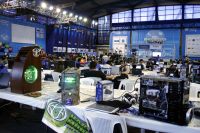
Campus Party Iberoamérica Credit: Ana Artigas/IPS
“Participating here are experts in robotics and software, as well as people involved in video games. The aim of this year’s edition is to foment digital and technological inclusion,” he said.
The Campus Party is an annual event held since 1997 by the Asociación E3 Futura, a non-profit organisation created in Spain whose stated mission is to “bring technology and society together.”
The event is sponsored by Spanish government agencies and companies from Spain and other countries around the world.
The Oct. 28-Nov. 1 Salvadoran edition of Campus Party has drawn 600 participants from 22 (mainly Latin American) countries. The thematic areas represented range from astronomy to robotics, innovation, and “modding”, which refers to modifying a piece of hardware or software to carry out a function for which it was not designed or intended.
Each thematic area is holding its own collective activity, while some participants are presenting projects aimed at expanding digital inclusion (broader access to computer and telecommunications technologies).
Technology appropriation – how people shape technology to make it their own – is the central theme of the statement to be delivered to the heads of state and government and other leaders from Andorra, Spain, Portugal and 19 Latin American countries attending the Oct. 29-31 Ibero-American Summit.
“In our consideration, the gap is no longer technological, at the level of software and hardware, but cultural. The most important thing is to ‘appropriate’ knowledge and know-how,” José Muñoz from Colombia, who is in charge of the Campus Party area of digital inclusion, commented to IPS.
The document underlines the need to do away with the idea that technology is an end in itself, and to see it instead as a tool. “We aren’t talking about hackers taking part in the Campus Party to show off what they do, but about people who use their computers to improve the quality of life of the larger community,” said Muñoz.
“For example, there are young Latin Americans from indigenous communities who are using Internet platforms for community initiatives aimed at keeping their cultures alive,” he said.
Jesús Laynes of the Asociación Enlace Quiché (roughly, the Quiché Link Association) has developed educational software in the Quiché language of his Maya indigenous community in Guatemala.
“Most people who are excluded from the world of technology don’t know they are excluded. To teach them how the Internet works, we have to do it in their own language, to facilitate their learning process. I believe that if we are able to place ancestral knowledge on the Internet, we can preserve it,” said Laynes.
Also taking part in this week’s technological gaming and Internet event in the capital of El Salvador are advocates of free or open source software – software that can be used, studied, modified, copied and redistributed without restriction.
One of them is Diego Saravia from Argentina, who says free software is not only indispensable for narrowing the digital gap but is “the only way to use it in an ethical manner. We are talking about freedom of knowledge, so that human beings can acquire the necessary tools for surviving in the world that is emerging.”
There are many ways to expand the use of free software, said Saravia. He pointed out, for example, that governments are increasingly adopting open source software, and taking political decisions to foment its use. Another is by means of ordinary people, who he said will increasingly use free software, as they become familiar with its advantages.
The innovation area, in which Saravia is taking part, plans to create a portal with a chat forum and an educational video game, which will host initiatives related to efforts to narrow the digital and technological gap.
The Polideportivo stadium in Ciudad Merliot, on the outskirts of San Salvador, will be full of computers, engineers and robots until Saturday.
One robot, the Basurator (“basura” means garbage in Spanish), is a Guatemalan creation made of recycled materials that shows where to dispose of rubbish, and the Udbito is a Salvadoran mechanical arm that moves objects.
“Robotics goes beyond digital inclusion; it will be the next revolution, it‘s the future, but everyone who fails to breach the digital gap will be excluded,” said Spanish expert Alejando Alonso Puig.
The first Campus Party was held in the southern Spanish city of Málaga, and subsequent editions were held in different parts of Spain, until this year, when editions took place in Brazil and Colombia. The Salvadoran event is the first one held in the framework of the Ibero-American Community of Nations.
 Print
|
Print
|



Pictures for this story
This story includes downloadable print-quality images -- Copyright IPS, to be used exclusively with this story.


