Languages
Friday, October 23, 2026



News and Views from the Global South
Active Citizens

Bhopal Cloud Hovers Over Industrial Safety in India
Three decades after 40 tons of deadly methyl isocyanate gas leaked from the Union Carbide India Limited plant in the central Indian city of Bhopal on Dec. 3, 1984 – killing an estimated 4,000 almost instantly and maiming and blinding hundreds of thousands of others – the world's worst industrial disaster remains a sharp lesson on the need for greater safety regulations in Asia’s third-largest economy.
Video Games, Poverty and Conflict in Bab Al-Tabbaneh
“People get used to war. During the last battle, children were still coming to play. Can you imagine, a seven-year-old boy running through the bullets just to play video games,” says Mohammad Darwish, a calm man with a curled beard framing his face.
OPINION: Global Citizenship, A Result of Emerging Global Consciousness
Globalisation is an integral feature of modernity. It already has significantly advanced to transform local experiences into global ones, to unify the disparate villages of the world into a global community, and to integrate national economies into an international economy.
Sri Lanka’s Minorities Choose “Unknown Angel” Over “Known Devil”
When the initial results started trickling in a little after midnight on Jan. 9, it still wasn’t clear exactly which way the country would swing: had Sri Lanka’s 15 million eligible voters thrown in their lot with incumbent President Mahinda Rajapaksa for a third term? Or would the desire for change put common opposition candidate Maithripala Sirisena at the helm?U.N. Chief Leads the Way on the ‘Road to Dignity’
Addressing the 193 member states of the General Assembly on Thursday, United Nations Secretary-General Ban Ki-moon called for sweeping changes that would set the world on the path of sustainable development.
Family Farming Eases Food Shortages in Eastern Cuba
Meat and vegetables are never missing from the dinner table of Damaris González and Omar Navarro, since they get almost all of their food from their farm, La Revelación, on the outskirts of the city of Santiago de Cuba, 765 km east of the Cuban capital.
The Rise and Fall of the World’s Poorest Nations
The world's 48 Least Developed Countries (LDCs) - a special category of developing nations created by the General Assembly in 1971 but refused recognition by the World Bank - have long been described as "poorest of the poor" in need of special international assistance for their economic survival.
Spectre of Violence Hangs Over Sri Lanka Polls
As 14.5 million Sri Lankans prepare to select their next leader, there is growing fear that violence could mar the Jan. 8 elections, billed as the closest electoral contest in the island’s history.
India’s ‘Manual Scavengers’ Rise Up Against Caste Discrimination
Watching Bittal Devi deftly weave threads of different colours into a vibrant patchwork quilt, it’s hard to imagine that this 46-year-old’s hands have spent the better part of their life cleaning toilets.
OPINION: Doubling Down on Dictatorship in the Middle East
For a moment, four years ago, it seemed that dictators in the Middle East would soon be a thing of the past.
Child Sex Crimes: Uruguay’s Ugly Hidden Face
Karina Núñez Rodríguez was only 12 when she was forced into prostitution. Now age 50 and a mother of six, she is an outspoken fighter against sexual exploitation of children and teenagers in Uruguay, a country reluctant to recognise this growing scourge.
OPINION: Tensions Rise as Sri Lankans Prepare for Historic Polls
These days, the national greeting in Sri Lanka is a simple question: “So, what do you think?” Everyone from van drivers waiting to pick kids up from school, to mechanics repairing vehicles, to barbers cutting your hair have only this question on their lips.
Children Stolen by Chilean Dictatorship Finally Come to Light
The suspicion that babies of people detained and disappeared during Chile’s 1973-1990 dictatorship were stolen is growing stronger in Chile, a country that up to now has not paid much attention to the phenomenon.
Thaw with U.S. Finds Transformed Civil Society in Cuba
The normalisation of relations between Cuba and the United States opens up a new path of “readjustments not free of risks”, which forms part of the process of “national transformation” ushered in by Raúl Castro, said Lenier González, one of the creators of the citizen initiative Cuba Posible.
OPINION: Understanding Education for Global Citizenship
Education for Sustainable Development (ESD) brings together concerns about the environment, economic development and social aspects. Since 1972, when the first U.N. Conference on the Human Environment was held in Stockholm, Sweden, there has been increasing awareness of the intricate link between conserving the environment and human development.
Climate Change Threatens Quechua and Their Crops in Peru’s Andes
In this town in Peru’s highlands over 3,000 metres above sea level, in the mountains surrounding the Sacred Valley of the Incas, the Quechua Indians who have lived here since time immemorial are worried about threats to their potato crops from alterations in rainfall patterns and temperatures.
Small Grants for Big Solutions in Northeast Argentina
Summers in northeast Argentina are hot and humid. At siesta time, the people of this rural municipality like to drink “tereré” (cold yerba mate), which until now they had problems preparing because of lack of clean water or electricity. But sometimes small donations can make a big dent in inequality.
Years in the Making, Arms Trade Treaty Enters into Force
A new Arms Trade Treaty (ATT) beginning on Dec. 24 represents a historic moment in global efforts to keep weapons proliferation in check.
Diversity and Inclusion for Empowering ‘People of Color’
A unique initiative – the Network Inclusion Leaders (NILE) project – has just held its second workshop here to set up a diversity and inclusion network for future leaders from among Germany’s ‘people of color’, or persons from different ‘non-white’ cultural backgrounds.OPINION: Reflections on Corruption and Political Regeneration in Spain
Political and institutional corruption has become the main concern of Spanish citizens after unemployment and the dramatic social consequences of the economic crisis, according to opinion polls.
Seeking Closure, Bougainville Confronts Ghosts of Civil War
Thirteen years after the peace agreement which ended a decade-long civil war in Bougainville, an autonomous island region of 300,000 people located east of the Papua New Guinean (PNG) mainland in the southwest Pacific Islands, trauma and grief continue to affect families and communities where the fate of the many missing remains unresolved.« Previous Page — Next Page »





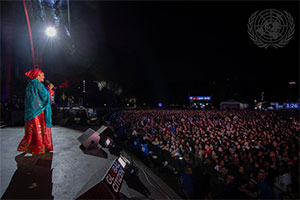 Global Citizen Festival in New York. Credit: UN Photo/Eskinder Debebe
Active citizens are committed to social change because they know that it is achievable. However, major political challenges face active citizens across the world. For example, in authoritarian regimes in Latin America where the hegemonic party has been in power for decades on end, protestors and human rights activists face enormous repression and struggle to materialize their advocacy into concrete results. The same can be said for Africans, where a shift towards elected government in recent decades has yet to translate into an effective voice in decision-making. Now, the Strengthening Citizen Demand for Good Governance, which uses evidence-based approaches – funded by DFID's Governance and Transparency Fund – seeks to raise their voices.
In 2025, the CIVICUS Monitor’s People Power Under Attack report revealed that civic freedoms are severely limited in 122 of 198 countries and territories, and only 7.2% of the global population now lives in countries where civic space is open. Through partnership with the Overseas Development Institute (ODI) and CIVICUS, IPS reporters across the continent will seek to define the extent and limits of state capability, government accountability and the responsiveness of leaders to the needs of citizens.

The Week with IPS

NEXT STOP - SDGs
Tracking global progress towards a sustainable world
Tracking global progress towards a sustainable world
