Languages
Tuesday, September 29, 2026



News and Views from the Global South
Aid

Dairy Farming Needs a Shot of Modernity
Mohammad Ali's routine has not changed in over three decades. A small dairy farmer in the village of Aliabad, in the Narowal district of Pakistan’s eastern Punjab province, he wakes at sunrise and walks to the barn to milk his three cows manually, stopping only for a breakfast of unleavened bread and tea heavily laced with milk before getting back to work.
Sugar Playing Catch-Up With Spice
Dotted with rice fields flanked by palm trees, Cambodia’s southeastern province of Kampong Speu is nothing short of picturesque. But behind the idyllic exterior is an on-going struggle to turn this region’s natural beauty into a global attraction and improve the lot of poor local farmers, as the neighbouring beachside Kampot province did just three years ago.
Transparency Could Tighten Drought Policy
Scientists gathered in Geneva for the first High-level Meeting on National Drought Policy (HMNDP) in over 30 years have identified data collection and sharing as some of the main challenges to effective prevention of drought. Clear goals and strong political will are vital to building policies at the national level, they say.Pak-Iran Pipeline Carries Energy and Defiance
After almost two decades of non-stop negotiations, and two years of intense U.S. opposition, the much-delayed and controversial 7.5 billion dollar Iran-Pakistan pipeline is well on its track to full operation in the next 15 months.
Cameroonian Farmers Find Justice in Fair Fruit
The fruit farmers in Njombe, a small town in the coastal Littoral Region of Cameroon, learned a life lesson about “making lemonade out of lemons” - or rather “dried fruit out of fruit” when their land was taken from them by the government and leased to an international farming company.
Afghanistan Faces “Massive Economic Constriction” after U.S. Withdrawal
Next year’s drawdown of U.S. forces and decline in U.S. aid will leave in its wake an Afghan political system lacking legitimacy and stability, according to interviews with Afghanistan experts, news reports and congressional studies.
Native Women Bring Solar Energy to Chile’s Atacama Desert
Three indigenous communities from the Chilean highlands have just received solar panels, which will be set up and maintained by unlikely solar engineers: five native women who travelled halfway around the world to India and overcame language and other barriers to bring photovoltaic energy to their villages.Drought Hits Policies
Drought has dramatically increased as a consequence of climate change. Most countries react to it only after it has occurred, but don’t have national policies to prevent it. The high-level meeting on national drought policies in Geneva this week is trying to match scientific knowledge with political awareness.
Civil Society Wants Bigger Role in Green Climate Fund Planning
As the new board of the United Nations Green Climate Fund meets in Berlin this week, activist and watchdog groups here and around the world are expressing frustration over proposed rules they say are already significantly limiting civil society participation in the new initiative.
From Brazil’s Family Farm to the School Lunchroom Table
Separating Maria Gomes Morais’ farm and a school in Rio de Janeiro are fields, hills and dirt roads that are impassable when it rains. But a school meal programme has forged a path linking the fresh produce harvested by small farmers like her with the need to provide nourishment to 45 million schoolchildren around Brazil.
Changing Weather, Changing Fortunes
Sri Lanka has paused for breath after the extreme weather conditions last year that many associate with climate change.Thailand Negotiating ‘Worrying’ Deal With EU
The negotiations launched this week for a Free Trade Agreement (FTA) between Thailand and the European Union have raised concerns among both Thai and European non-governmental organisations, who fear that EU demands could have a negative impact on Thailand’s progressive public health policies.Pressure Grows on Washington to Pass IMF Governance Reforms
More than 130 scholars, former government officials and policymakers are calling on the U.S. Congress to enact pending legislation enabling broad governance reforms within the International Monetary Fund (IMF) that would strengthen the voice of developing countries within the institution.
‘Every Day Is a Fukushima Memorial’
Japan prepares to mark the second anniversary of the Mar. 11 triple disaster - an earthquake, tsunami and a critical nuclear reactor accident - with much soul searching across the country.
Women Entrepreneurs Overcoming Barriers in Mexico
The culture of entrepreneurship is weak among women in Mexico, despite the positive influence that it has on women’s development, in a world where women continue to face greater obstacles than men when it comes to setting up and running a business.
Fighting Poverty Was Chávez’s Crusade
The struggle against poverty was the late Venezuelan president Hugo Chávez's top political priority, and at the same time a tool to consolidate his power and project his strategies abroad.U.S. Austerity Ripples Outward
Since the 2008 financial crisis, and most recently with the broad federal spending cuts beginning Mar. 1, experts have warned that an austerity-minded political system could bring about dramatic changes in the U.S. foreign aid model.
Cuba Loses an Essential Friend
Hugo Chávez of Venezuela was the president who made the most visits to Cuba, where flags are flying at half-mast in official mourning for his death Tuesday Mar. 5, and where his friend and political mentor, Fidel Castro, survives him.
Gaza Women Suffer on ‘Their’ Day
“In Gaza we don't lead normal lives, we just cope, and adapt to our abnormal lives under siege and occupation,” says Dr. Mona El-Farra, a physician and a long-time human rights and women's rights activist in the Gaza Strip. On International Women's Day, when many of the world's women are fighting for workplace equality and an end to domestic violence, Farra and the majority of Gaza's women fight for the most basic of rights.Fishing Labour Out of the Dark Ages
When Ko Mynt fled poverty in Myanmar for a job in neighbouring Thailand, the thought of labouring long hours in a shrimp peeling shed was far from his mind. So was this seaside town south of Bangkok. The 29-year-old had set his sights on employment in a garments factory.
North Kivu Refugees Hope to Find Peace in Uganda
As dawn rises over Nyakabande, a village in southwestern Uganda, people line up in front of a reception tent, exhausted and carrying only the few belongings they could bring across the border.« Previous Page — Next Page »


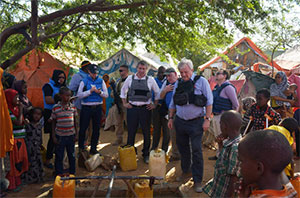 UN Emergency Relief Coordinator Visits Somalia. Credit: UN Photo/Tobin Jones
In recent years, conflicts have broken out across the world with no sign of slowing down or stopping. In times like this, millions of people globally are in dire need of humanitarian aid. Famine, warfare, natural disasters, and economic decline plague a host of nations, including Palestine, Sudan, Chad, Lebanon, and Haiti, to name a few. Humanitarian aid provides millions of people with critical services including healthcare, food, clean drinking water, psychosocial support, housing, and access to education. UN agencies such as the UNDP, UNICEF, the World Food Programme (WFP), UNHCR, UNRWA, and UNEP work with the UN Office for the Coordination of Humanitarian Aid (OCHA) and local organizations to come up with the best possible strategies to support affected communities. At the same time, humanitarian aid and those working on the frontlines are consistently threatened by both actors directly involved in conflict as well as those who are meant to contribute to the international humanitarian regime at large. The near-collapse of United States international aid structures in 2025, including the termination of 83% of USAID’s 6,300 global initiatives, has left millions of people without access to vital humanitarian assistance. 98 million people in 2025, only 65% of people targeted for humanitarian assistance, received the help they needed. In contrast, 123 million people received some form of humanitarian assistance in 2024, and OCHA’s 2026 Global Humanitarian Overview estimates that 239 million people are in need of assistance in 2026. IPS is well-positioned to discuss current initiatives to provide aid and relief through in-depth reporting and opinion content.

The Week with IPS

NEXT STOP - SDGs
Tracking global progress towards a sustainable world
Tracking global progress towards a sustainable world
