Languages
Tuesday, September 29, 2026



News and Views from the Global South
Aid

Afghanistan a Minefield for the Innocent
Efforts to clear Afghanistan of landmines have been painfully slow. At least 45 people on average lose their limbs every month to deadly anti-personnel mines, according to the Mine Action Coordination Centre of Afghanistan, formerly a project of the UN Mine Action Service, and now a national entity.
UNRWA Head Warns of Palestinian Crisis in Syria
A top United Nations official is warning that the plight of Palestinian refugees is being neglected amidst the ongoing crisis in Syria.U.S. Wasted Billions of Dollars on Iraqi Reconstruction
Almost exactly a decade after the 2003 U.S. invasion of Iraq, Washington’s efforts to help reconstruct the country have fallen far short, according to the final report by the U.S. Special Inspector General for Iraq Reconstruction (SIGIR) released here Wednesday.
World Bank Urges African Agriculture Rethink
The World Bank is urging African governments to retool their agriculture policies, particularly to include a far greater focus on agribusiness as a critical driver of future development.
Malian Refugees Look to Rebuild their Lives
Malian refugees in Mangaïze, northwest Niger, are keen to return home to start work and be able to support themselves once more.Immigrant Groups Say Spanish Hospitality in Danger
“We used to be seen as really useful, and now we’re a pain in the neck,” said Roberto Suárez, an Ecuadorian who was complaining about proposed fines or prison sentences that could target Spanish citizens who help undocumented immigrants.Capitol Hill Coddles Uzbekistan’s Karimov
Central Asian states do not face an “imminent” threat posed by Islamic militants, but they need U.S. assistance to help defend against potential dangers, according to top U.S. diplomats.
Q&A: No “Us” and “Them” in Fight for Women’s Rights
As the earthquake in Haiti has proven, even more important than a recognised name or robust physical presence is the quality of services delivered by humanitarian relief organisations.Aid Hurting Palestinians
Local food for local people. That’s the idea behind Sharaka (‘partnership’, in Arabic), an entirely volunteer-run, Palestinian organisation that aims to bring locally grown products directly to Palestinian dinner tables.
Groups Applaud Potential Reforms to U.S. Food Aid
Advocacy groups working on global hunger and poverty are hailing rumoured proposals that would change the way the United States distributes its international food aid.
U.S. Cuts to Global Health Budget “Mass-scale Malpractice”
Public health workers, activists and policymakers are stepping up a last-minute campaign to highlight the global health impact of historic, sweeping cuts to the U.S. federal budget due to go into effect Friday if Congress doesn’t act.
Peace and Dead Sea at a New Low
Two of the three main objectives of the Red Sea-Dead Sea canal project grapple with how to “save the Dead Sea” and “build a symbol of peace in the region.” With Israeli-Palestinians relations and the Dead Sea at an all time low, questions arise whether the ‘Red-Dead Canal’ (as it is known in environmental jargon) could save not only the hyper-saline desert lake but peace itself.Europeans Urge U.S. Action on Financial Transaction Tax
Two European policymakers on Monday called on their U.S. counterparts to rethink opposition to proposals for a small tax on stock purchases and other financial transactions, which proponents say could raise hundreds of billions of dollars for poverty alleviation, action on climate change and financing international development.
More Dead Than Red
The World Bank has declared the Red Sea-Dead Sea canal project feasible. Designed to “save the Dead Sea”, “desalinate water and/or generate hydroelectricity at affordable prices in Jordan, Israel and the Palestinian Authority”, and “build a symbol of peace in the Middle East”, the scheme, green groups warn, is fraught with environmental hazards.Winter of Discontent Progresses to Bulgaria
Bulgarian prime minister Boiko Borisov of the ruling centre-right Citizens for the European Development of Bulgaria (GERB), announced his resignation Wednesday, following two weeks of sustained protests across the country which were sparked by rising electricity and heating costs.Abrupt U.S. Cuts Could “Devastate” Overseas Development Programmes
With just a week to go before massive, indiscriminate spending cuts kick in across the U.S. government, policymakers and humanitarian groups are becoming increasingly anxious about the enduring impact the cuts would have on the communities across the globe assisted by U.S.-funded development and aid programmes.
Market Gardening Provides Livelihoods for Refugees in DR Congo
Standing behind her market stall in Masisu, in the Democratic Republic of Congo (DRC), which overflows with cabbages, carrots and onions, Marceline Dusabe does not fit the traditional profile of an internally displaced person. She, unlike many others displaced by the internal conflict in North Kivu, is not in need of food aid.Major Audit Urges Devolution of U.S. AIDS Programme
A major audit of the United States’ flagship global anti-HIV/AIDS programme, prepared for the U.S. Congress, notes “remarkable progress” over the past decade. However, it is also warning of insufficient monitoring and urging a stepped-up process of handing over greater control to partner countries.
U.S. Urged to Delink Foreign Military, State-building Actions
Development workers and aid strategists are urging the U.S. government to adopt a comprehensive strategy for addressing root problems in “fragile states”, warning that an outdated focus on military intervention is draining resources and exacerbating security problems.
Q&A: “Neoliberalism Negates Human Rights”
Thousands of people marched through the streets of cities across Portugal "against exploitation and impoverishment" caused by the government's austerity cuts, in a protest organised by the General Confederation of Portuguese Workers (CGTP), the country's largest trade union.
The Struggle to Keep Swaziland’s Primary Schools Free
As the Swazi government struggles to guarantee a no-cost nationwide primary school system, it finds itself sparring against school principals over the question if it is a lack of funds or an abundance of corruption that is standing in the way of its success.« Previous Page — Next Page »


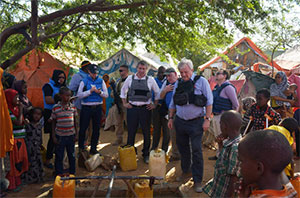 UN Emergency Relief Coordinator Visits Somalia. Credit: UN Photo/Tobin Jones
In recent years, conflicts have broken out across the world with no sign of slowing down or stopping. In times like this, millions of people globally are in dire need of humanitarian aid. Famine, warfare, natural disasters, and economic decline plague a host of nations, including Palestine, Sudan, Chad, Lebanon, and Haiti, to name a few. Humanitarian aid provides millions of people with critical services including healthcare, food, clean drinking water, psychosocial support, housing, and access to education. UN agencies such as the UNDP, UNICEF, the World Food Programme (WFP), UNHCR, UNRWA, and UNEP work with the UN Office for the Coordination of Humanitarian Aid (OCHA) and local organizations to come up with the best possible strategies to support affected communities. At the same time, humanitarian aid and those working on the frontlines are consistently threatened by both actors directly involved in conflict as well as those who are meant to contribute to the international humanitarian regime at large. The near-collapse of United States international aid structures in 2025, including the termination of 83% of USAID’s 6,300 global initiatives, has left millions of people without access to vital humanitarian assistance. 98 million people in 2025, only 65% of people targeted for humanitarian assistance, received the help they needed. In contrast, 123 million people received some form of humanitarian assistance in 2024, and OCHA’s 2026 Global Humanitarian Overview estimates that 239 million people are in need of assistance in 2026. IPS is well-positioned to discuss current initiatives to provide aid and relief through in-depth reporting and opinion content.

The Week with IPS

NEXT STOP - SDGs
Tracking global progress towards a sustainable world
Tracking global progress towards a sustainable world
