Languages
Tuesday, September 29, 2026



News and Views from the Global South
Aid
Water, Water Everywhere – and No Early Warning in Sight
Muzeka Muyeyekwa from Mapfekera Village in Zimbabwe’s Manicaland Province wonders what he will feed his three children for lunch.
Land Is Life, and It’s Slipping Away
Nean Narin, a humble man and father of three children, says his family is going hungry. Narin lives in the village of Boeung Kak, situated on the edge of Cambodia’s capital, Phnom Penh. For years, he and other villagers relied on the Boeung Kak Lake for fish and plants, which they would eat and sell.
Trout Trump the Taliban
The rivers in northern Pakistan’s Khyber Pakhtunkhwa (KP) province were once thick with trout. Spanning hundreds of kilometres, these water bodies played host to the exotic fish, first introduced by the British in the early 1900s, which eventually became a staple in the diets and livelihoods of the province’s 20 million residents.
African Troops Arrive As Divisions Fracture Malian Army
Soldiers belonging to the African-led International Support Mission to Mali continue to stream into this West African nation, as several hundred troops have already been deployed to secure towns across the country.
U.N.’s Water Agenda at Risk of Being Hijacked by Big Business
Amidst growing new threats of potential conflicts over fast-dwindling water resources in the world's arid regions, the United Nations will commemorate 2013 as the International Year of Water Cooperation (IYWC).
Women’s Leadership Breathes New Life into Bangladesh
Monashatoli, a small coastal village of 5,000 residents in Bangladesh’s southwestern Barguna district, located about 470 kilometres south of the capital Dhaka, is a living model of the success of bottom-up community development.
World Bank Unmoved on Auditor’s Criticism of Forest Policy
Officials at the World Bank are forcefully rejecting a new internal evaluation that is highly critical of the institution’s decade-long forest policy, expressing their “strong disagreement” with some assertions in the report.‘Tsunami’ of Diseases Waiting to Hit
A tsunami is looming on the horizon and the world is unprepared for it. This one won’t be a massive wall of water but a tidal wave of disease – and experts say the international community needs to act fast to keep it from crashing.Davos Puts Protests Behind
Barbed wire and safety fences are dismantled, the police and army are withdrawn and freedom of movement is restored. The 43rd annual meeting of the World Economic Forum (WEF) ended last month with negligible protests against the 'global leaders'.
Northern Mali Faces Food and Currency Shortages
Communities in northern Mali are in need of humanitarian intervention following the recent military operations in Gao and Timbuktu, leading non-governmental organisations to call for deliveries of food aid, fuel and even currency notes.
Malians Digging Deep to Support War Effort
Malians, including students and businesses owners, are donating money to their military’s costly war against armed Islamic groups that have occupied the north of this impoverished West African country and committed atrocities against local populations.
The Open and Rocky Road Post-2015
What values does a Yemeni journalist who fuelled the Arab Spring hold in common with a former principal of the U.S. National Security Council? And how in turn will they see eye to eye with a Jordanian queen, or the president of Indonesia?
No Woman Should Die Giving Life
Every single day, 452 women in sub-Saharan Africa die from pregnancy-related causes; that’s 18 women every hour.IFC to Fund Major New Microfinance Institution in Myanmar
The International Finance Corporation (IFC), the World Bank Group arm that focuses on the private sector, announced Wednesday that it would be backing a new microfinance institution in Myanmar aimed at reaching 200,000 people by 2020.Cautious Welcome for ‘Robin Hood’ Tax
Non-governmental organisations across Europe welcomed the move by 11 European Union countries Tuesday to move forward with the introduction of a financial transaction tax (FTT), but they urged national governments to ensure that a part of the revenues would be allocated to development.
Malawi’s President Faces a Crisis of Confidence
She has taken a personal pay cut, promised reforms, resumed aid flows from Western donors and put her predecessor’s private jet up for sale.
Q&A: “There is Nothing Worse Than Holding a Dying Woman in Your Arms”
Despite staggering advances in medical science and technology over the years, women around the world continue to suffer gravely as a result of inadequate access to basic reproductive health services.U.S. Public Supports UNESCO, Despite Funding Cuts
A national poll revealed that 83 percent of voters in the United States believe it is important for the country to be a member of and provide funding to the United Nations Educational, Scientific and Cultural Organisation, commonly referred to as UNESCO.
Rural Water Projects Depend on Women
During the dry season, when dirt roads are cracked from the relentless heat, the sight of women walking miles, balancing pots of water on their heads, is common in rural Sri Lanka.
OP-ED: Learning from Haiti’s Goudou Goudou
On a hillside overlooking Port-au-Prince, a muscular Haitian man in a green tank top raises a heavy steel pry bar over his head and brings it down into a hole, shattering a bit of Haiti’s limestone skeleton.Fighting for a Future in Rio’s Toughest Neighbourhoods
Teachers at a local primary school here, the Escola Municipal IV Centenário, are trained to help their pupils find cover in case of gun battles.« Previous Page — Next Page »


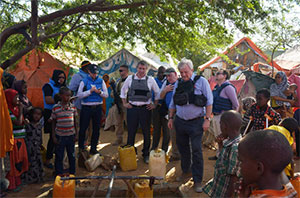 UN Emergency Relief Coordinator Visits Somalia. Credit: UN Photo/Tobin Jones
In recent years, conflicts have broken out across the world with no sign of slowing down or stopping. In times like this, millions of people globally are in dire need of humanitarian aid. Famine, warfare, natural disasters, and economic decline plague a host of nations, including Palestine, Sudan, Chad, Lebanon, and Haiti, to name a few. Humanitarian aid provides millions of people with critical services including healthcare, food, clean drinking water, psychosocial support, housing, and access to education. UN agencies such as the UNDP, UNICEF, the World Food Programme (WFP), UNHCR, UNRWA, and UNEP work with the UN Office for the Coordination of Humanitarian Aid (OCHA) and local organizations to come up with the best possible strategies to support affected communities. At the same time, humanitarian aid and those working on the frontlines are consistently threatened by both actors directly involved in conflict as well as those who are meant to contribute to the international humanitarian regime at large. The near-collapse of United States international aid structures in 2025, including the termination of 83% of USAID’s 6,300 global initiatives, has left millions of people without access to vital humanitarian assistance. 98 million people in 2025, only 65% of people targeted for humanitarian assistance, received the help they needed. In contrast, 123 million people received some form of humanitarian assistance in 2024, and OCHA’s 2026 Global Humanitarian Overview estimates that 239 million people are in need of assistance in 2026. IPS is well-positioned to discuss current initiatives to provide aid and relief through in-depth reporting and opinion content.

The Week with IPS

NEXT STOP - SDGs
Tracking global progress towards a sustainable world
Tracking global progress towards a sustainable world
