Languages
Tuesday, September 29, 2026



News and Views from the Global South
Aid

In Haiti, Aid Dollars Corroded Social Fabric
A World Bank-funded community development project in Haiti appears to have inadvertantly harmed or even dissolved some of the grassroots organisations it was designed to strengthen.
World Bank “Success” Came at High Cost in Haiti
A 61-million-dollar, eight-year community development project funded by the World Bank and executed by the Haitian government and two international development agencies has raised questions of waste and corruption, and even carried out what could be called “social and political re-engineering".
U.N. Aims at Sustainable Energy for All by 2024
When the General Assembly wound down its 67th session in late December, it underscored the key role for energy in the U.N.'s post-2015 economic agenda by declaring 2014-2024 the "Decade of Sustainable Energy for All".
Increasing Uganda’s Cotton and Coffee Production
 Cotton was once one of Uganda's key cash crops but a collapse in world prices in the 1980s led to a slump in the market and production. However, cotton production doubled in the 2010/2011 season and brought in 48 million dollars in export earnings.

Renewable Energy Alliance Stretches From Germany to Central America
A recent agreement between El Salvador and Germany, with the latter supporting two renewable energy projects that would increase installed capacity in the Central American country by 94.2 megawatts by 2013, points to a promising alliance for carbon-free energy.Kinshasa Graveyard Home to Hundreds
Despite the health risks, officials say hundreds of families are living in a cemetery in the Congolese capital, Kinshasa. Municipal authorities seem powerless to act.
Guyana Hits Paydirt on Low Carbon Development Path
Imagine Guyana and Dominica without forests and rivers, or Antigua, Barbados and St. Lucia without beaches.
Local Communities Stake Claim in Protecting Disaster-Prone Asia
From her half-built house, Ari Haryani takes a few steps to reach a freshly cemented path that snakes through the narrow, dusty walkways of this resettlement village. The path offers the 36-year-old a route to safety in case the nearby Mount Merapi, Indonesia’s most active volcano, erupts.
Thousands Orphaned by Poverty in Kashmir
Seventeen-year-old Afzal is an unusual orphan. Though his father died many years ago, his mother is still alive and living with Afzal’s grandparents and younger siblings in a house not far from the orphanage where the boy has spent most of his teenage years.
Funding Shortage Thwarts Reconstruction Efforts
The landscape in northern Sri Lanka’s former war zone can change abruptly from the ordinary to the surreal.
India Looks to Diverse Strategy on Disability
Twenty-year-old Reshma, hailing from the village of Aryanad in the Thiruvananthapuram district of the South Indian state of Kerala, was forced to drop out of school early as a result of obsessive-compulsive disorder (OCD).
Africa’s Mobile Health Revolution
A nurse working in a remote clinic in Mueda, a small town in northern Mozambique’s Makonde Plateau, receives a shipment of vaccines from the national health department. Using special software on her mobile phone, she sends out a mass text message to alert mothers in the area about the availability of immunisations.
Latin America Hosts Artists-in-Residence
Artists-in-residence, once found only in the industrialised North, can now be found throughout Latin America, which is hosting artists from different parts of the world to produce and exhibit their work. There are also opportunities for visiting artists simply to seek inspiration.Drug-Resistant Malaria Pushes Rural Thailand to Shoulder Global Role
As Thailand braces itself to combat drug-resistant malaria, a spread of small, nondescript buildings scattered close to corn and rice fields along its hilly, western border are being cast into a bigger, international role.
BRICS Tracking Where the Money Flows
The five leading developing nations grouped in the BRICS alliance – Brazil, Russia, India, China and South Africa – are planning to intensify efforts to collect accurate trade data, so they can get a better picture of trade flows.
MDGs a Distant Dream for Nepali Children
Currently classified as one of the world’s Least Developed Countries (LDCs), Nepal has one of the highest malnutrition rates globally, with over 41 percent of children suffering from chronic under-nourishment, particularly in rural areas.

Washington Struggles for Relevance as Assad’s Fall Approaches
This week, the United States officially recognised the newly-formed National Coalition for Opposition and Revolutionary Forces as the legitimate representatives of the Syrian people, culminating a two-year process of legitimising the Syrian opposition with the U.S. government.
Unregulated Drug Market Has Deadly Impact in Pakistan
When 26-year-old Muhammad Qasim, a rickshaw driver from Lahore’s low-income Shahadra settlement, died last month, his family was shocked to learn that the cause of death was an overdose – of cough syrup.
Brazil’s Economic Model Offers Ray of Hope
As governments struggle to find ways out of the persistent global financial crisis, Brazil’s development model offers an alternative path to recovery and growth, according to some economists and politicians.
Saving Tanzania’s Poorest Children
Half asleep, Anuary lies exhausted on his bed in Amana Hospital in Dar es Salaam, Tanzania’s capital. His mother, Mariam Saidi, sits on the edge of his mattress, staring blankly out of the window. Every now and then, she turns to wipe her 18-month-old son’s forehead.
Students Stuck With Shoddy Textbooks in Afghanistan
New textbooks, printed as part of an ambitious multi-million dollar exercise to reform the curriculum in Afghan public schools, have been found to contain glaring mistakes, adding yet another burden on a cash- and resource-strapped sector of this war-torn country.« Previous Page — Next Page »


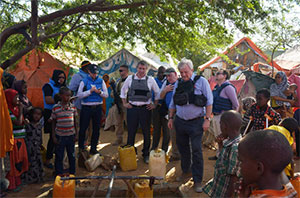 UN Emergency Relief Coordinator Visits Somalia. Credit: UN Photo/Tobin Jones
In recent years, conflicts have broken out across the world with no sign of slowing down or stopping. In times like this, millions of people globally are in dire need of humanitarian aid. Famine, warfare, natural disasters, and economic decline plague a host of nations, including Palestine, Sudan, Chad, Lebanon, and Haiti, to name a few. Humanitarian aid provides millions of people with critical services including healthcare, food, clean drinking water, psychosocial support, housing, and access to education. UN agencies such as the UNDP, UNICEF, the World Food Programme (WFP), UNHCR, UNRWA, and UNEP work with the UN Office for the Coordination of Humanitarian Aid (OCHA) and local organizations to come up with the best possible strategies to support affected communities. At the same time, humanitarian aid and those working on the frontlines are consistently threatened by both actors directly involved in conflict as well as those who are meant to contribute to the international humanitarian regime at large. The near-collapse of United States international aid structures in 2025, including the termination of 83% of USAID’s 6,300 global initiatives, has left millions of people without access to vital humanitarian assistance. 98 million people in 2025, only 65% of people targeted for humanitarian assistance, received the help they needed. In contrast, 123 million people received some form of humanitarian assistance in 2024, and OCHA’s 2026 Global Humanitarian Overview estimates that 239 million people are in need of assistance in 2026. IPS is well-positioned to discuss current initiatives to provide aid and relief through in-depth reporting and opinion content.

The Week with IPS

NEXT STOP - SDGs
Tracking global progress towards a sustainable world
Tracking global progress towards a sustainable world
