Languages
Tuesday, September 29, 2026



News and Views from the Global South
Aid

Doha Climate Summit Ends With No New CO2 Cuts or Funding
The United Nations climate talks in Doha went a full extra 24 hours and ended without increased cuts in fossil fuel emissions and without financial commitments between 2013 and 2015.
A Hotter World Is a Hungry World
Food prices will soar and hundreds of millions will starve without urgent action to make major cuts in fossil fuel emissions. That is what is at stake here on the last day of the U.N. climate talks known as COP 18, scientists and activists say.
An Empty Table at Doha Climate Talks
United Nations climate talks are on the edge of collapse Thursday, according to a coalition of civil society and representatives from half of the world's countries.
Uganda’s “Kill the Gays” Bill Spreads Fear
Gay activist Gerald Ssentongo of Uganda is afraid to talk openly about his cause. Not only that, but he is terrified of being “caught” socialising with gay people and only meets his friends at night in out-of-reach places.
India Shrugs Off UK Aid Cuts, Despite Poverty
As India forges ahead with a host of trade agreements with various European countries, including France, some Indian commentators say the country can well do without the “paltry” sum in financial aid it currently receives from the United Kingdom.
From Doha to Dakar, Food Insecurity is the Norm
Qatar may be one of the richest countries in the world, but it has something in common with its African counterparts – food insecurity.

Funding for Neglected Diseases “Heavily Reliant” on U.S.
International financial support aimed at counteracting the world’s “neglected diseases” increased by nearly a half-billion dollars over the past five years, according to new research released Monday, but changing funding dynamics could already be having a negative impact on the development of cures for diseases that affect a substantial proportion of the world’s poor.
Free Syria Faces Tough Times
As the death toll in Syria tops 40,000 and some 400,000 have taken refuge beyond the country’s borders, a dearth of funding for civilian projects in areas under Free Syrian control risks undermining efforts to keep inhabitants united and the limited lines of communication flowing.
Somaliland Rising from the Ruins of Somalia
As Somalia starts to emerge from its quagmire of instability and chaos, 20 years of relative peace and stability are starting to pay dividends for its close neighbour Somaliland, as this November it struck its first major oil deal since seceding from Somalia in 1991.Doha Faces an Indonesian Test
To most people, holes in the ozone layer or the melting of polar ice caps can sound like distant catastrophes. “But let's talk about concrete examples,” says an Indonesian director whose documentary film captures the lives of local farmers affected by a dramatically changing environment.
There’s Life in the AIDS Ribbon
Thirty-year old Swapna Raj of Hyderabad is a woman in a hurry: in time for the International AIDS day Swapna, a HIV positive person on anti-retroviral therapy (ART), has received a contract from the state government to deliver 5,000 red ribbons.
Anti-gay Stigma Hinders Bid to Lower Côte d’Ivoire’s HIV Rate
When Emmanuel Kokou, a 28-year-old sex worker, moved from his native Togo to Abidjan, Côte d’Ivoire in 2010, he knew there was a good chance that he had previously been exposed to HIV. But he had no intention of getting tested.
Striving to Increase African Food Productivity
For decades food security and self-sufficiency in Africa have been seen as a distant dream. The Comprehensive Africa Agriculture Development Programme, however, hopes to make it a reality, and while it may have begun with a slow start, its coordinators are confident it will produce more positive results in the coming years.
OP-ED: Loss and Damage from Climate Change Must Not Become the “New Normal”
As United Nations climate talks get underway this week in Doha, Qatar, they show a subtle, unsettling shift in the global climate change debate.
Major New U.S. AIDS Plan Disallows Funding for Family Planning
At perhaps a critical turning point in the global fight against HIV/AIDS, the U.S. government, the single largest funder in that fight, on Thursday unveiled a major new strategy for pushing towards achieving an “AIDS-free generation”, the stated U.S. goal.
/UPDATE*/ Africa – Calling for a GMO-Free Continent
South African smallholder farmer Motlasi Musi is not happy with the African Centre for Biosafety’s call for his country and Africa to ban the cultivation, import and export of all genetically modified maize. "I eat genetically modified maize, which I have been growing on my farm for more than seven years, and I am still alive," he declared.
A Million Hardships in Pakistan’s North
More than a million people displaced from the Federally Administered Tribal Areas by growing militancy and military operations are facing severe hardship after losing businesses and work.
Taking the Knowledge of Doha Back to Kenya’s Rural Communities
The skyscraper Qatari capital city of Doha is a far cry from Cecilia Kibe’s home in Turkana district, a remote area in Kenya inhabited by mostly nomadic communities and pastoralists hit hard by the effects of climate change.New HIV Epidemic Looms over Romania
New HIV infections among Romanian drug users have grown exponentially over the past couple of years, from three to five cases annually between 2007 and 2009, to 98 just in the first half of 2012.
African Negotiators Saving Kyoto from the Grave
African negotiators attending the United Nations climate change talks in Doha, Qatar say they are determined to ensure that developed countries do not let the Kyoto Protocol die as its commitment period comes to an end.
Q&A: COP18, Another ‘Conference of Polluters’
There is no political will among rich nations to find funding for developing countries experiencing the brunt of changes in global weather patterns, and the current climate change conference will fail to do so, according to Professor Patrick Bond, a leading thinker and analyst on climate change issues.
« Previous Page — Next Page »


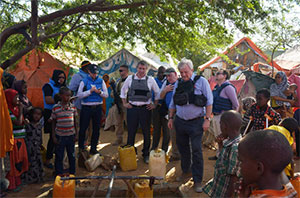 UN Emergency Relief Coordinator Visits Somalia. Credit: UN Photo/Tobin Jones
In recent years, conflicts have broken out across the world with no sign of slowing down or stopping. In times like this, millions of people globally are in dire need of humanitarian aid. Famine, warfare, natural disasters, and economic decline plague a host of nations, including Palestine, Sudan, Chad, Lebanon, and Haiti, to name a few. Humanitarian aid provides millions of people with critical services including healthcare, food, clean drinking water, psychosocial support, housing, and access to education. UN agencies such as the UNDP, UNICEF, the World Food Programme (WFP), UNHCR, UNRWA, and UNEP work with the UN Office for the Coordination of Humanitarian Aid (OCHA) and local organizations to come up with the best possible strategies to support affected communities. At the same time, humanitarian aid and those working on the frontlines are consistently threatened by both actors directly involved in conflict as well as those who are meant to contribute to the international humanitarian regime at large. The near-collapse of United States international aid structures in 2025, including the termination of 83% of USAID’s 6,300 global initiatives, has left millions of people without access to vital humanitarian assistance. 98 million people in 2025, only 65% of people targeted for humanitarian assistance, received the help they needed. In contrast, 123 million people received some form of humanitarian assistance in 2024, and OCHA’s 2026 Global Humanitarian Overview estimates that 239 million people are in need of assistance in 2026. IPS is well-positioned to discuss current initiatives to provide aid and relief through in-depth reporting and opinion content.

The Week with IPS

NEXT STOP - SDGs
Tracking global progress towards a sustainable world
Tracking global progress towards a sustainable world
