Languages
Wednesday, October 14, 2026



News and Views from the Global South
Aid

Climate Change Response Must Be Accompanied By a Renewed Approach to Economic Development
In the face of the many challenges posed by climate change, Panos Caribbean, a global network of institutes working to give a voice to poor and marginalised communities, says the Caribbean must raise its voice to demand and support the global temperature target of 1.5 °C.
How to Green Uganda’s Cities
Locals in Kampala, Uganda’s capital, always have two or three things to say in a conversation about how the city is developing. Some say it is filthy because of the growing waste; others say it is a slum because of its unplanned settlements; and then there are those who say it is just plain inconvenient because of the traffic congestion created by the boda boda (motorcycle taxis) and commuter taxis that honk incessantly as they make their way along the streets.
Fixing the Crisis of Confidence in the Green Climate Fund
The Green Climate Fund's mandate couldn't be more crucial: accelerating climate action in developing countries by supporting transformational investments in adaptation and emissions reduction.
More Women Owning Agricultural Land in Africa Means Increased Food Security and Nutrition
Despite women being key figures in agriculture and food security, gender inequality is holding back progress towards ending hunger, poverty, and creating sustainable food systems.
Without Food Security, There Is No Peace
Reversing years of progress, global hunger is on the rise once again and one of the culprits is clear: conflict.
India Uses Tech to Power its New Battle Against Malnutrition
Kanaklata Raula from Kaptipada village in India’s Mayurbhanj District is on duty 24x7. The 52-year-old community health worker from Odisha state rides a bicycle for hours each day, visiting community members who need nutrition and reproductive healthcare.
Countries On the Frontline of Climate Change Impact Call for Stronger Mitigation Commitments
Caribbean leaders want larger countries to pick up the pace at which they are working to meet the climate change challenge and keep global warming from devastating whole countries, including the most vulnerable ones like those in the Caribbean.
Levelling the Playing Field for Persons with Disabilities in the United States
When it was time for Joe Lupinacci to graduate from his high school in Stamford, Connecticut, he knew he wanted to go to college. While other students were deciding which college to apply to, the choice required more thought and research on Lupinacci and his parents’ part. Lupinacci, who has Down Syndrome, needed a college that would meet his needs.
Amid Chronic Violence, Millions of Afghans Face Risks of Drought Related Displacement
Amid a precarious security situation in Afghanistan, the worst drought in recent history, that hit two out of three provinces in Afghanistan in July, has destabilized the lives of tens of thousands of civilians, some of whom have already been displaced.
Damning U.N. Report Outlines Crimes Against Rohingya As Children Suffer from Trauma One Year Later
At 12, Mohammed* is an orphan. He watched his parents being killed by Myanmar government soldiers a year ago. And he is one of an estimated half a million Rohingya children who have survived and been witness to what the United Nations has called genocide.
Rohingya Refugees Left in Limbo One Year On
Aid funding for refugee relief is running out while conditions are still not in place for the safe return of over 700,000 people forced to flee Myanmar to neighbouring Bangladesh after violence broke out one year ago.
Accessible Public Transportation and Housing, a Need for People with Disabilities in Major Cities
Even though over six billion people—nearly one billion of whom will have disabilities— are expected to live in urban centres by 2050, many of the world’s major urban cities have a long way to go before their infrastructure becomes inclusive for people with disabilities.
How the Yanadi, an Oppressed Indigenous People in India, are Reclaiming Their Rights One Village At a Time
Under the blazing midday sun, a tractor moves slowly along a dirt trail in Nacharwari Pallem, a village of the Yanadi indigenous people located some three hours from Chennai city in South India. Atop the tractor, women of the village – 36 in all – sit expectantly, ignoring the heat. Squeals of excitement fill the air as the tractor slowly halts near a stretch of rice fields.
Support of Influential World Leaders Not Enough to End Rohingya Crisis
Despite having the strong support of influential global leaders, Bangladesh has "missed" the opportunity to mobilise the world’s superpowers and place pressure on Myanmar to allow for the repatriation of the Rohingya refugees.
Family Planning Is A Human Right
It has been five decades since the international community affirmed the right to family planning but women still remain unable to enjoy this right, which is increasingly under attack around the world.
Urgent Action Needed to Safeguard Saint Lucia’s Biodiversity
Wildlife conservationists consider it to be one of the most striking parrots of its kind. Saint Lucia’s best-known species, the endangered Amazon parrot, is recognised by its bright green plumage, purple forehead and dusty red-tipped feathers. But a major conservation organisation is warning that climate change and a lack of care for the environment could have devastating consequences for Saint Lucia’s healthy ecosystems and rich biodiversity, including the parrot.
War, High Tariffs and Nationalisation – their Cost to Africa’s Climate
Africa’s political instability, its armed conflicts and regulatory issues are placing at risk investment needed to tackle climate change and reduce greenhouse gas (GHG) emissions on the continent.
Declining Birth Rates Not Exclusive to Wealthy Nations
Countries do not have to be economically prosperous to move from a situation of high birth and death rates to low fertility and mortality rates. Education, social security, environments conducive to economic development and good value systems are what promote this, as evidenced by the recorded experiences of Asian countries as far apart as Japan and India.
Overly Bureaucratic Procedures and Long Waits Cuts off Support to 22 Million Yemenis
As Yemen’s people struggle to survive amid what has been described as the world’s worst humanitarian crisis, the stranglehold by both government coalition forces and rebels over the country’s main ports of entry and distribution is cutting off a lifeline of support to 22 million people.
West Africa Moves Ahead with Renewable Energy Despite Unpredictable Challenges
The West African nation of Guinea may be a signatory of the Paris Agreement, a global undertaking by countries around the world to reduce climate change, but as it tries to provide electricity to some three quarters of its 12 million people who are without, the commitment is proving a struggle.
Savagery of Rapes of Minors
Rapes of minors surged from 16 per day in 2001 to 46 per day in 2016. As if this was not horrendous enough, their savagery adds to it. In 2016, 43.3% of the total female rape victims were minors. Around 13% of the minor female victims were of age 11 and below. The deceased victim in the Kathua rape case from a nomadic Muslim community was barely eight years old. Her crumpled body was found in a blood-smeared dress in January, 2018. A group of Hindu men lured her into a forest, kidnapped her, drugged her, locked her in a Hindu temple, gang-raped her and then strangled her.« Previous Page — Next Page »





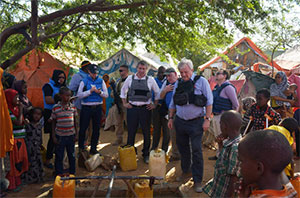 UN Emergency Relief Coordinator Visits Somalia. Credit: UN Photo/Tobin Jones
In recent years, conflicts have broken out across the world with no sign of slowing down or stopping. In times like this, millions of people globally are in dire need of humanitarian aid. Famine, warfare, natural disasters, and economic decline plague a host of nations, including Palestine, Sudan, Chad, Lebanon, and Haiti, to name a few. Humanitarian aid provides millions of people with critical services including healthcare, food, clean drinking water, psychosocial support, housing, and access to education. UN agencies such as the UNDP, UNICEF, the World Food Programme (WFP), UNHCR, UNRWA, and UNEP work with the UN Office for the Coordination of Humanitarian Aid (OCHA) and local organizations to come up with the best possible strategies to support affected communities. At the same time, humanitarian aid and those working on the frontlines are consistently threatened by both actors directly involved in conflict as well as those who are meant to contribute to the international humanitarian regime at large. The near-collapse of United States international aid structures in 2025, including the termination of 83% of USAID’s 6,300 global initiatives, has left millions of people without access to vital humanitarian assistance. 98 million people in 2025, only 65% of people targeted for humanitarian assistance, received the help they needed. In contrast, 123 million people received some form of humanitarian assistance in 2024, and OCHA’s 2026 Global Humanitarian Overview estimates that 239 million people are in need of assistance in 2026. IPS is well-positioned to discuss current initiatives to provide aid and relief through in-depth reporting and opinion content.

The Week with IPS

NEXT STOP - SDGs
Tracking global progress towards a sustainable world
Tracking global progress towards a sustainable world
